
Quick answer: a server CPU cold plate that fits the platform and the order
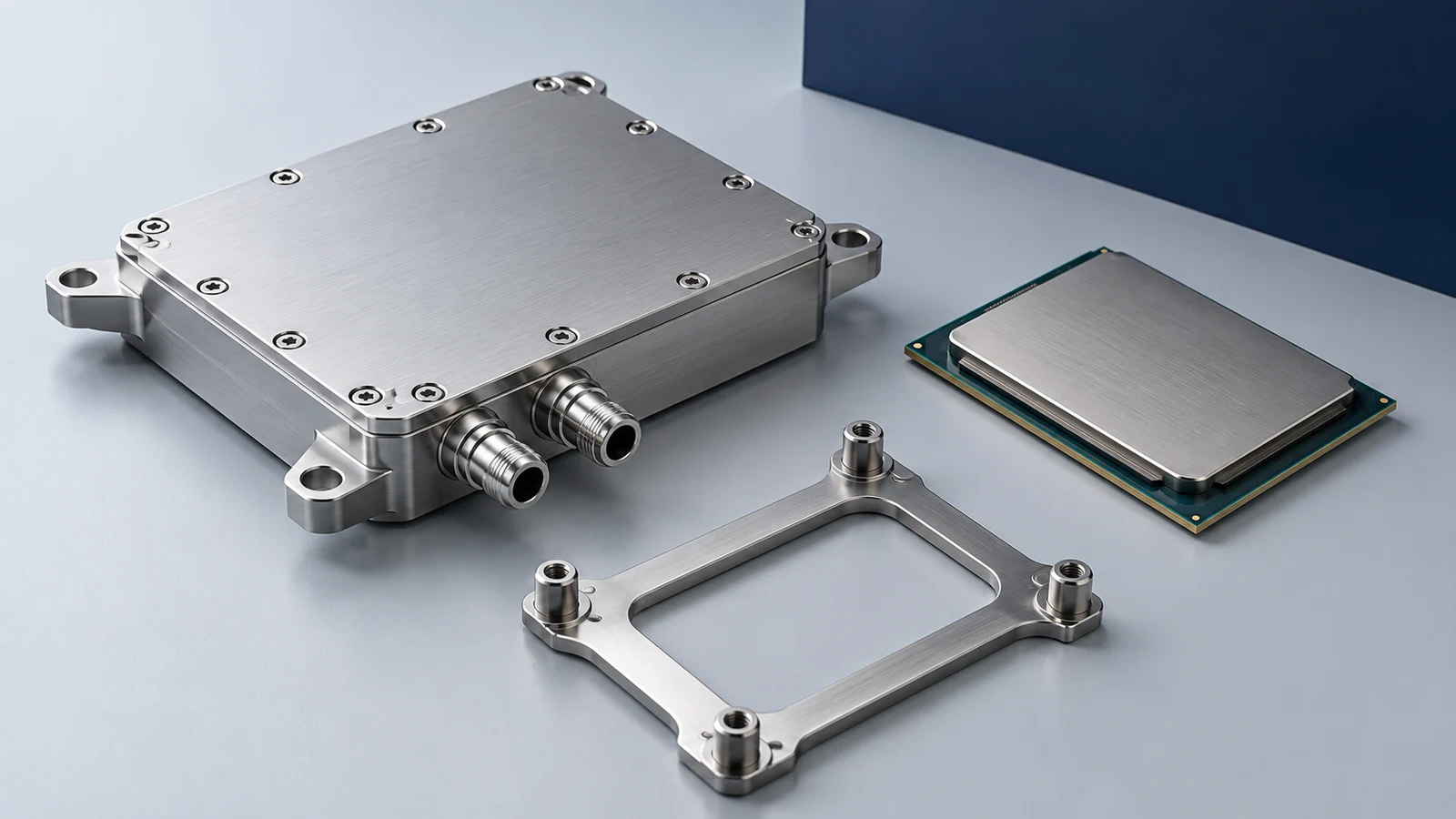
BAOSONG develops custom server CPU cold plate solutions around your processor interface, mounting stack and production requirements. Direct-to-chip CPU cold plates carry heat from the processor through its specified contact interface into circulating coolant. We bring custom aluminum manufacturing and engineering support together to deliver a coordinated body, mounting and connection solution.
For a new design with compatible coolant and an achievable thermal target, we recommend an aluminum body with the mounting and connection features integrated where practical. This uses aluminum’s low mass and machining flexibility to simplify the assembly. If your approved thermal core or wetted-material specification must remain unchanged, we retain it and develop the aluminum retention structure around it. Released drawings go straight into manufacturing review and quotation.
Start with the information you already have. Send your drawing, sample photo, CPU platform or a short project description. We turn it into a recommended component scope, a list of decisions we will resolve with you, and a quotation basis for the quantities you need.
At a glance: our recommendation for your project
| Your starting point | What BAOSONG recommends | What you receive |
|---|---|---|
| Approved drawing ready for sourcing | Quote the released material, geometry and acceptance requirements; identify manufacturing improvements as separate proposals. | A supply scope with clear assumptions and no unapproved design changes. |
| New CPU platform or changed board layout | Resolve contact height, retention, keep-outs and port access together before releasing the affected features. | A coordinated component proposal that addresses installation as well as cooling. |
| Working sample but incomplete drawings | Use the sample to establish geometry, then confirm the material, internal construction and functional requirements needed for reproduction. | A controlled specification for the replacement or improved part. |
| Transfer, repeat order or cost-reduction project | Keep approved functional interfaces stable; compare stock, machining, closure and inspection at the requested batch quantities. | A production quotation separating unit cost, tooling and any change qualification. |
What a direct-to-chip CPU cold plate must match
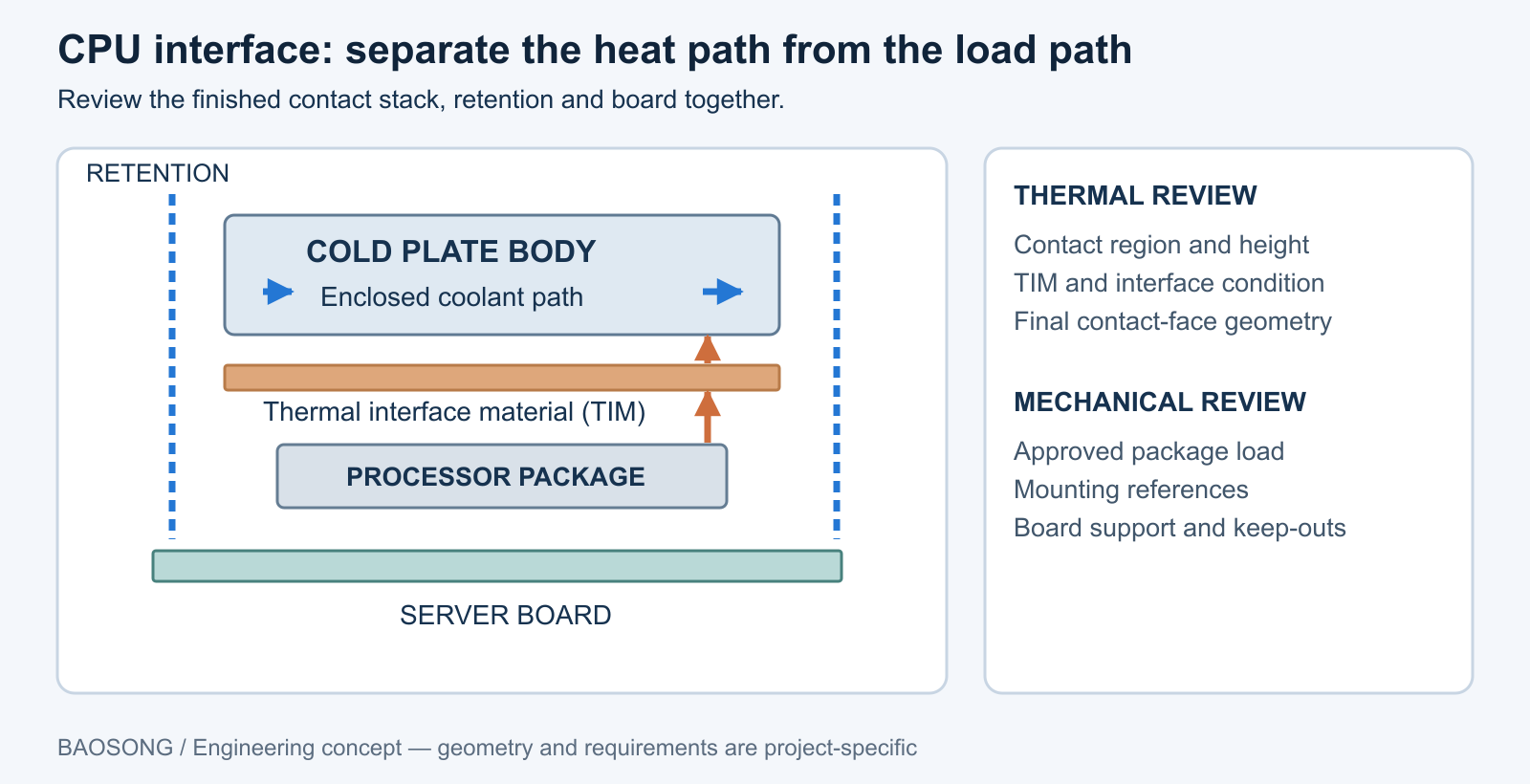
A liquid cooled CPU cold plate is a heat exchanger mounted to the processor’s approved thermal interface. In a typical packaged-processor arrangement, heat travels through the package heat spreader and thermal interface material, or TIM, before reaching the cold plate. The specified processor interface governs the contact construction; the term direct-to-chip does not automatically mean bare-die contact.
We define the quoted item early: a machined base and cover, a sealed plate, or a plate with an agreed retention and connection assembly. That distinction makes responsibility for sealing, fittings and acceptance visible in the quotation. For the wider component family, see our AI server cold plate design and sourcing guide and our aluminum hardware for AI servers.
For CPU work, a socket name alone is insufficient to release a custom part. The processor package, board revision, retention hardware and service envelope form the actual installation. We use their shared datums—the agreed references for locating features—to connect the contact face, fastener pattern and ports.
Resolve the CPU mounting stack before it becomes an assembly problem
Our starting recommendation is to preserve the platform’s approved load path and adjust the cold plate around it. Changing a mounting hole can also change how load reaches the package or motherboard. We therefore review the contact surface and retention system as one stack, then put the critical relationships on the manufacturing drawing.
| Customer problem | BAOSONG action | Why it helps | Release evidence |
|---|---|---|---|
| Good hole alignment, uneven thermal contact | Review contact height, final flatness, TIM thickness and mounting load together. | Targets the interface responsible for uneven contact instead of tightening unrelated dimensions. | Approved stack and contact-face requirements in the final joined and finished state. |
| Plate or bracket interferes with nearby components | Check the board revision, keep-outs and installation sequence against the part envelope. | Finds interference while the geometry can still be corrected. | Revision-specific envelope and assembly fit review. |
| Fittings fit, but hoses or tools do not | Include connector engagement, hose routing and tool access in the port-position review. | Protects installation and removal space around the CPU. | Approved port orientation and service envelope. |
| Socket or retention changes between variants | Assess a separate aluminum retention frame around a retained cooling core. | Can isolate a mechanical adaptation from the fluid-path design. | Interface comparison and confirmation that the retained core still meets the revised use conditions. |
| Repeat parts fit differently after joining | Sequence joining and final machining around the contact datum; specify the acceptance state. | Connects manufacturing distortion control to the assembled fit requirement. | First-article dimensions and final-state contact-face inspection. |
This is where our aluminum part design review creates value: you receive proposed feature and process changes with their reasons, while approved platform requirements remain under your change control.
For dual-socket CPU cooling, solve the routing before copying the first plate
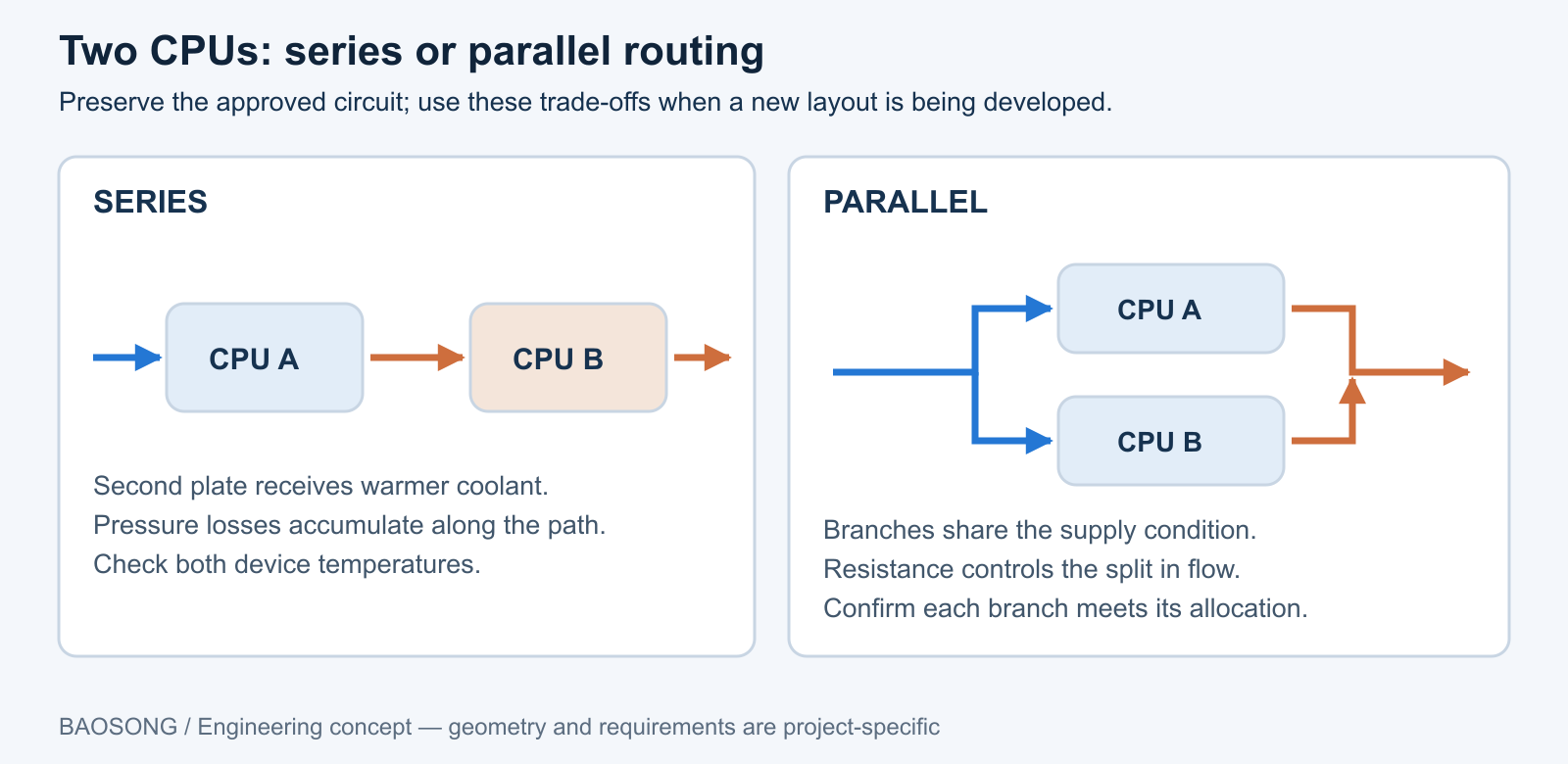
For dual-socket CPU cooling, we start with the board envelope and the server’s allocated flow and pressure budget. In a series circuit, the second plate receives coolant warmed by the first and the component pressure drops accumulate. Parallel branches can share a supply temperature, but the branch resistances determine how flow divides. Two visually identical plates do not by themselves establish balanced cooling.
For a new layout that needs similar inlet conditions at both CPUs, we recommend evaluating parallel branches first, with branch resistance and available flow included in the design. We favor a series route when the second CPU still has sufficient thermal margin and the combined pressure loss fits the circuit, particularly where a simpler hose route is valuable. If the existing platform already specifies the circuit, we design the connections to match it. A shared body is worth considering only when its contact heights, mounting compliance and service consequences work for both processors.
When we recommend an aluminum CPU cold plate
An aluminum CPU cold plate is a strong starting point when lower component mass and integrated custom geometry matter, and the thermal and coolant requirements permit an aluminum fluid path. Machining the port bosses, mounting features and body from a coordinated design can remove unnecessary adapters and simplify dimensional control. The benefit comes from the finished construction, not a blanket claim that one metal always cools better.
Aluminum’s low weight and ability to integrate functions are useful material and manufacturing advantages described by Hydro’s data-center aluminum overview. Our recommendation applies those advantages to the particular component; it does not transfer a heat-sink result or a material price into a cold-plate performance guarantee.
| Construction | We recommend it when | Customer advantage | What changes the decision |
|---|---|---|---|
| Aluminum body and cover | The required contact-to-coolant performance and the approved fluid/material combination support it. | Low mass, flexible machining and integration of mounting or port features. | An inadequate thermal margin, incompatible fluid chemistry or an established material restriction. |
| Approved cooling core with an aluminum frame | The thermal core should stay fixed while socket retention or surrounding structure changes. | Retains the core and puts customization into the mechanical interface. | The new load, contact or thermal conditions also require the core to change. |
| Copper or an engineered mixed construction | The thermal contact design or an existing qualified fluid path requires it. | Addresses the specific thermal or material constraint while keeping aluminum where it adds structural value. | Added mass, interfaces, joining and coolant-exposed materials require a better total solution. |
We keep the distinction between an aluminum structural frame and wetted aluminum explicit. Changing only the external frame does not introduce aluminum into the coolant. Changing a base, cover, filler, coating or connector in the fluid path does require compatibility review. Boyd’s cold-plate technical data illustrates why material and coolant must be considered together; the exact fluid formulation and complete wetted construction remain project inputs.
Choose the production route at quotation, not after the sample
A CNC machined server CPU cold plate can be the production design as well as the development design. We compare the cost of material removal, setups, joining, final finishing, cleaning and inspection at your order quantities. A new tool or near-net blank is justified by the geometry and repeat economics, not by the assumption that machining is only for prototypes.
| Route | Best project fit | Manufacturing decision we resolve | Trade-off to account for |
|---|---|---|---|
| Machined body with a specified sealed cover | Custom ports, local channels, multiple revisions, or production quantities that support machining. | Tool access, practical channel features, sealing lands and the sequence for final contact-face machining. | Machining time and the cover’s sealing and fastening requirements. |
| Machined channels with a permanent joined cover | A sealed assembly where the closure can be qualified for the design and order plan. | Join geometry, support and access, distortion allowance, cleanliness and final inspection. | Joining feasibility and its effect on final geometry and material condition. |
| Brazed internal construction | Channel or fin structures for which a brazed architecture is technically and commercially appropriate. | Material/filler compatibility, joint layout and acceptance for the finished assembly. | The thermal cycle, joint consistency, residues and final flatness. |
| Separate machined aluminum retention parts | A retained cold-plate core needing a platform-specific bracket or carrier. | Mounting datums, load path, tool access and repeat assembly. | Added mechanical interfaces must be controlled. |
Our precision aluminum CNC machining scope is translated into the actual part features and acceptance requirements in the quote. Where a proposed construction needs a joining or qualification operation, the project scope identifies that operation and its deliverable before release.
For high-volume server CPU cold plate sourcing, we separate recurring part cost from fixtures, tooling, first articles and design-change qualification. Transfer orders also need a controlled reference part and revision. This makes price comparisons meaningful and avoids reducing the quoted price by quietly removing inspection, closure or cleaning work.
Agree what proves the CPU cold plate is ready
We divide acceptance into the component features we must deliver and the platform results that depend on the installed processor, TIM and cooling loop. A dimensional report cannot substitute for thermal performance, and a leak result cannot establish service life. The quotation and inspection plan should make the evidence owner clear.
| Question | Evidence to agree | How the project is assigned |
|---|---|---|
| Does it fit the approved CPU stack? | Final-state critical dimensions, contact-face condition, port relationships and an assembly fit check. | BAOSONG’s component inspection scope plus the buyer’s platform-interface approval. |
| Is the quoted fluid boundary intact? | Defined leak method, sensitivity, pressure and acceptance; separate proof or life testing when required. | Named test responsibility for the plate or assembly included in the order. |
| Does it meet the thermal and hydraulic targets? | Matched heat input, contact stack, coolant, inlet temperature, flow and pressure-drop measurements. | Agreed component test scope and the platform team’s integration acceptance. |
| Can it be supplied consistently? | Approved revision, material/lot traceability, cleanliness, protected ports and change-control records. | The production control and documentation package defined for repeat orders. |
The OCP Cold Plate Development and Qualification white paper treats thermal performance at a specified flow and the installed processor interface as connected measurements. We use that distinction when defining evidence; citing the document does not claim that a particular component is OCP-certified.
Our aluminum component inspection planning identifies which dimensions and records belong in your order. A mature approved design may need manufacturing first-article acceptance rather than a new thermal-development program. A change to a fluid path, contact surface or material has a different validation impact.
Why choose BAOSONG for a server CPU cold plate project?
Choose a CPU cold plate manufacturer that can turn interface details into a coherent manufacturing proposal. BAOSONG connects the aluminum body, retention parts, ports and final inspection in one component review. You receive a recommended route and identified drawing decisions instead of a list of unranked processes.
For OEM teams comparing server CPU cold plate suppliers in China, we make the drawing revision, quoted assembly scope and inspection package explicit. This gives your sourcing team a consistent basis for comparing offers and transferring an approved part into repeat supply.
We concentrate customization where it creates value
When an approved cooling core already works, our first recommendation is to retain it and adapt the surrounding aluminum parts if that resolves the new requirement. When the body must change, we review the contact, connection and mounting features together. That keeps the scope tied to your actual problem.
We make production economics visible from the start
We compare the requested sample, initial and repeat quantities when selecting the route. The proposal separates the cost of making the component from tooling and qualification choices, so your purchasing and engineering teams can approve the same scope.
We connect approval to repeat supply
The agreed drawing revision, critical characteristics, material and acceptance requirements form the reference for the next order. Proposed changes are presented for approval, with their effect on fit, sealing or thermal acceptance identified.
Start your server CPU cold plate quotation
| You have | BAOSONG’s next action | You receive |
|---|---|---|
| CAD and a released drawing | Review manufacturing, critical features, quantities and acceptance. | A quote scope and separately identified deviations or improvements. |
| A physical sample or clear photos | Establish what can be measured and which material or internal details need confirmation. | A path to a controlled reproduction or improvement specification. |
| A CPU platform and a cooling or installation problem | Review the interface and propose the component architecture and material direction. | A concrete next-step plan for design decisions and quotation. |
| A transfer or repeat-production requirement | Compare the reference specification, process route and supply quantities. | A manufacturing and first-article plan linked to repeat supply. |
Discuss your custom server CPU cold plate with BAOSONG. Send whichever starting material is available. We will identify the missing decisions with you and develop the component proposal and quotation scope.
Frequently asked questions
Can an aluminum CPU cold plate replace a copper design?
It is worth evaluating when lower mass, feature integration or repeat cost is the objective. We first compare the thermal contact and coolant requirements, then propose the aluminum construction and the necessary change verification. Where the copper core must stay, an aluminum frame or carrier can still deliver a useful mechanical improvement.
Can you work from a sample rather than a complete drawing?
Yes. A sample or photo is enough to begin the discussion. We use it to identify the geometry and then establish the material, internal construction and functional specification needed to quote and reproduce the part responsibly. A photo alone cannot reveal the complete coolant path.
Is a separate retention bracket better than integrated mounting ears?
We favor a separate bracket when platform variation can be handled without changing the thermal core. Integrated mounting features are attractive when the layout is stable and reducing interfaces simplifies the assembly. The selected route must preserve the package load and contact requirements.
Does every custom CPU cold plate need a prototype?
No. A released design can proceed through the agreed manufacturing and first-article route. Development samples are useful when a new or changed feature needs verification. We match the approval plan to the project and consider the production route during quotation.
What determines the price of an OEM CPU cold plate?
The quote reflects construction, material, channel complexity, joining, critical tolerances, cleanliness, inspection, quantities and packaging. Compare those inclusions alongside unit price. An attractive piece price is only useful if it covers the component and acceptance package you actually need.