
Quick answer: a board-specific cold plate and a clear manufacturing route
BAOSONG develops custom GPU cold plate solutions around your board, thermal interfaces and production requirements. Direct-to-chip GPU cold plates transfer processor heat through the specified interface and plate into circulating coolant. We connect that thermal path with mounting, sealing and a practical manufacturing route.
Make aluminum’s light weight and manufacturing flexibility work for your assembly. We recommend a machined aluminum body for a compatible loop and achievable thermal target. Where an approved cooling core must stay unchanged, we retain it and adapt the aluminum frame and mounting structure. Your proposal explains the recommended construction and its manufacturing benefits.
Start with what you have. Send your drawing, sample photo or a short description. We identify the critical interfaces and turn your requirement into a component proposal and quotation scope.
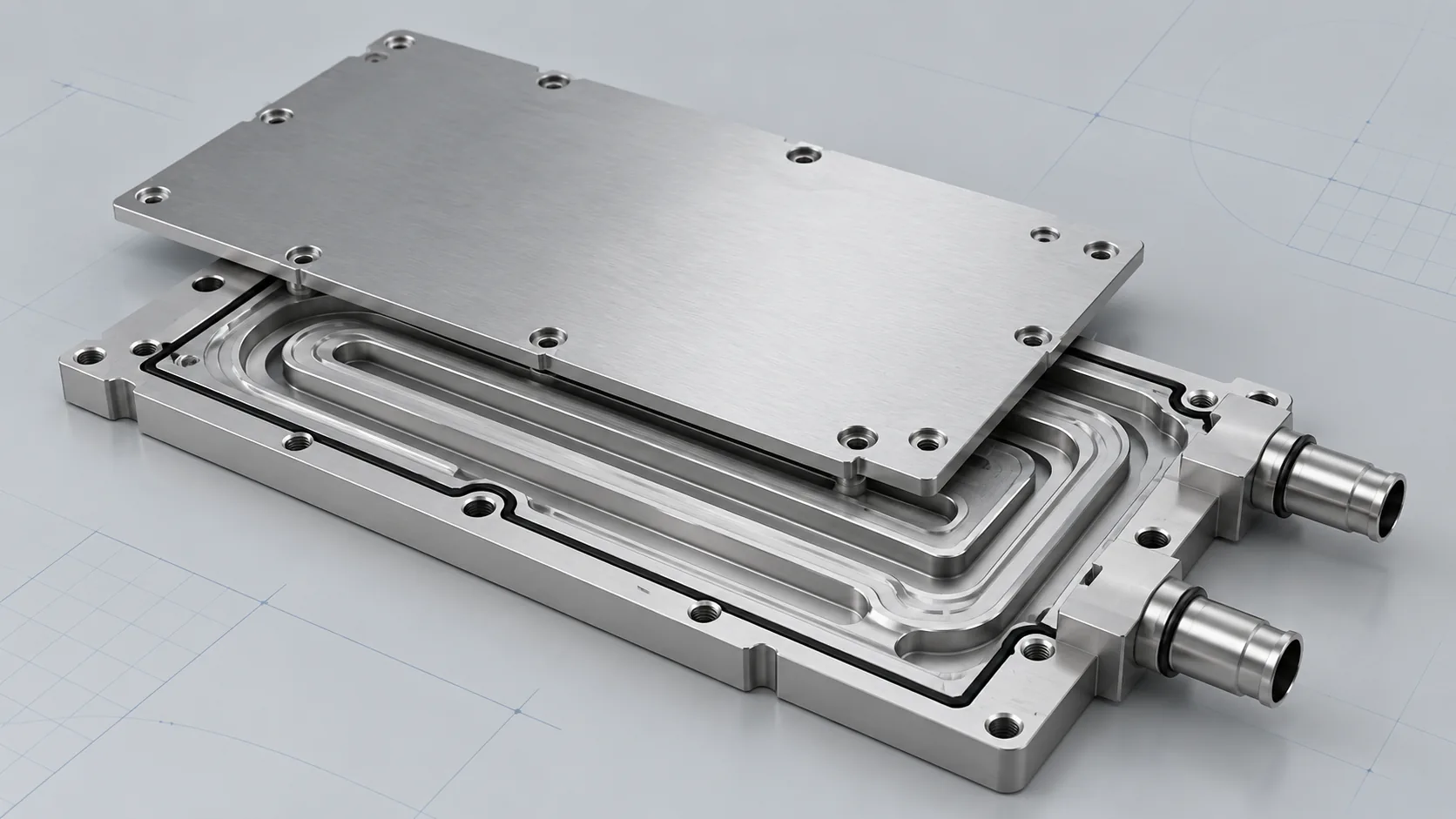
At a glance: our recommended path for your GPU cold plate project
| Your situation | BAOSONG’s recommendation | What you gain |
|---|---|---|
| Released drawing, ready to source | Review manufacturability and quote the approved specification; present any proposed changes separately. | A clear supply scope without restarting product development. |
| New GPU board or changed layout | Resolve the contact map, mounting references and port envelope before releasing the affected geometry. | Cooling and installation decisions tied to the correct board revision. |
| Aluminum-compatible loop and a weight-sensitive assembly | Develop an aluminum body with integrated mounting and connection features; match the channels to the thermal and flow conditions. | A lightweight, board-specific component with fewer unnecessary interfaces. |
| Approved copper cooling core or fixed wetted-material specification | Keep the approved thermal core; adapt a non-wetted aluminum frame or support around it. | Aluminum’s structural and manufacturing benefits without an unnecessary fluid-path material change. |
| Repeat orders, production transfer or cost reduction | Retain functional requirements while comparing stock, setups, joining and inspection at the requested quantities. | A production proposal that separates recurring cost from tooling and change qualification. |
What direct-to-chip GPU cold plates must match
Direct-to-chip describes the heat-transfer arrangement, not a universal bare-die contact design. The thermal path may include the processor package’s heat spreader or an approved exposed-die interface, with the specified thermal interface material (TIM) between the device and cold plate. The coolant stays inside its designed fluid boundary; this is not immersion cooling.
For an OEM liquid-cooled GPU cold plate, the GPU family name is only a starting point. The board revision, package arrangement, contact heights, allowable mounting load and surrounding components define the part that will actually fit. We connect those inputs to the cold plate geometry instead of assuming that one plate fits every board carrying the same processor.
This article covers the GPU component and its manufacturing solution. The wider family of processor-cooling components is covered in our AI server cold plate guide; a complete rack cooling system has additional responsibilities beyond the plate.
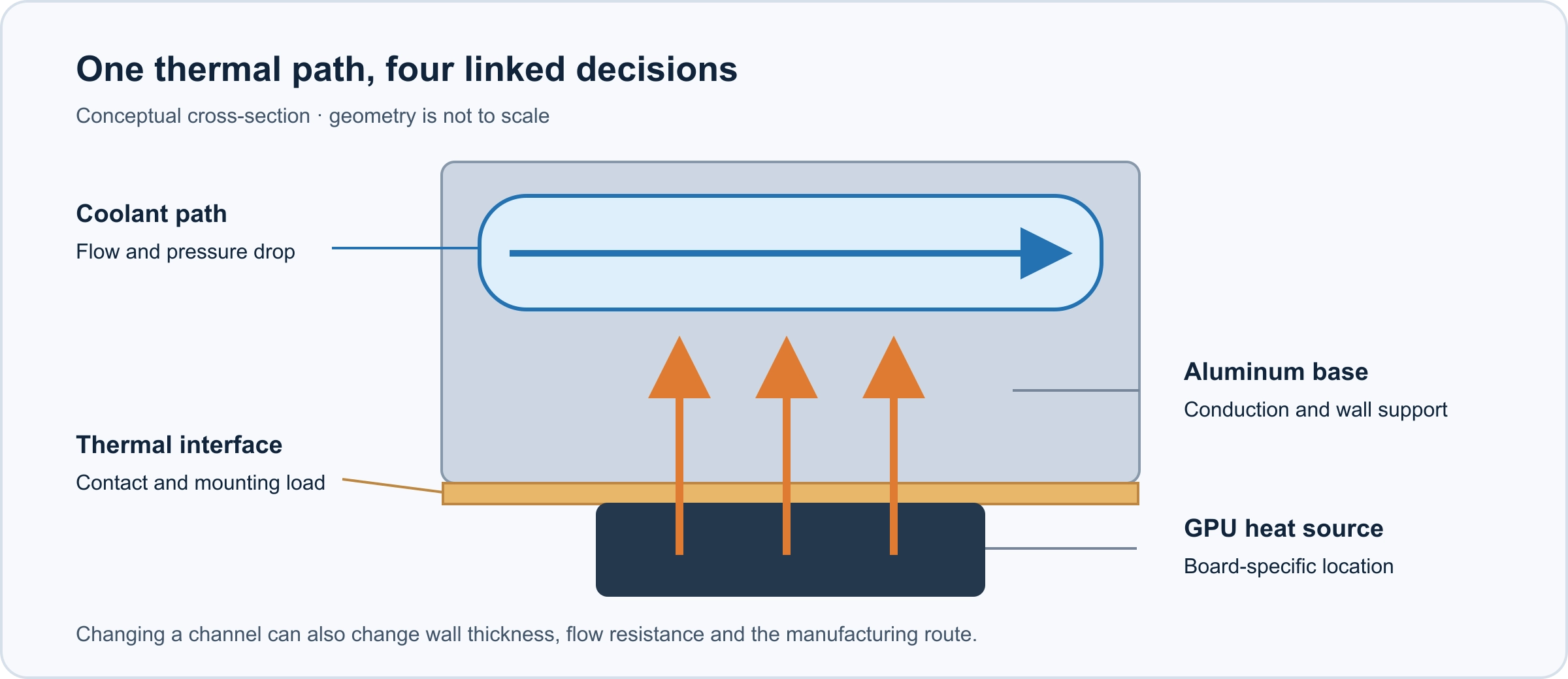
Where aluminum creates the most value
An aluminum GPU cold plate is most attractive when low assembly mass, custom geometry and manufacturing efficiency matter together. Aluminum can combine the thermal body with mounting bosses, port features and clearance pockets. This reduces the need for separate brackets and the alignment interfaces they introduce, where integration suits the assembly.
Aluminum’s lower density than copper is useful for board-spanning structures, while machining supports local geometry and suitable extrusions can provide repeatable starting sections. Hydro’s thermal-management guidance explains aluminum’s shaping advantages. The saving for a finished part still depends on its geometry and production route—not material price alone.
| Recommended construction | When we recommend it—and why | Change trigger and verification |
|---|---|---|
| Machined aluminum body and compatible cover | The loop permits aluminum and the thermal target is achievable with the proposed geometry. Integrate the contact, channels, mounting and ports to control mass and alignment. | If local heat spreading or loop compatibility is limiting, revise the thermal architecture. Check coolant/material compatibility, temperature and pressure drop under the specified operating conditions. |
| Approved cooling core with a non-wetted aluminum frame | The existing core already meets thermal or wetted-material requirements. Use aluminum for board-specific retention and support while keeping coolant out of the frame. | Check package loading, stiffness, contact height and clearance after the frame change. Reassess thermal behavior when clamping or TIM changes; a retained core does not automatically validate a new assembly. |
| Released material and construction retained | The design is approved and the task is supply, transfer or cost improvement. Quote to the controlled specification and optimize the manufacturing plan first. | A material, joint or critical-geometry change becomes a separately approved proposal with a defined verification scope—not a silent substitution. |
A non-wetted aluminum mounting frame gives the project a practical aluminum route even when the cooling core stays unchanged. It carries the board-specific mounting and support geometry without adding aluminum to the coolant path. This separation of functions has a documented industry precedent: Boyd’s CPU/GPU cold plate datasheet describes an aluminum mounting frame. The frame still needs its own structural and environmental review.
For wetted components—the surfaces actually exposed to coolant—we review the complete material list, including seals, joints and connectors. Adding an aluminum-wetted plate to an existing copper loop is a system-material change, not simply a lighter replacement. We recommend the compatible architecture and carry that decision into the component specification.
Resolve GPU contact and board fit before they become assembly problems
We turn the board layout into a contact map: which surfaces transfer heat, which features locate the plate, and which areas must remain clear. A GPU/HBM contact map follows the actual package design. High-bandwidth memory (HBM) must not automatically be treated as a separate exposed contact surface; its cooling interface depends on the processor package specification. Discrete memory and voltage-regulator components are included only where the approved assembly requires them.
| The problem | What BAOSONG does | The result to confirm |
|---|---|---|
| A plate fits the holes but does not seat correctly | Reference contact heights, clearance pockets and mounting locations to the same approved board model and drawing revision. | Defined contact and clearance—not compatibility inferred from the GPU model name. |
| One contact zone compresses before another | Review the height stack, TIM and mounting load together; define locating and stop features without exceeding package limits. | A controlled installed interface rather than fixing poor contact by simply tightening harder. |
| A flat machined base changes after joining | Plan the joint, fixturing and any permitted final machining around the required finished contact plane. | Acceptance in the specified final state, not only before joining. |
| Ports collide with nearby hardware or strain the plate | Check connector orientation, tool access and hose routing against the installation envelope; support connection loads where needed. | An assembly that can be installed and serviced without forcing the board or fittings. |
The OCP cold plate development and qualification paper links mechanical acceptance to processor specifications, keep-out zones and retention loads. We use those categories to define the review; the applicable platform requirements supply the actual limits.
Example: adapt a new board revision without redesigning everything
Illustrative engineering scenario: an OEM retains its approved cooling core, but a board revision moves mounting holes and a connector. We recommend checking a revised aluminum carrier and local clearance features first, retaining the core where the thermal interface and liquid connections can remain compatible. The proposal identifies the changed drawing features, affected load path and fit checks. If the new carrier changes contact pressure or TIM behavior, the verification plan includes that effect. This is a design approach, not a claimed BAOSONG customer case.
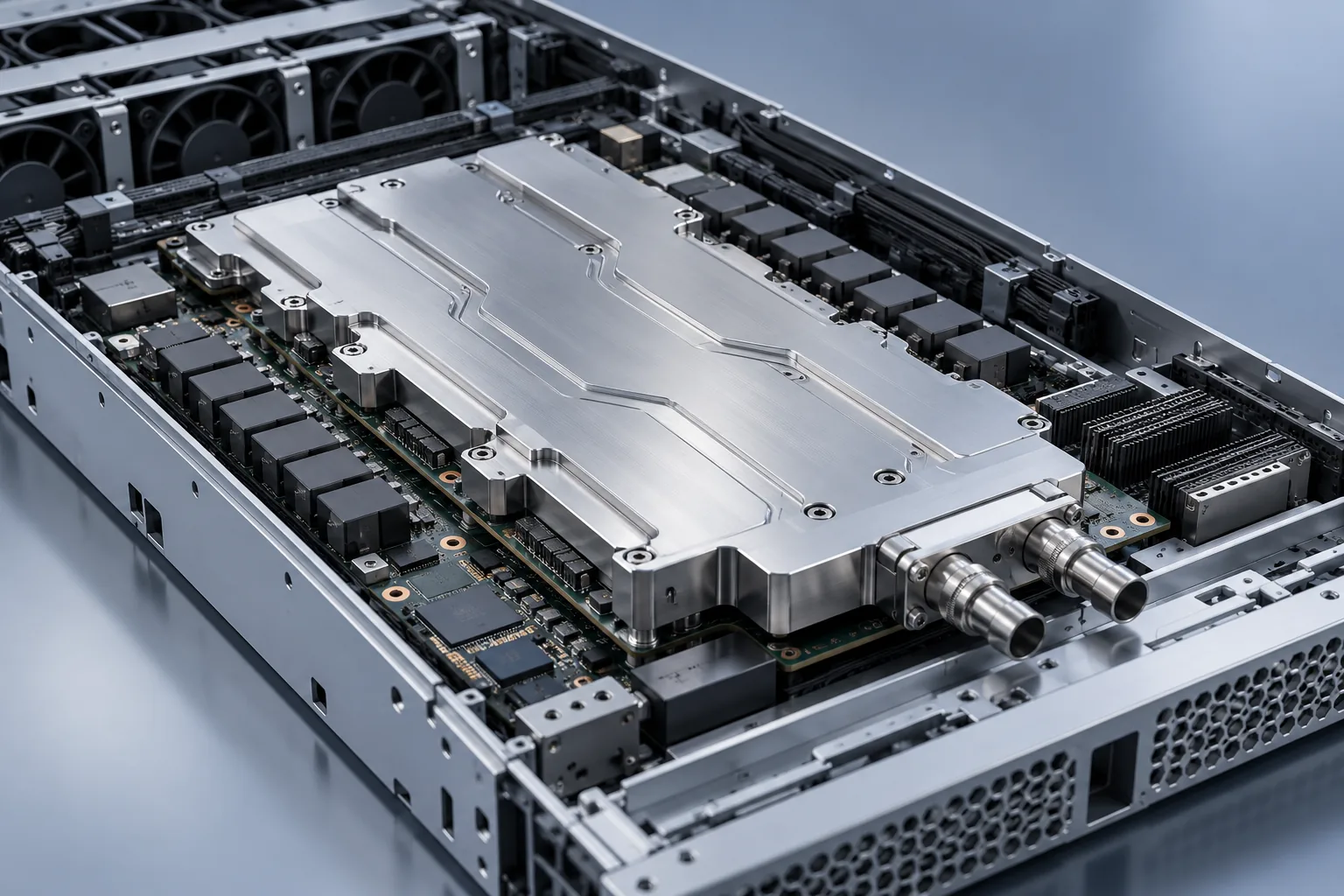
Target the hot spot without creating an avoidable flow restriction
Our recommendation is to identify the limiting part of the thermal path before making every channel smaller. Poor device contact calls for an interface correction; limited heat spreading calls for a base or material decision; insufficient transfer to coolant calls for flow and heat-transfer surface changes. These are different problems.
Pressure drop is the pressure lost as coolant passes through the plate. A denser channel pattern can add heat-transfer area while demanding more pressure, so the useful comparison is temperature and pressure drop at the flow the branch can actually supply. We tie the channel proposal to the heat-source map, inlet conditions and available flow—not a headline wattage from a different test.
For a new single-phase design with several heat zones, we examine shorter parallel paths and local enhancement near the demanding regions before specifying uniformly fine passages. Flow distribution still needs checking: a low-resistance bypass can starve the intended cooling area. Tool access, supported fin geometry, deburring and internal cleanliness are part of the same manufacturing decision.
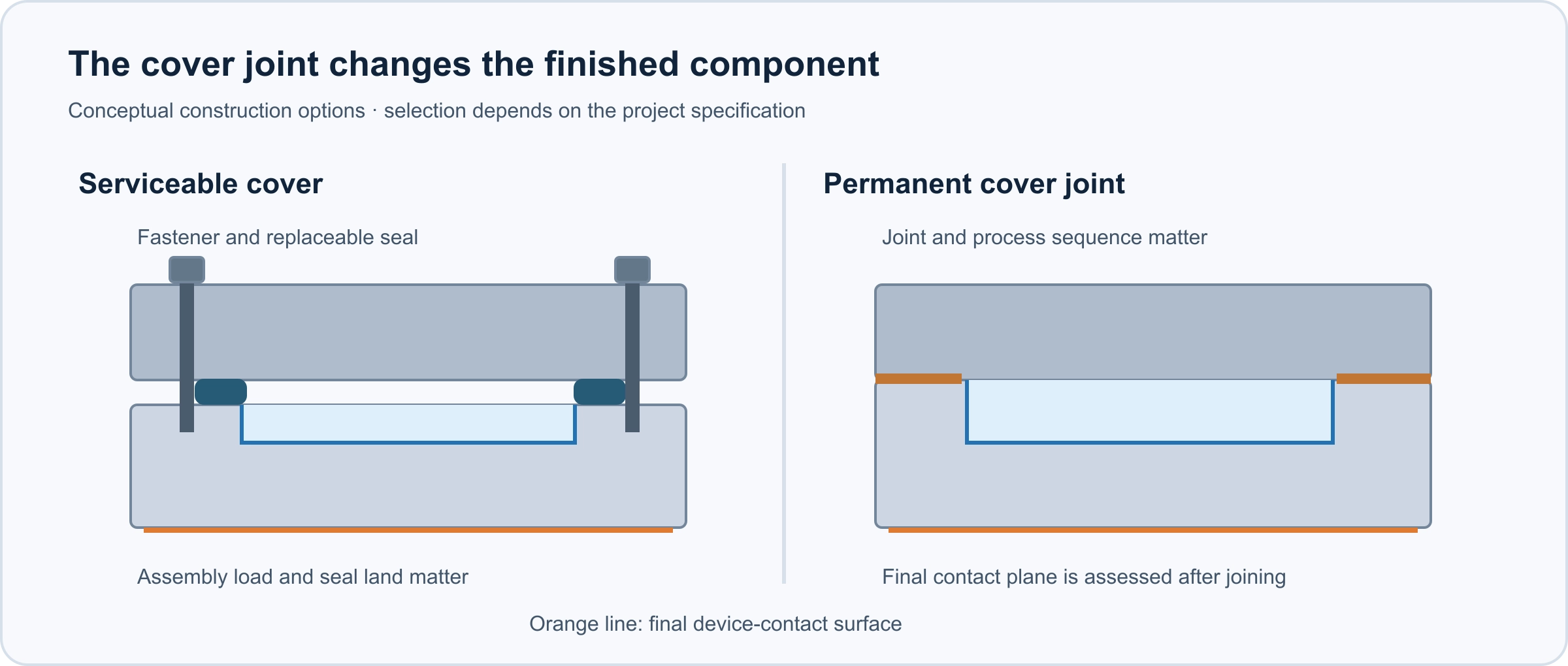
Select the cover joint around service access and the finished contact face
Use a bolted, sealed cover when reopening the plate is a genuine project requirement. We define the seal groove, sealing land, fastener pattern and assembly condition together. Where a permanently closed assembly is required, we develop a compatible welded or brazed joint and its process sequence around the channel and contact geometry.
The choice is not “prototype equals bolts, production equals brazing.” A released production design can use either construction when qualified for its service conditions. Permanent joining affects inspection access and can affect dimensions; an opening cover adds a seal and fastening system to control. The proposal identifies those consequences and the leak/pressure acceptance scope rather than promising that a process name guarantees reliability.
CNC machining and production cost: compare the complete route
A CNC-machined GPU cold plate can be the production part, not just a temporary prototype. For board-specific pockets, local channels and changing layouts, machining from plate or billet offers direct control of the required geometry. Our precision aluminum CNC machining approach connects those features to workholding, access and inspection.
| Route | Recommendation and benefit | When to change—and what to check |
|---|---|---|
| Plate or billet plus CNC machining | Prefer for irregular, board-specific geometry or revisions that do not justify dedicated blank tooling. Suitable for development and repeat production. | If repeat stock removal dominates cost, compare a closer-to-shape blank. Check remaining machining, wall support and critical-feature access. |
| Extruded blank plus finish machining | Recommend when a stable, useful section can carry material distribution or support geometry into the blank, leaving local features for machining. | Do not force a variable channel layout into an unsuitable section. Compare tooling, quantity, lead-in work, revision outlook and the complete joined-part cost. |
| Controlled transfer of an approved route | For an existing part, retain the released functional specification and define the production/inspection handoff. | Review changes to material, joint, finish, critical tools or acceptance separately. First-article and qualification scope follow the actual change. |
For high-volume GPU cold plate procurement, we compare recurring machining, joining, cleaning, inspection and packaging costs alongside one-time tooling or qualification. We protect the contact, seal and mounting requirements, then simplify noncritical features and unnecessary setups. Your quotation can distinguish the approved design from a proposed cost-down option at the requested order quantities.
Ask BAOSONG to review your existing cold plate for manufacturability and repeat-order cost. A current drawing, sample photo or description of the expensive feature is enough to begin.
Agree what the finished component must demonstrate
We connect the acceptance plan to the drawing revision and supply scope. A machined body, a sealed cold plate and a qualified installed cooling assembly are different deliverables. The proposal states which one is being supplied and which records accompany it.
| Requirement | Defined check | Conditions recorded |
|---|---|---|
| Contact and fit | Dimensions, contact-plane condition and assembly fit | Board/drawing revision, measurement references, finished state and applicable mounting condition. |
| Fluid boundary | Specified leak test and pressure test | Medium, pressure, duration, test boundary and acceptance criterion. A leak result alone does not establish thermal performance. |
| Thermal and hydraulic behavior | Temperature and pressure-drop characterization where required | Heat input and map, coolant, inlet temperature, flow, TIM and mounting condition. |
| Internal cleanliness | Agreed cleaning and cleanliness verification | Channel access, permitted residue/particles, drying and protection after cleaning. |
| Repeat supply and changes | Agreed first-article and production records | Controlled material, drawing, joint/process revision and changes that require approval. |
New-design qualification and routine production inspection serve different purposes. We identify the required scope for the project rather than applying a complete development test program to every repeat order. Our quality and inspection approach connects the agreed requirements to the supplied parts.
Why choose BAOSONG for your custom GPU cold plate project?
One connected review of the features that determine fit. We bring the contact map, retention, sealing and port geometry into the same aluminum part design review. You receive a coordinated component scope instead of separate recommendations that conflict at assembly.
An aluminum solution matched to the real constraint. We recommend the aluminum body or supporting architecture that creates value without unnecessarily changing an approved cooling core. The proposal explains what stays, what changes and what must be verified.
A manufacturing and quotation path for the project you actually have. Released drawings move toward supply; unfinished requirements move toward a defined part; repeat orders keep critical revisions and acceptance connected. GPU cooling components sit within our broader aluminum hardware for AI servers.
Frequently asked questions
Do I need a completed cold plate design to request a quote?
No. Send the information you have. With a released drawing, we review manufacture and price the defined supply scope. With a photo, board layout or cooling problem, we recommend the component direction and identify the few decisions needed to turn an initial proposal into a production quotation.
When should I specify a microchannel GPU cold plate?
Specify a microchannel GPU cold plate when the heat-transfer requirement justifies fine internal features and the available flow, pressure and cleanliness conditions support them. If poor contact is the main limitation, finer channels do not fix it. We resolve the limiting interface first, then select a manufacturable channel structure.
Can one cold plate cover the GPU and its memory?
Yes, where the approved package and board layout support that construction. We map each required contact, its height and interface material. HBM may be part of the processor package rather than a separate surface to contact; discrete memory and power components may need different interfaces. The board-specific contact map governs the design.
What matters when sourcing GPU cold plates from China?
Keep the drawing revision, delivery scope, acceptance records and commercial terms attached to the same quotation. BAOSONG coordinates the manufacturing proposal around those requirements. For a supplier transfer, identify which materials and functional features must remain unchanged and agree the first-article scope before repeat supply.
Start from the information you already have
| You already have | BAOSONG’s next action | You receive |
|---|---|---|
| Approved CAD and drawing | Review the controlled features, supply boundary and requested quantities. | A manufacturing quotation with any proposed changes identified separately. |
| A sample or a problematic existing part | Define the reproduction or improvement scope and the interfaces to retain. | A recommendation for the affected geometry, manufacturing route and confirmation steps. |
| A board layout, sketch or functional brief | Develop the contact/clearance map and recommend the material architecture. | A component proposal and the remaining decisions needed for a defined production quote. |
| A repeat-order or production-transfer requirement | Review revisions, acceptance records, quantity bands and change controls. | A supply proposal that connects production cost, first-article requirements and repeat-order consistency. |
Bring us the board, the drawing or the problem. We will turn it into a practical component and manufacturing proposal. Include quantity and timing if available; the detailed technical review follows the initial discussion.