
Quick answer: a liquid-cooled chassis built around the whole assembly
BAOSONG develops custom aluminum liquid cooled server chassis solutions around your boards, cooling hardware and service requirements. For a panel-based enclosure, we recommend formed aluminum panels combined with precisely machined mounting and connector parts. This puts machining where alignment matters while keeping large covers and walls practical to manufacture.
The chassis must carry the cooling hardware without compromising its connections or the remaining airflow. We review board supports, rail references, hose space, connector mounts and removal paths together, then define the manufacturing and inspection route. Aluminum gives this structure low mass and flexible geometry; ribs, sections and local reinforcement provide the stiffness the assembly needs.
Start with the information you already have. An approved drawing can go directly to manufacturing review and quotation; a sample, layout or problem description gives us a starting point for a component solution. Send your drawing, sample photo or a short description to discuss your liquid-cooled server chassis project.
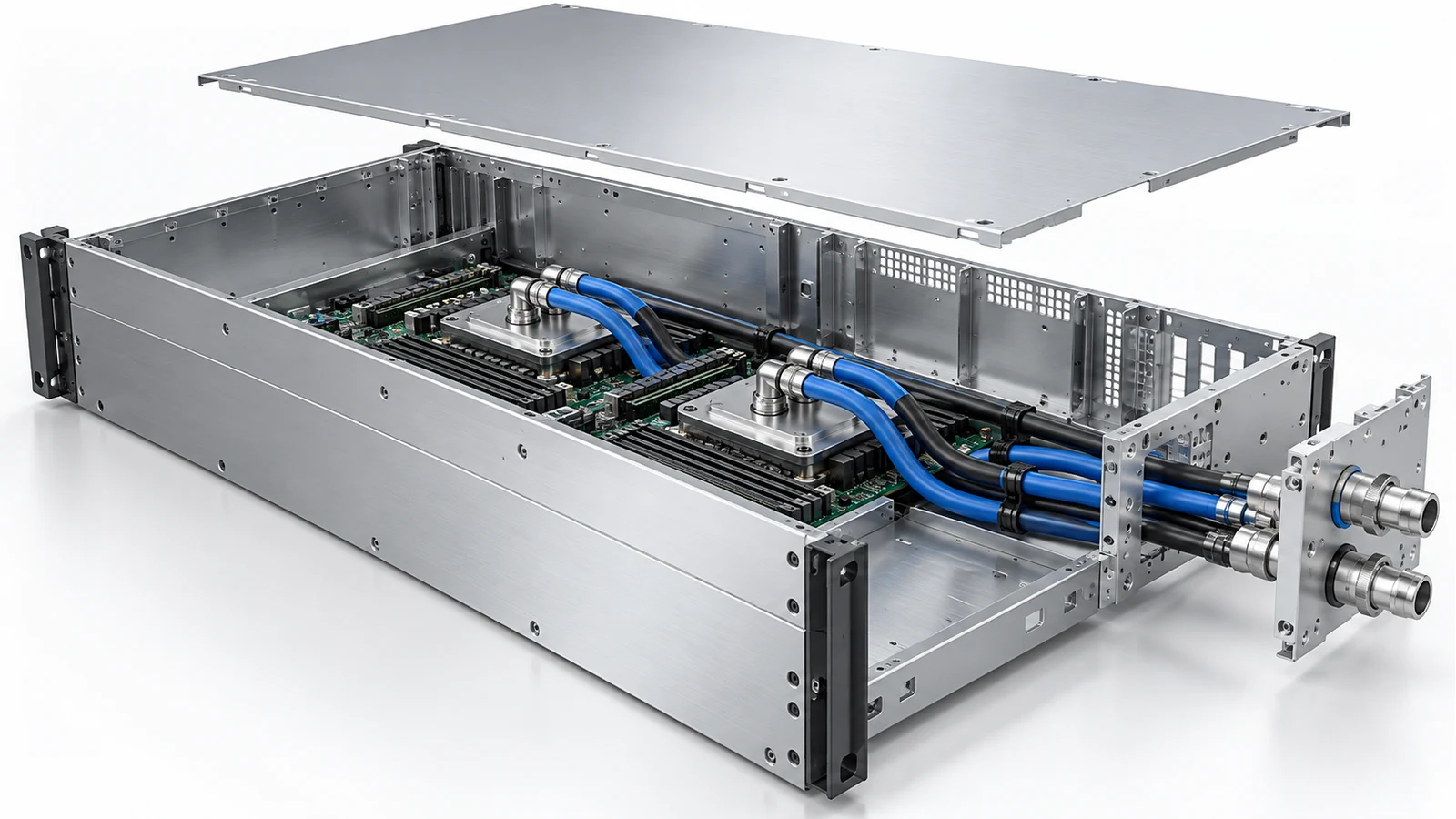
At a glance: the chassis decisions that matter
| Your priority | Our recommended action | What it addresses |
|---|---|---|
| Accurate liquid connections | Locate the connector mount from the same assembly references that position the chassis in the rack. | Misalignment between individually acceptable parts. |
| Accessible maintenance | Make the cooling connection panel and service covers accessible within the agreed removal sequence. | Hoses or brackets blocking a replaceable part. |
| Low structural weight | Use aluminum with ribs, folded returns or rail sections; reinforce concentrated loads locally. | Unnecessary bulk while retaining useful stiffness. |
| Practical recurring production | Combine panel forming with selective CNC machining and controlled assembly fixtures. | Machining every surface when only some interfaces need it. |
| Predictable acceptance | Check finished geometry and mating fit in the specified assembly state. | Parts that measure correctly but do not assemble correctly. |
Define the chassis scope around the hardware it supports
A liquid-cooled server chassis is the mechanical enclosure and support structure for a server using a liquid cooling circuit. Its base, side members, covers, board supports and connection mounts position the electronics and cooling hardware. In direct-to-chip liquid cooling, cold plates collect heat from the processors through their thermal interfaces; the chassis supports that arrangement and its service connections.
For a custom chassis order, specify the metalwork and mechanical assembly as a clear deliverable. We define the supplied panels, supports, fasteners and agreed subassemblies alongside the mating parts supplied by your team or cooling partners. Cooling connectors, hoses and cold plates can then be coordinated against the same interface information. A structural aluminum chassis is normally outside the wetted circuit; if a chassis part also carries coolant, it needs a separate fluid-boundary specification.
An AI server compute tray is a removable module carrying compute hardware; a custom aluminum server chassis can also serve air-cooled equipment. Here, the focus is the extra mechanical work needed for liquid-cooled chassis integration. The broader application context is covered by our aluminum hardware for AI servers.
Choose a manufacturing route that fits your chassis
For new panel-based designs, our preferred route is formed panels plus dedicated machined interface parts. Use the panels for enclosure surfaces and the machined parts for connector positions, locating features and concentrated loads. For an approved OEM liquid-cooled server chassis, we retain the specified construction and raise manufacturing improvements for your approval.
| Route and best use | Why we recommend it | When to change route | Verify before release |
|---|---|---|---|
| Formed aluminum panels + CNC interface parts Panel-based enclosures with localized alignment features. | Separate enclosure geometry from critical mounting geometry; replace a bracket or panel without remaking the entire base. | If assembled panel movement prevents acceptable mating, add a more stable member or change how the interface is located. | Bend and assembly stack-up, connector position, fastener access and finished fit. |
| Extruded members + panels + machined ends Repeatable rail or side-member sections across related variants. | Put stiffness and fixing channels into a repeated section while adapting end features and panels. | If the section changes frequently or tooling is unjustified, retain formed or machined members. | Section suitability, joint stiffness, end references, tooling and order economics. |
| CNC-machined structural parts or base Complex integrated mounting geometry or an approved machined design. | Control connected features in a common part and reduce some joint-related variation; suitable for prototypes and recurring production. | If material removal and machining dominate without functional benefit, split large enclosure surfaces from critical parts. | Distortion, fixture access, finished dimensions, useful stiffness and recurring cost. |
A CNC-machined liquid-cooled server chassis does not have to mean machining every cover and wall from solid stock. We use precision aluminum CNC machining where the design benefits from connected datums, seating faces or precise mounting geometry. The manufacturing proposal identifies those features and the inspection state that proves they work.
Why aluminum is valuable in this application
Aluminum lets the chassis combine manageable weight with adaptable structure. Lower material density is useful for removable covers, service modules and installed metalwork. Its forming, extrusion and machining options let us put stiffness into the section shape and accurate geometry into the local interfaces. The resulting weight and cost depend on the actual design, rather than on material choice alone.
We select material by part function. A formable sheet alloy is a sensible candidate for bent panels; a suitable 6xxx alloy is a candidate for machined or extruded members. Hydro’s 5052 material guidance supports its use in forming, while its extrusion-alloy overview describes 6061 machining characteristics. The project specification still selects the alloy, temper and finish for each part.
Where a fixing, rail contact or repeated service operation creates a concentrated load, we consider a local reinforcement, insert or replaceable wear piece. Keep an approved steel member when its required section or joint performance makes it the better solution. Aluminum is the structural material recommendation here; it does not by itself establish cold-plate thermal performance or coolant compatibility.
Design the mechanical, cooling and service interfaces together
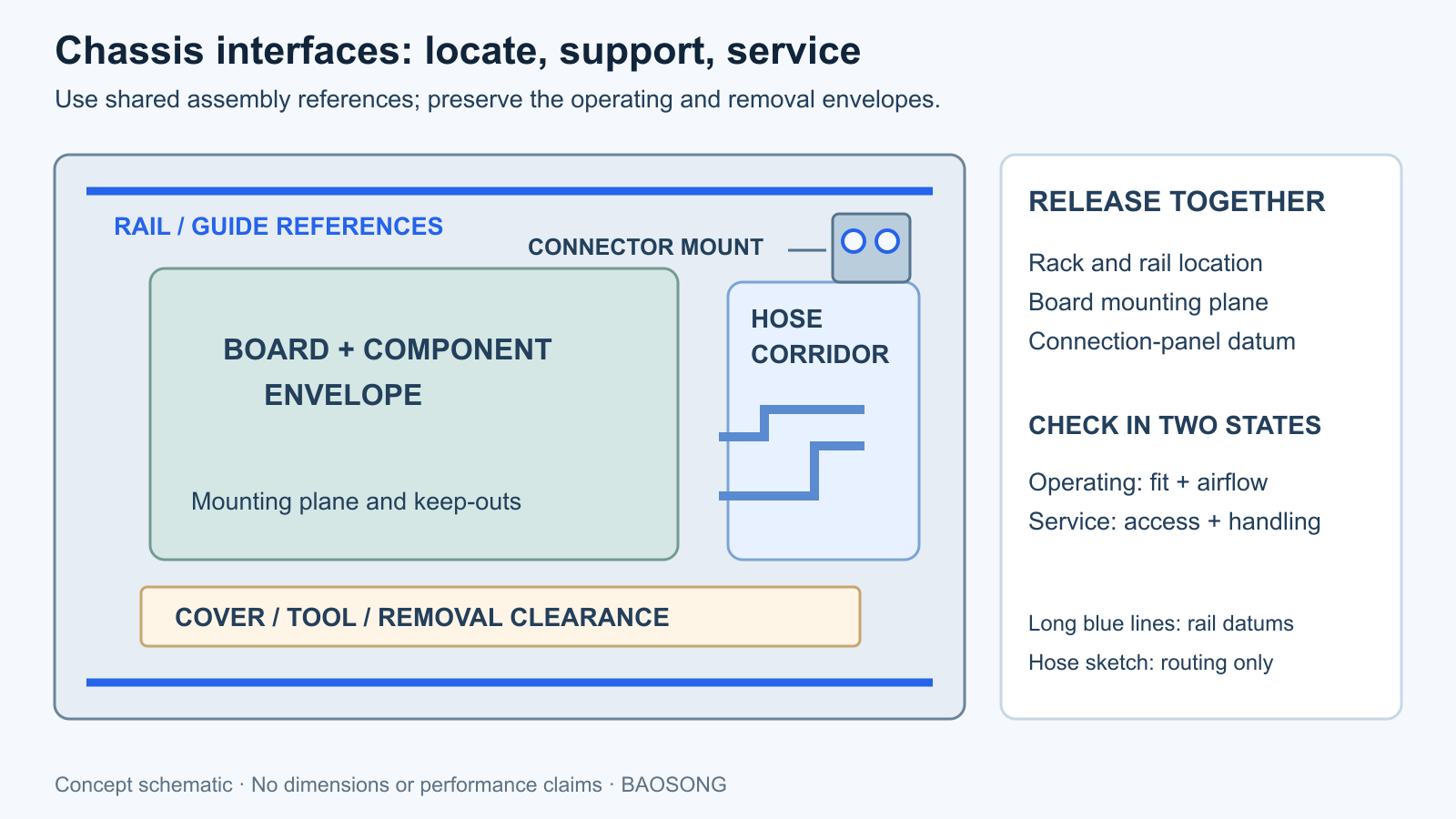
Start with the references that control the assembled chassis, then locate the cooling interfaces from them. A datum is the reference used to position or measure a feature. The rack or rail location, board mounting plane and connection-panel location need a shared relationship so that their separate tolerances do not create an assembly conflict.
Manual connections or blind-mate connectors?
Use accessible manual connections when the approved service sequence allows a technician to reach and disconnect them. They avoid making connector engagement depend on chassis insertion alone. Choose blind-mate connectors when the required service method calls for connection during insertion and the matching guides, connector mounts and engagement mechanism can be engineered together.
For blind mating, we locate connector mounts against the rail and guide references, check the installed mating travel, and account for the selected connector’s engagement forces and permitted movement. CPC’s blind-mate guidance describes connector alignment and the role of guides in engagement. Obtain the selected model’s mounting instructions rather than assigning a generic clearance to every chassis.
Hose space, remaining airflow and removal sequence
We reserve a defined corridor for hoses and connection hardware, keep supported bends clear of edges, and check the cover and service-tool sweep. Keep the cooling route clear of the airflow still needed by other components. OCP’s 2023 OAI liquid-cooling guidelines, section 4 identify chassis space, remaining air cooling and pipe support as design considerations; these are context for the review, not a universal chassis specification.
Make serviceability an assembly requirement, then review the chassis in its service state as well as its operating state. Show which panel is removed first, where a disconnected hose rests, how a latch is reached and whether a board can leave its mounts without pulling on the circuit. If a connection may release residual liquid, define the handling or containment arrangement with the system team. A drain hole or catch feature alone is not proof of leak protection.
Turn assembly problems into specific design actions
| Assembly problem | What BAOSONG addresses | Outcome and check |
|---|---|---|
| Connection mount and rack interface do not align. | Relate their datums; review assembled variation and use a dedicated locating part or controlled adjustment where appropriate. | Defined mating geometry, checked with the agreed counterpart or representative fixture. |
| Hoses rub an edge or move when a cover is removed. | Revise edge treatment, support positions and the service corridor against the hose specification. | A supported route checked in closed, open and maintenance positions. |
| Board support moves under hardware weight or connector force. | Review the load path; add folded returns, a structural member or local reinforcement where the analysis requires it. | Mounting references assessed under the specified assembly loads. |
| Finish changes a fit or interrupts a required electrical contact. | Specify the finished inspection state and approved masking/contact locations. | Fit and any required contact continuity checked after finishing and assembly. |
| Service replacement requires disturbing too many adjacent parts. | Separate accessible covers and connection supports; review the sequence with the intended replaceable unit. | A demonstrated access path, with necessary circuit isolation defined by the system procedure. |
These actions turn an enclosure drawing into an assembly plan. Our aluminum part design review connects the selected construction with the mating conditions before tooling and inspection details are released.
Two practical project routes
New connector location on an existing chassis: our recommended starting point is a dedicated machined connector bracket located against the rail references, with a revised panel opening and supported hose corridor. This keeps the approved enclosure geometry where it still works and concentrates the change on the connection and access problem. Verify mating and removal access using the selected counterpart before releasing the revised parts.
Transfer of an approved production design: when changing your liquid-cooled server chassis supplier, keep the drawing revision, material, finish and mating requirements as the baseline. BAOSONG reviews the fabrication and locating sequence, proposes any useful changes for approval, and aligns the first-article and repeat-order records. These are illustrative project routes, not claims about completed customer projects.
Build repeatability into the production route
For high-volume liquid-cooled server chassis production, control the interfaces and the revision before trying to shorten cycle time. The same controls support mass production of an approved chassis design. We plan repeated fabrication, machining, finishing and assembly against the same approved drawing and acceptance criteria to keep panel fit and connection alignment consistent.
- Review the manufacturing package. Identify the supplied parts, mating drawings, material and finish, order quantities and features that control fit. Record proposed changes for customer approval.
- Set the operation and locating sequence. Decide which surfaces are formed, which are machined, and how they are referenced during assembly. For aluminum sheet metal fabrication, assess bend variation and its effect on later mounts.
- Approve the finished assembly condition. Use the agreed sample or first-article requirements to check critical dimensions, panel fit and mating access after all relevant operations.
- Release the repeat-order controls. Retain the approved drawing revision, material/finish specification, fixture references and inspection record requirements. A board or connector change triggers review of affected interfaces.
A new tooling route is worthwhile when it supports the intended geometry and recurring order pattern. We assess that at quotation, alongside machining and assembly work. CNC machining can remain the production route for critical parts; a move to forming or extrusion needs a functional and commercial reason.
Accept the chassis at the correct level
Part dimensions, assembled fit and cooling-system performance answer different questions. Our chassis proposal identifies the mechanical checks and records included in the order. It also identifies which mating parts or fixtures are needed for agreed assembly checks, and how these results feed the server team’s system validation.
| Acceptance level | What to establish | Inputs and records |
|---|---|---|
| Finished metal parts | Specified material, dimensions, edge condition, threads, finish and critical reference features. | Approved drawings, finished-state requirements and agreed dimensional records. |
| Mechanical chassis assembly | Panel fit, board/rail locations, connector mount and hardware access in the specified assembled state. | Mating drawings or representative parts, assembly specification and fit-check record. |
| Service and load conditions | Removal sequence and structural behaviour under the project’s defined loads. | Approved service sequence, loads, restraints and agreed demonstration/test arrangements. |
| Cooling circuit and complete server | Applicable fluid, leak, thermal and electrical/system requirements for the completed configuration. | System-team criteria and an agreed validation responsibility; a chassis dimensional report alone does not prove these results. |
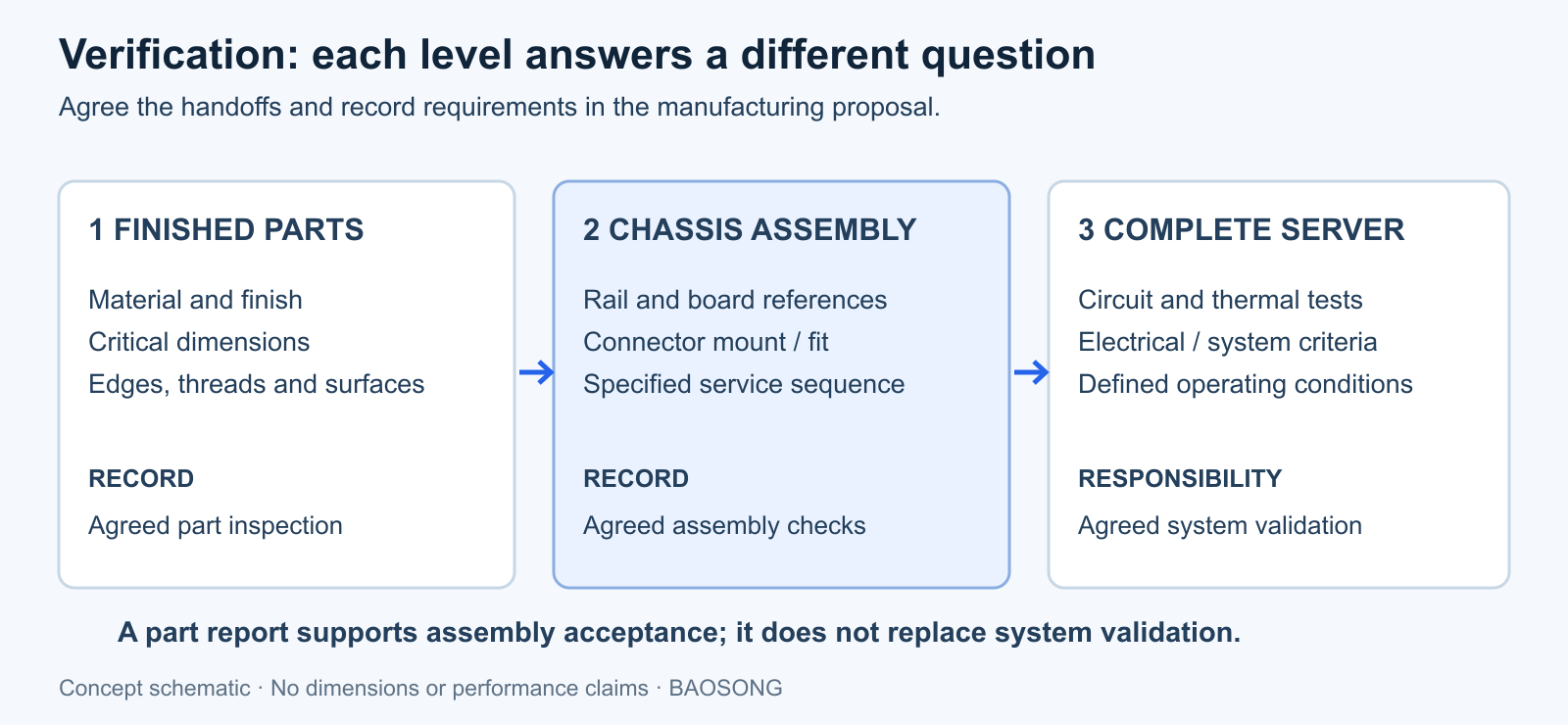
Specify those checks in the aluminum component inspection plan. Include required mating references and supplied records, rather than adding a generic tolerance or test claim to every feature.
Why bring your chassis project to BAOSONG?
Choose a liquid-cooled server chassis manufacturer that turns interface requirements into an executable manufacturing package. BAOSONG connects the aluminum structure, cooling-component mounts and repeat-order controls in one proposal, so your team can progress the project with a clear scope and approval path.
| Procurement priority | BAOSONG’s project action | Value for your team |
|---|---|---|
| Clear scope and quotation | Identify the supplied metal parts and mechanical assembly, mating cooling hardware and agreed inspection work in the proposal. | A defined order scope for the formal quotation and technical approval. |
| Useful customization | Select panel, section and machined-part routes around the interface problem, locating features and quantity plan. | Changes tied to alignment, access or structural function rather than cosmetic redesign. |
| Repeat-order consistency | Align the approved revision, locating sequence, fixture references and required production records. | A common manufacturing baseline across repeat orders and approved changes. |
| Quality and assembly fit | Define finished-state checks, the mating counterpart or fixture, and the agreed sample/first-article requirements. | Approval based on the condition in which the chassis will be assembled and used. |
| Delivery and supplier transfer | Align the required quantity, approval milestones, delivery schedule and packaging requirements with your purchasing team. | A documented handoff and supply plan, with changes reviewed against the approved product. |
Move from your current information to a chassis solution
| What you have | What we do next | What you receive |
|---|---|---|
| Approved drawings and an order requirement | Review manufacturability, interfaces and inspection scope; quote the approved construction. | Manufacturing clarifications and a formal quotation. |
| A sample or existing chassis with an assembly problem | Identify the controlled features and discuss the fault, mating parts and authorised changes. | A defined reproduction or improvement scope for approval and quotation. |
| A layout, envelope or new cooling requirement | Propose the structural arrangement, material/process route and interface-confirmation steps. | A chassis component proposal and the inputs needed to progress it. |
| An approved design for repeat supply or supplier transfer | Align the drawing revision, first-article requirements, production route and repeat-order records. | A production proposal and an agreed approval path. |
Request a liquid-cooled server chassis quote
BAOSONG provides a formal liquid-cooled server chassis quote after reviewing your drawing or requirements, material, interfaces, quantity and agreed inspection scope. Send the information you have; we will identify the remaining details needed to quote the project accurately.
Frequently asked questions
Can an existing air-cooled chassis be adapted for liquid cooling?
Yes, when its structure can accommodate the cooling hardware and a workable service route. We first review the connection location, hose corridor, local supports and remaining airflow, then recommend an approved panel/bracket modification or a replacement structural arrangement. Adding holes for fittings is only one part of that conversion.
Can we keep our approved chassis design and change manufacturer?
Yes. Provide the current drawing revision and any approved sample or mating requirements. We build the manufacturing review around that baseline, define the first-article checks and raise any change for approval before it reaches production.
What should an overseas OEM prepare when sourcing a liquid-cooled server chassis from China?
Start with the drawing, sample or chassis requirement you already have. For production release, align the drawing units and revision, material/finish specification, mating references, agreed inspection records and delivery terms in one controlled package. This helps the overseas engineering and supplier teams work against the same assembly requirements.
Do all chassis projects need a new prototype?
No. An approved production design follows its specified sample or first-article approval route. A new layout, changed connector or different construction needs verification of the affected features; we define that work around the actual change instead of restarting the entire development programme.
Bring us the drawing, the part or the problem. BAOSONG will turn it into a defined aluminum chassis manufacturing proposal with clear interfaces and a practical route to supply. Discuss your custom liquid-cooled server chassis and request a quote.