Quick answer: what should an OEM specify for a rack liquid cooling manifold?
For a custom rack liquid cooling manifold, BAOSONG recommends evaluating a machined aluminum manifold body first when the project needs lower component mass, compact internal flow paths, custom port positions and fast design revision. We convert the rack envelope, branch layout and interface requirements into a practical body concept, manufacturing route and quotation scope rather than asking you to choose a process alone.
This recommendation is for a custom body where the project permits an aluminum wetted path. If an adopted rack specification fixes stainless steel, or the coolant, connected metals, pressure, sealing or service-life requirements rule out aluminum, BAOSONG will identify that constraint and define the appropriate component or assembly route. We do not propose substituting aluminum for a material locked by an approved system specification.
You can start with a released drawing, CAD model, sample photo, port map or a short application description. Send BAOSONG what you have; we will organize the missing inputs, identify the proposed manifold-body scope, flag the interfaces that need confirmation and prepare the basis for a formal quote.
Rack manifold decisions at a glance
| Project condition | BAOSONG recommendation | Problem solved | Confirm before release |
|---|---|---|---|
| Custom ports, tight rack space, weight pressure | Start with a CNC-machined aluminum manifold body | Integrates passages and interfaces into a compact part | Coolant compatibility, connected metals, sealing and proof requirements |
| Customer has a released drawing | Run manufacturing and quotation review against the controlled revision | Avoids unnecessary redesign and keeps approval responsibility clear | Critical features, inspection method, quantity and change control |
| Only a sample, photo or port map is available | Reconstruct the component scope and issue a proposed specification | Moves the project forward without demanding a complete RFQ first | Unknown interfaces, operating conditions and acceptance owner |
| Stainless wetted path or complete valve/QD assembly required | Separate the assembly package from the aluminum body opportunity | Prevents a low-mass part decision from conflicting with the loop specification | Who supplies fittings, performs assembly and owns system qualification |
| Prototype must scale to repeat production | Quote the prototype and production route together | Controls setup, fixture, inspection and revision costs before volume grows | Forecast quantity, revision maturity and lot-level documentation |
Manifold body, manifold assembly or complete cooling system?
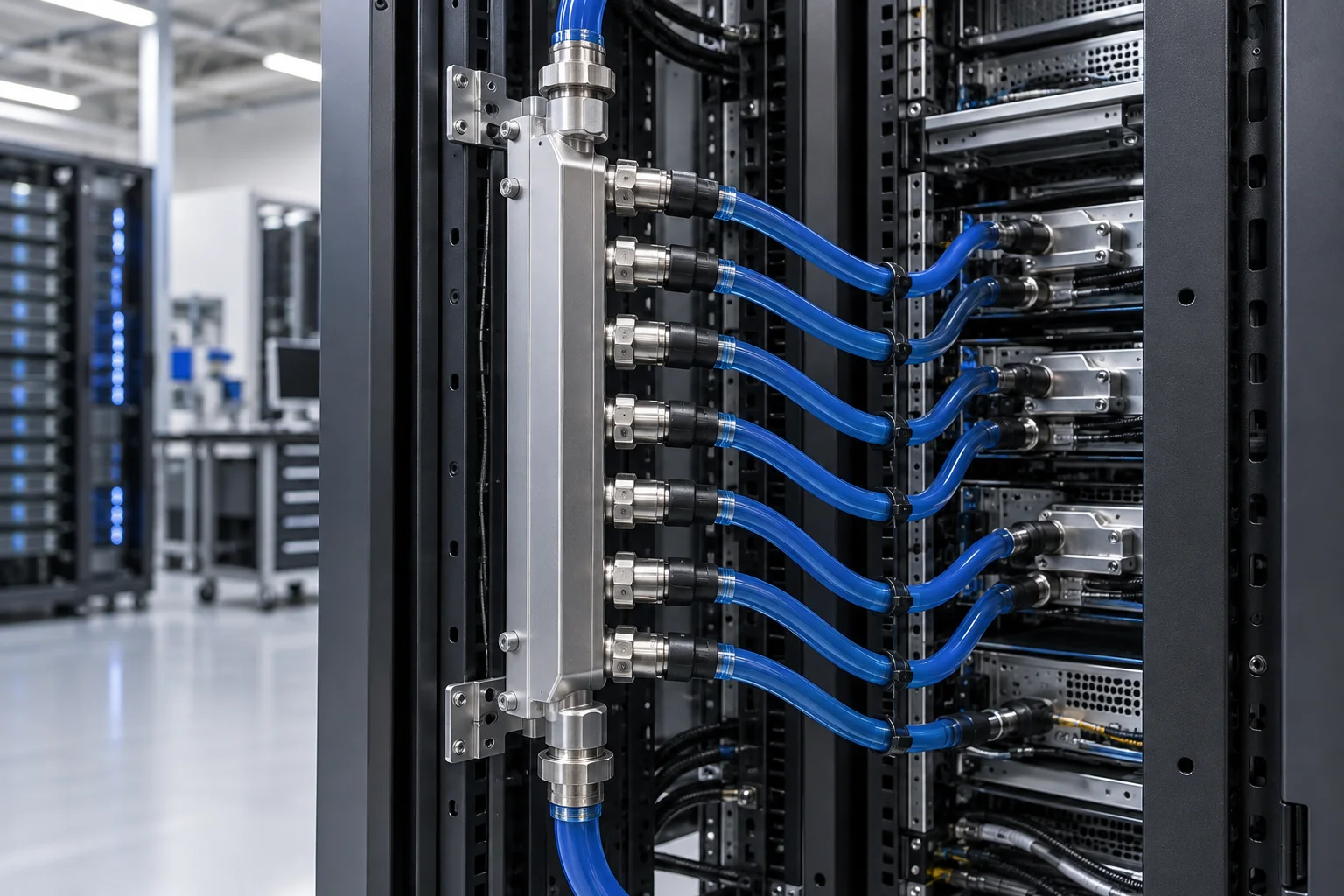
A liquid cooling distribution manifold divides supply flow among server branches and collects return flow. The product name is often used for three very different deliverables, which is why two quotations can appear incomparable even when both are called a server rack cooling manifold.
| Delivery level | Normally included | Main buying decision | C04 position |
|---|---|---|---|
| Machined manifold body | Aluminum block, internal galleries, ports, mounting and defined sealing features | Geometry, alloy/temper, machining access, surface condition and inspection | Primary BAOSONG custom-component opportunity |
| Manifold assembly | Body or tube plus plugs, valves, fittings, quick disconnects and brackets | Purchased-component specification, assembly responsibility and leak/pressure acceptance | Scope must be agreed item by item |
| Rack/CDU system | Manifold, hoses, controls, pumping/heat exchange and system integration | System architecture, controls, commissioning and facility interfaces | Not presented as the same product as a custom machined body |
This manifold body and manifold assembly distinction protects the schedule and the budget. BAOSONG can lead the aluminum component solution and coordinate a defined project scope, while the quotation identifies which purchased items, assembly steps and system tests are included. See the wider aluminum hardware for AI servers context and our AI server cold plate guide for the cold-plate side of the loop. The rack and facility system remain separate engineering responsibilities.
Why we recommend a custom aluminum manifold body first
Aluminum is valuable here because a long distribution body can combine the main gallery, branch ports, mounting faces and service features in one machinable component while keeping mass under control. It also supports fast geometry changes when port count, spacing or rack mounting changes between server platforms. These are direct manufacturing and packaging benefits; they do not depend on claiming that aluminum is universally superior.
| Buyer pain | BAOSONG action | How the action works | Customer result |
|---|---|---|---|
| Catalog manifold does not match port spacing | Build the port map around the actual rack and branch interfaces | Moves inlets, outlets and mounting features into one controlled model | Fewer adapters and a cleaner installation envelope |
| Rack-side mass and space are constrained | Evaluate an aluminum block with material removed where function permits | Uses aluminum’s low density and machinability to integrate the required features | A compact part concept without making an unsupported weight-saving promise |
| Cross-bores create plug, burr or contamination risk | Review drilling access, intersections, closure features and cleaning access before release | Designs manufacturing and verification into the body rather than treating them as afterthoughts | Clearer acceptance criteria and less late rework risk |
| Prototype and production quotes do not align | Review setup, fixtures, inspection and quantity at the quotation stage | Separates one-time work from recurring part cost | A production path that does not assume CNC is only for prototypes |
We change direction when the system specification requires stainless wetted materials, when chemical compatibility has not been approved, when an assembled tube/valve architecture is the real deliverable, or when the pressure and joint strategy favor another construction. For example, the OCP Open Rack V3 Blind Mate Manifold specification defines stainless materials for its reference manifold tube and brackets. That is a system-specific requirement—not proof that every custom rack manifold must use the same construction.
How BAOSONG turns the cooling requirement into a manufacturable manifold
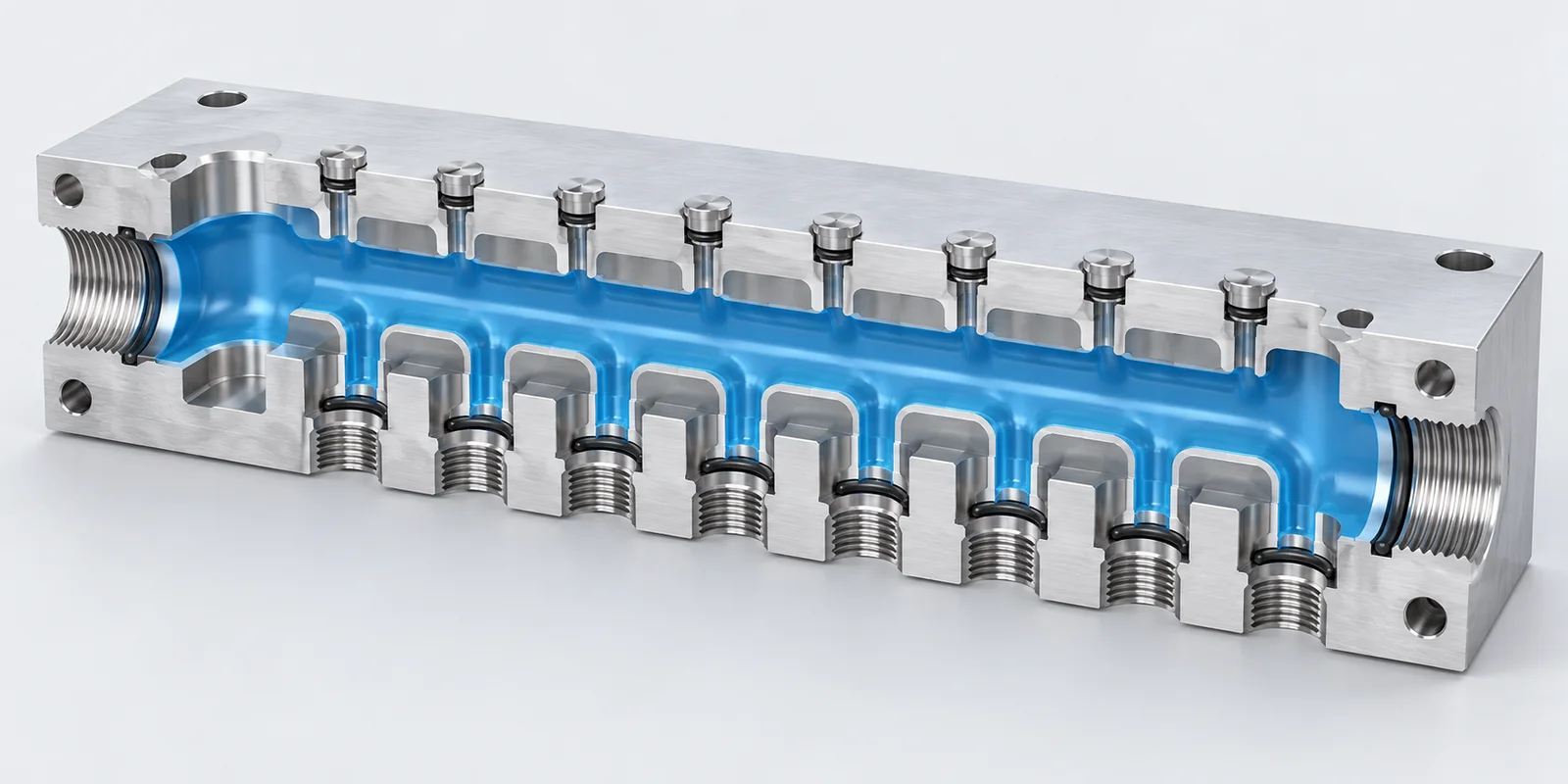
A strong custom solution begins with the coolant circuit and the physical rack, then converts both into controlled component features. BAOSONG does not ask the customer to select “3-axis or 5-axis” in isolation. We choose a manufacturing route after mapping the features that must be reached, sealed, inspected and repeated.
- Define the delivery object. We identify the machined body, plugs, fittings, valves, quick disconnects, brackets and documentation that belong inside or outside the quotation.
- Build the interface map. The model records rack mounting, inlet/outlet position, branch count, thread or connector standard, hose direction, installation clearance and service access.
- Set the fluid and pressure boundary. The project specifies coolant composition, connected wetted materials, operating temperature, operating pressure, proof requirement, allowable pressure drop and the party responsible for system validation.
- Design the machining path. We review gallery diameter, tool access, cross-bore intersections, plug or cap strategy, sealing lands, datum scheme, deburring access and cleaning method.
- Plan verification before release. Dimensional inspection, port gauges, sealing-surface checks, cleanliness, leak/proof or flow-pressure verification are assigned to the agreed supplier or system owner with acceptance criteria.
A CNC-machined rack liquid cooling manifold can be a prototype or a repeat-production part. Multi-face geometry does not automatically require simultaneous five-axis machining; fewer controlled setups may lower total cost, but the correct route depends on cross-face relationships, tool access, part length, fixture stability and inspection needs.
Which manifold construction should your project use?
| Route | Best fit | Why use it | Trade-off and switch condition |
|---|---|---|---|
| Custom machined aluminum body | Custom port map, compact envelope, lower component mass, rapid revision or integrated mounting | Combines passages and interfaces in one controllable part; suitable for prototype and repeat CNC production | Switch if coolant/galvanic compatibility, pressure/joint design or governing material specification is not satisfied |
| Stainless tube or manifold assembly | Specified stainless wetted path, many standard valve/QD branches, system-level assembly procurement | Aligns with architectures that prioritize corrosion specification and purchased fitting integration | Usually heavier and adds welding/assembly/supplier coordination; it is not a like-for-like bare-body comparison |
| Integrated rack/CDU solution | Buyer needs controls, pumping, heat exchange, hoses and commissioning as one package | Moves compatibility and commissioning responsibility to a system integrator | Higher scope and lock-in; use when the real task is system procurement rather than a custom aluminum component |
For a custom component whose material is open to engineering selection, BAOSONG recommends the machined aluminum body route first and checks it against the actual loop conditions. Where the approved rack specification already fixes stainless wetted parts, we work from that requirement and identify the appropriate component or assembly scope. Either way, we turn the chosen architecture into manufacturing and quotation actions.
What can you send, and what will BAOSONG return?
| You already have | BAOSONG’s next action | You receive |
|---|---|---|
| Released drawing and BOM | Review manufacturability, critical interfaces, inspection and quantity route | Clarification list, proposed manufacturing scope and formal quote basis |
| Existing part or sample photos | Identify measurable interfaces, unknown internal features and improvement targets | Reverse-engineering/replication scope and a list of items requiring confirmation |
| Port map, rack layout or application target | Develop the manifold-body concept around branch and mounting constraints | Recommended aluminum route, interface checklist and development quotation scope |
| Current supplier drawing and transfer problem | Separate approved design from proposed manufacturing changes and inspection controls | Transfer plan, first-article/lot acceptance proposal and repeat-order controls |
A mature OEM rack liquid cooling manifold does not need to be redesigned simply because production changes supplier. Conversely, an early project does not need a perfect drawing before the first conversation. The difference is the deliverable: released work enters manufacturing review; incomplete requirements enter a controlled definition process.
Verification must match the feature being protected
“Leak tested” is not a complete acceptance specification. A reliable plan identifies the medium, pressure, duration, temperature, allowable loss or detection threshold, plugs/fittings included and the assembly state. The same discipline applies to flow balance and cleanliness: define what is being measured, at which ports, under what configuration and who owns the system-level result.
| Verification layer | Protects | Define on drawing or PO |
|---|---|---|
| Dimensional/interface inspection | Rack fit, branch alignment, threads, sealing lands and mounting | Datums, critical features, gauge method, sampling and report requirement |
| Internal passage and cleanliness review | Flow path, debris-sensitive connectors and cold plates | Deburring, flushing/cleaning method, inspection evidence and packaging state |
| Leak/proof verification | Pressure boundary and closures | Medium, pressure, time, temperature, acceptance threshold and included components |
| Flow-pressure verification | Branch distribution and pump-budget compatibility | Fluid properties, inlet conditions, active branches, measurement points and allowable result |
| Rack/system integration | QD alignment, service access and operating performance | System owner, rack revision, hoses/connectors and final commissioning criteria |
How do I get a custom manifold quote?
For a rack liquid cooling manifold quote, BAOSONG reviews your drawing or requirements, port layout and order quantity before confirming the manufacturing scope and price. Send a drawing, sample photo or short project description to start; accurate pricing is confirmed in BAOSONG’s formal quotation.
From prototype to high-volume manifold production
A high-volume rack liquid cooling manifold project succeeds when the design revision, fixtures, purchased interfaces and inspection plan mature together. We review the intended quantity at the first quotation so the prototype route does not create avoidable cost or unstable datums later. CNC remains a valid production process when it fits the geometry and economics; scaling is not automatically a switch to another process.
For rack liquid cooling manifold mass production, the production package should freeze the alloy/temper, controlled revision, critical-to-function features, plug and seal specification, cleaning state, traceability and lot acceptance. The same planning applies to server rack cooling manifold mass production, data center cooling manifold mass production and liquid cooling distribution manifold mass production: the phrase “mass production” is not a capacity promise—it is a requirement for repeatable controls and a quantity-specific quotation.
Why use BAOSONG for the custom aluminum component?
We start with a recommendation, not a generic checklist. BAOSONG frames the aluminum body, assembly boundary and validation responsibilities around your project, then explains when another construction is the better route. That reduces the chance of receiving a cheap body quote that omits the features or verification your rack actually needs.
We connect design decisions to manufacturing consequences. Port location, cross-bores, closures, sealing lands, mounting and inspection are reviewed as one part. The customer receives a defined manufacturing scope and decision points rather than a collection of unrelated process options.
We plan the next order while quoting the first. Released drawings, samples, early requirements and transfer projects follow different paths, but quantity, revision control and acceptance are considered from the beginning. This is the difference between purchasing a machined block and establishing a repeatable OEM component.
Rack liquid cooling manifold FAQ
Can BAOSONG work from a photo or port map instead of a finished drawing?
Yes. A photo, sample, rack layout, port map or application description can start the project. We identify the known interfaces and return the missing decisions in a controlled list; the final production quotation is based on the approved specification.
Is an aluminum manifold always better than stainless steel?
No. Aluminum is our recommended first evaluation route for a compact custom body because it supports lower mass, integrated machining and faster geometry changes. Stainless or another construction is preferable when the governing coolant/material specification, pressure/joint design or complete assembly architecture requires it.
What does a rack liquid cooling manifold China sourcing request need to state?
State the required manufacturing origin or supply-chain condition, Incoterm, destination, quantity, drawing revision and inspection/documentation requirement. The same applies to a server rack cooling manifold China, data center cooling manifold China or liquid cooling distribution manifold China search: geographic wording alone does not define the component or quotation.
Can one supplier quote include quick disconnects and valves?
It can, but the RFQ must say whether the supplier buys them, assembles them, verifies the joint and warrants the assembled pressure boundary. Otherwise compare the machined body and purchased assembly items as separate lines.
What information changes the quote most?
Maximum body size and stock, branch/port count, internal galleries and closures, setup count, alloy/temper, sealing tolerances, finish, quantity and verification scope are the main quote inputs. Send what you already have; BAOSONG will organize the remaining questions.
Request a custom manifold solution and formal quote
Send BAOSONG your drawing, CAD file, sample photo, port map or short project description. Include the expected quantity if known. We will review the component boundary, recommend the aluminum manufacturing route where it fits the approved system requirements, identify the confirmation points and prepare the basis for your formal quote.