
Quick answer: which custom extruded aluminum heat sink should you choose?
Choose a custom extruded aluminum heat sink when your design needs a repeatable fin-and-base profile with project-specific mounting and contact features. BAOSONG recommends reusing an existing extrusion profile when it meets the required geometry and cooling conditions; specify a new die when the continuous cross-section must change. Aluminum brings heat-conducting fins, a lightweight structure and useful mounting features into one manufacturable profile.
We turn the profile into a finished-component manufacturing plan. BAOSONG reviews the alloy and temper, fin channels, base, cut length, CNC features, surface treatment and inspection together. Approved drawings move into manufacturing review and quotation; for a new design, we recommend the production route and agree the validation needed before release.
Start with what you already have. Send a drawing, sample photo, sketch or short description. Request your custom heat sink proposal and quote, with a recommended route, the key interface decisions and a defined supply scope.
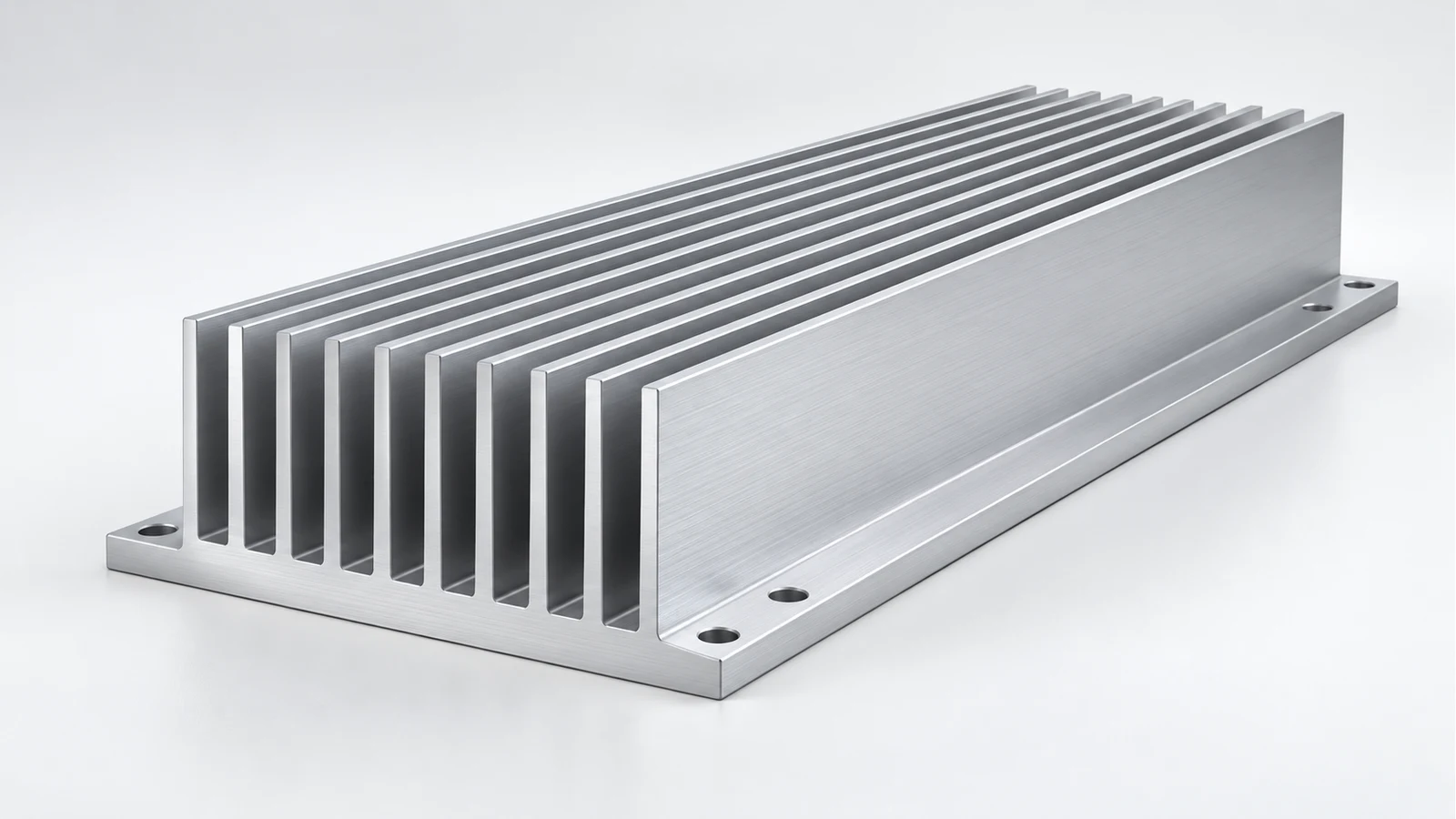
At a glance: the route we recommend
| Your project condition | BAOSONG recommendation | What it resolves |
|---|---|---|
| An available profile fits the thermal envelope and mounting layout | Reuse the section, then cut and machine the required features. | Avoid unnecessary new tooling without giving up custom interfaces. |
| Fin channels, base or continuous mounting geometry must change | Develop a custom extrusion die and approve the finished first article. | Build the required features into the profile instead of adding avoidable parts. |
| A standard section fits, but the contact face or holes do not | Keep the extrusion; machine only the functional interfaces. | Correct assembly fit without paying to machine every fin from solid stock. |
| The design calls for very dense or tall fins | Review airflow and die feasibility together before committing to the section. | Avoid a manufacturable profile that cools poorly, or a thermal design that is difficult to extrude. |
| You need repeat orders or a supplier transfer | Lock drawing, die, machining, finish and inspection revisions as one release. | Make the approved component reproducible across orders. |
What BAOSONG delivers: a profile, a finished part or an agreed assembly
A heat sink extrusion is not automatically an assembly-ready heat sink. The die forms the continuous cross-section. Cutting establishes the length; secondary operations create features such as mounting holes, end pockets and a specified contact surface. The purchase specification must identify whether you need unfinished profile, cut blanks, finished components or an agreed mechanical assembly.
For an OEM extruded aluminum heat sink, we define the supplied material state, finished geometry, surface requirements and records in the manufacturing proposal. Bought-in clips, fasteners, thermal interface materials or other assembly items are included only in the agreed scope. A complete fan module, processor cooler or liquid-cooling system is a different deliverable.
This article focuses on profile and tooling decisions. For the wider server application, see our aluminum hardware for AI servers. Power electronics heat sinks can also use extrusion, but their device-specific cooling requirements remain separate from the extrusion manufacturing decision.
Why aluminum is a strong choice for this manufacturing route
Use aluminum to combine heat transfer, low weight and integrated geometry. Extrusion can form fins and mounting features together, reducing the number of separate pieces needed to achieve the same layout. The Aluminum Extruders Council explains how heat-sink profiles integrate mounting or enclosure functions. Our recommendation is to exploit those continuous features, then reserve machining for the interfaces that actually need it.
6063 aluminum is a practical first candidate for a new finned profile. Hydro identifies its good extrudability and surface finish; those qualities matter when the section contains multiple fins and will be anodized. Select the temper and material specification against the approved mechanical and thermal requirements, rather than substituting an alloy because its name is familiar. See Hydro’s 6063 alloy guidance.
The manufacturing advantage is not a guarantee of cooling capacity. A concentrated heat source, constrained airflow or an incompatible mounting arrangement may require a different base, heat spreader or manufacturing route. We first recommend the aluminum extrusion solution that fits the interfaces and operating conditions, then identify the specific condition that would justify a change.
Existing profile, new die or machining from billet?
Our preferred route is the least complicated one that meets the approved requirements. An existing profile is valuable only if it genuinely fits. When the required fin-and-base geometry cannot be obtained from an available section, a custom die becomes the appropriate route—not something to postpone until after an unsuitable prototype has been built.
| Route and recommendation | When to choose it / problem solved | Tradeoff and change trigger | What we confirm |
|---|---|---|---|
| Existing profile + cut/CNC Choose when its section already fits. | Customize length, holes and contact features without a new profile die. Useful for both smaller orders and recurring production. | Fin spacing and base shape are inherited. Change to a new die if machining compromises the section or cannot deliver the required geometry. | Profile access and specification, machining allowance, installed clearance and agreed thermal acceptance. |
| Custom die + extrusion + selective CNC Choose when continuous geometry must change. | Integrate the required fins, base, rails or ledges. Especially useful when repeat demand supports dedicated tooling. | Tooling and trial approval are required; aggressive sections may need revision. Change route if die feasibility or order economics remain unsuitable. | Section feasibility, material state, trial profile, finished first article and tooling/reorder arrangements. |
| Machined-from-billet heat sinks Choose when extrusion is the wrong geometric or purchasing fit. | Make localized or changing three-dimensional features without a dedicated extrusion die; CNC can also serve repeat orders. | Fin machining removes material and consumes machine time. Compare extrusion again when the geometry stabilizes and recurring demand changes the balance. | Tool access, thin-feature support, contact geometry and a like-for-like finished-part quotation. |
BAOSONG brings the selected route into one manufacturing proposal: profile and tooling requirements, secondary operations, production responsibilities and acceptance deliverables. Our custom aluminum extrusion service is the starting point for a new section.
High-density heat sink extrusion: approve the air path and the section together
A high-density heat sink extrusion needs useful airflow through its fins—not merely more metal surface. Closely spaced channels can change flow resistance and bypass behavior, so a fan’s free-air rating alone is not enough to select the profile. ATS discusses this interaction in its Qpedia guidance on heat-sink airflow and bypass. We recommend reviewing the channel geometry against the installed airflow before approving an aggressive fin layout.
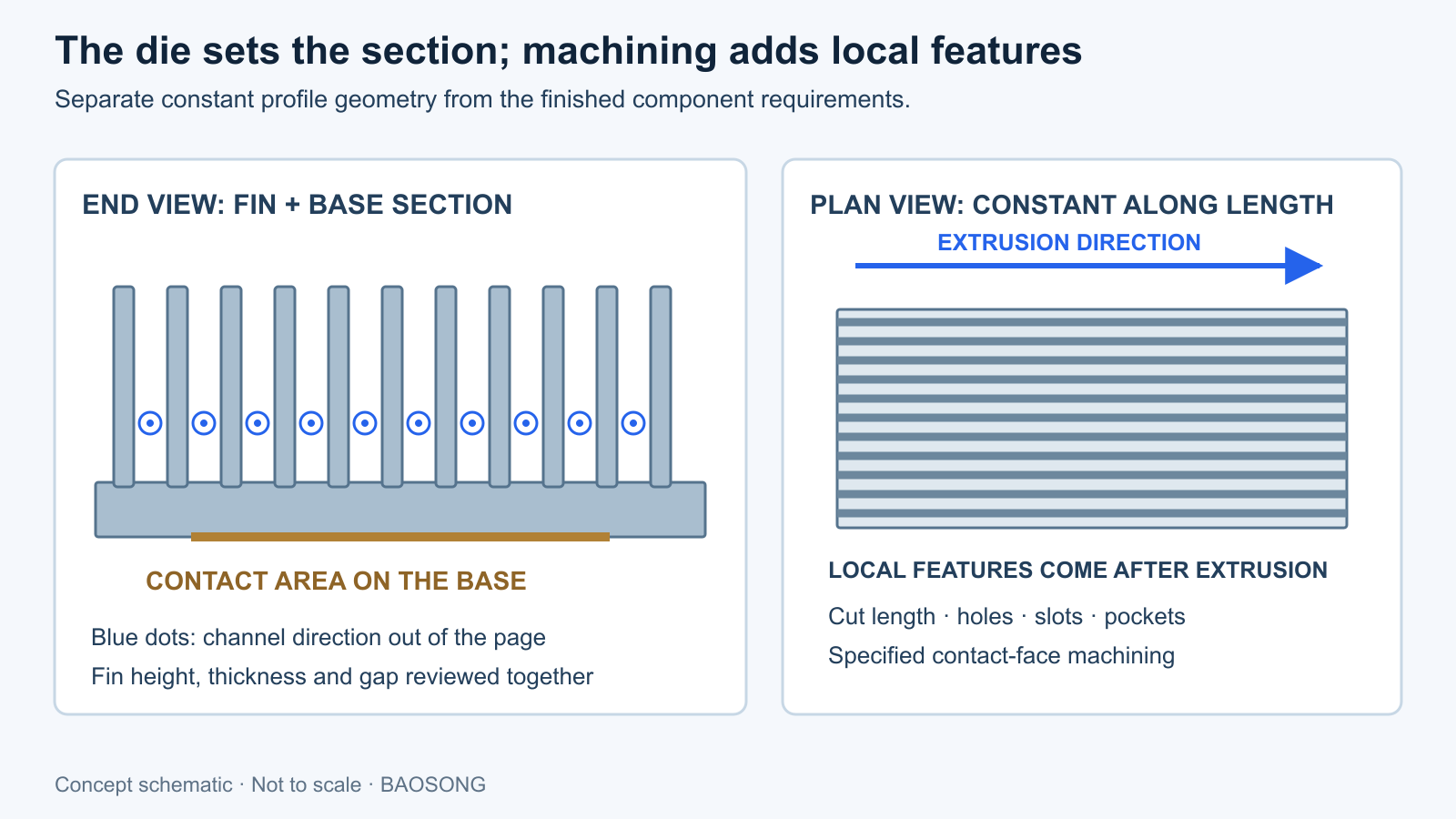
For a new profile, BAOSONG separates the review into four decisions:
- Set the extrusion direction. The base and fins form a constant section along this direction. Isolated holes, transverse slots and local pockets belong in the subsequent machining plan, not in the extrusion cross-section.
- Preserve an effective air path. Orient straight channels with the intended flow where the package allows it. For natural convection, review the installed orientation and unobstructed entry and exit; for forced air, consider the enclosure and fan operating conditions together.
- Make the fin roots and base practical. Review fin height, thickness and gap together with base thickness, transitions and asymmetry. The AEC’s extrusion design guidance identifies abrupt thickness changes and wide, thin sections as potential sources of distortion or manufacturing difficulty. We use that as a review principle, not a universal minimum-wall or aspect-ratio rule.
- Keep the contact area and mounting references explicit. Identify the heat-source footprint and the base area that must meet the approved contact requirement. If that area needs machining, include the allowance and supporting fixture approach before releasing the section.
CNC machining should protect the interfaces, not replace the whole profile
A CNC-machined extruded aluminum heat sink keeps the efficient finned profile and adds the features needed for assembly. BAOSONG recommends retaining the extruded fins when they meet the design, then machining the contact face, hole pattern, pockets or end features selectively. The priority is the finished relationship between these features—not a blanket tight tolerance on every surface. See our CNC machining for aluminum extrusions.
| Buyer pain point | BAOSONG action and mechanism | Customer outcome / check |
|---|---|---|
| The base does not seat correctly against the heat source | Define the contact area, its drawing requirement and the thermal interface material—the layer between the heat source and heat sink; plan machining and support around that area. | An inspectable contact surface, checked in the specified free or installed condition. |
| Mounting holes fit individually but the assembly does not | Relate hole location, base and assembly reference in one machining/inspection plan. A datum is the reference used to locate or measure a feature. | A hole pattern checked against the actual mounting reference, not unrelated dimensions. |
| Cut ends or cross-slots leave damaged fins and burrs | Plan workholding and tool access; define edge condition and cleaning after cutting and machining. | Specified channels and edges remain clear and suitable for handling and assembly. |
| Finishing changes a fit or covers an electrical-contact area | Specify the final surface state, masking and inspection sequence before finishing. | Critical fits and contact areas are accepted in their delivered state. |
| Reorders no longer match the approved sample | Link the drawing, die, machining program, finish specification and approved sample to the same release. | Documented change control and repeat-order acceptance references. |
Specify the finish by function. Anodizing can provide a protective surface, but Hydro notes that its oxide coating is electrically insulating. Therefore, electrical-contact or grounding areas need an explicit treatment or masking instruction, not an assumption that any aluminum surface remains conductive. See Hydro’s surface-treatment guidance. Set thermal-contact surfaces by the approved interface requirement as well; black color alone is not proof of improved device cooling.
For mass production, control the finished part—not just the die drawing
Mass production needs one controlled route from material to accepted component. We plan tooling, machining, finishing and inspection against the order pattern during quotation, rather than assuming a prototype route will automatically scale. A profile may remain suitable for years while a mounting feature, finish or supplied material state changes; those changes still need approval.
For high-volume extruded aluminum heat sinks, BAOSONG recommends a production-release sheet with the following entries. You can copy this structure into your own purchasing specification; we help complete the missing decisions during review.
- Product release: part number, drawing/3D revision, approved changes and supplied state—profile, cut blank or finished part.
- Profile release: die identifier and revision where applicable, alloy, temper, section requirements and approved trial/sample reference.
- Functional features: contact area, mounting datum, holes/threads and the drawing requirements that need individual inspection.
- Final-state acceptance: finish, masked areas, edge/cleanliness requirements, inspection condition and required records.
- Reorder and transfer: quantities and order pattern, tooling access/maintenance arrangements, packaging, permitted changes and reapproval triggers.
Before release, we identify which features are checked on the profile and which must be checked after machining or finishing. For a supplier transfer, we compare the existing approved part with the incoming material and proposed route, then resolve discrepancies before production approval. Your reorder specification stays tied to the accepted component—not just the original die drawing.
Separate profile checks, finished-part acceptance and thermal validation
Each acceptance level answers a different question. A profile check confirms the section; a finished-part report confirms the delivered component; a thermal test assesses the installation under defined conditions. BAOSONG ties the agreed manufacturing records to your drawing and helps define the handoff, so a dimensional pass is not mistaken for a cooling-performance pass.
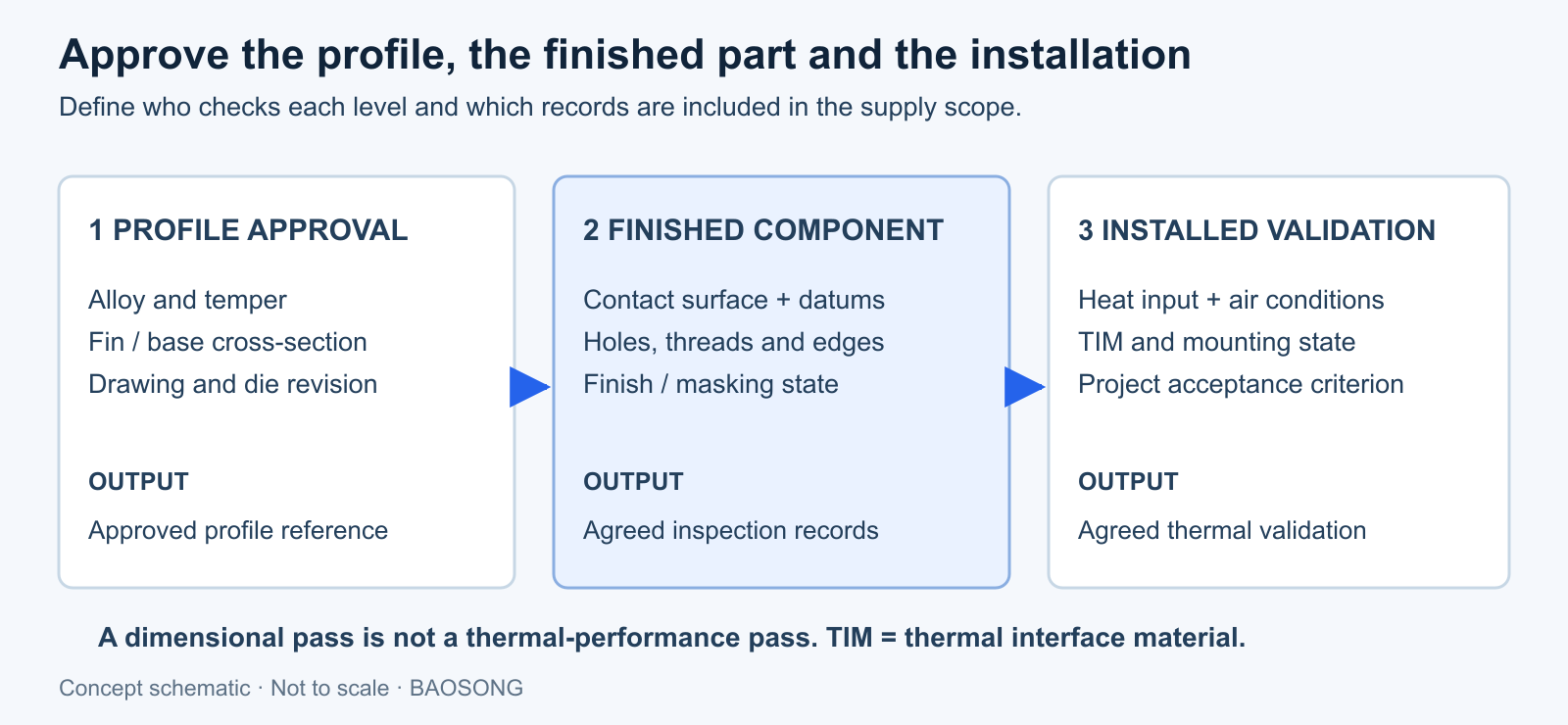
| Acceptance item | Define before manufacture | Agreed evidence |
|---|---|---|
| Alloy and material condition | Material specification, temper and required traceability. | Material documentation and lot identification where specified. |
| Extruded profile | Section geometry, length-related requirements and allowable appearance. | Trial/profile checks to the approved drawing. |
| Finished contact and mounting features | Datums, contact area, holes/threads and measurement condition. | First-article and recurring inspection records as agreed. |
| Finish and handling | Delivered coating/masking state, edge condition and protective packing. | Final-state checks and agreed packaging reference. |
| Installed cooling result | Heat input, inlet/ambient conditions, airflow or orientation, interface material, mounting and acceptance criterion. | Project-specific test or validation report from the agreed responsible party. |
Our aluminum component inspection support addresses the agreed manufacturing checks. An established customer design does not need to restart thermal development solely because a new order is placed; validation or requalification follows the drawing, project requirements and approved changes.
Two examples of how we choose the route
A recurring electronics assembly with a usable existing section
Illustrative project, not a customer case: the approved section already clears the enclosure and meets the customer’s established cooling conditions, but the mounting holes and contact face need customization. We recommend retaining that profile and defining the CNC features, final finish and inspection references. A new die is justified only if the section or profile access no longer supports the project—not simply because the component is custom.
A new enclosure that needs integrated fins and mounting rails
Illustrative project, not a customer case: separate brackets occupy space needed by the airflow path, and available profiles cannot provide the required base and rails. We recommend a custom section that integrates those continuous features, with localized CNC for end holes and interfaces. The release depends on section feasibility and finished-part approval; if the proposed fin channels are unsuitable for the installed cooling conditions, we revise the layout before committing to the die.
Why choose BAOSONG for your extrusion heat sink project?
We connect the profile decision to the component you need to install and reorder. As your custom extruded heat sink manufacturer and solution partner, BAOSONG turns your drawing, sample or requirements into a defined manufacturing proposal. The useful comparison is not a headline tolerance or an extrusion-only price: it is whether the supplier addresses the finished-part decisions below.
| Buying priority | What BAOSONG puts into the proposal | What you gain |
|---|---|---|
| Budget and supply scope | Compare existing-profile and new-die routes; distinguish tooling, finished parts, bought-in items and agreed records. | A like-for-like purchasing scope instead of an attractive but incomplete profile price. |
| Quantity and consistency | Connect order pattern to tooling arrangements, approved revisions and recurring acceptance. | A repeat-order plan tied to the accepted part. |
| Customization and process | Separate extruded features from CNC interfaces and finishing; identify the proposed operation responsibilities. | Useful integration without forcing every feature into the extrusion die. |
| Quality support | Identify the contact and mounting features that need evidence, and the delivered state in which they are checked. | Inspection information relevant to assembly and acceptance. |
| Delivery and handoff | Agree milestones, documentation, packing and the handling of changes before release. | A clearer route from approval to usable components. |
For a new or revised component, our aluminum part design review brings these decisions together. For an approved design, we focus on manufacturing conformity and quotation; proposed changes are submitted for your approval.
Questions buyers ask before placing an order
Does “custom” always mean a new extrusion die?
No. Custom length, holes, pockets or a machined contact face can be produced from an existing extrusion profile when its section is suitable and available. A new die is needed when the continuous cross-section itself must change.
Is there a universal minimum order or fin aspect ratio?
No single number covers all profiles and supply routes. For small orders, we recommend checking available-profile and machining options first; for a new die, we review the section, material and order pattern together. A quoted limit must belong to the proposed production route, not be copied from an unrelated supplier.
What should I check when sourcing extruded aluminum heat sinks from China?
Use the approved drawing and material specification as the common reference. Confirm who is responsible for extrusion, machining, finishing and final acceptance; agree document language, tooling arrangements, packaging and delivery terms before ordering. A supplier’s location alone does not establish its quality, capacity or certification.
How do I get an extruded aluminum heat sink quote?
Send your drawing, sample photo or requirements; BAOSONG will confirm the profile route, material, quantity, machining, finish and acceptance scope before issuing a formal quotation. Tooling and recurring part supply are identified separately where applicable; pricing is not calculated automatically online.
Send what you have—we will define the next manufacturing step
| What you already have | BAOSONG’s next action | What you receive |
|---|---|---|
| Approved drawing or CAD | Review the section, functional features, process sequence and acceptance requirements. | A manufacturing proposal and quotation against the approved design. |
| A sample or photos of an existing part | Confirm the geometry and material information needed; identify replication or improvement decisions. | A clear reproduction/improvement route and the information needed for quotation. |
| A sketch, package layout or cooling requirement | Recommend the profile route and identify the interface and validation decisions to resolve. | A proposed component scope and next development/quotation steps. |
| A repeat order or supplier-transfer need | Review the approved sample, revisions, tooling access and production acceptance. | A transfer/reorder plan with agreed checks and supply scope. |
You do not need to finish the entire specification before contacting us. Discuss your custom extruded aluminum heat sink project with BAOSONG. Share what is available, and we will recommend the manufacturing route and help complete the decisions needed to move it into production.