
Quick answer: what does “marine-grade aluminum” mean for a finished component?
“Marine-grade aluminum” is a convenient description, not a complete material specification. A production drawing should identify the alloy, temper, product form and governing standard, then control fabrication, welding, dissimilar-metal contact, drainage, coating and inspection for the actual saltwater exposure.
5xxx-series alloys are common starting points for welded marine plate and sheet, while selected 6xxx alloys are widely used for extruded rails, frames and machined fittings. The best choice depends on strength, section thickness, welding, forming, machining, temperature, corrosion mechanism and any class or customer requirement.
Corrosion resistance belongs to the complete assembly. Even a suitable alloy can suffer at stagnant crevices, poorly drained joints, damaged coatings, contaminated welds or direct contact with more noble metals. Resolve these details before production and verify the fabricated component rather than approving alloy chemistry alone.
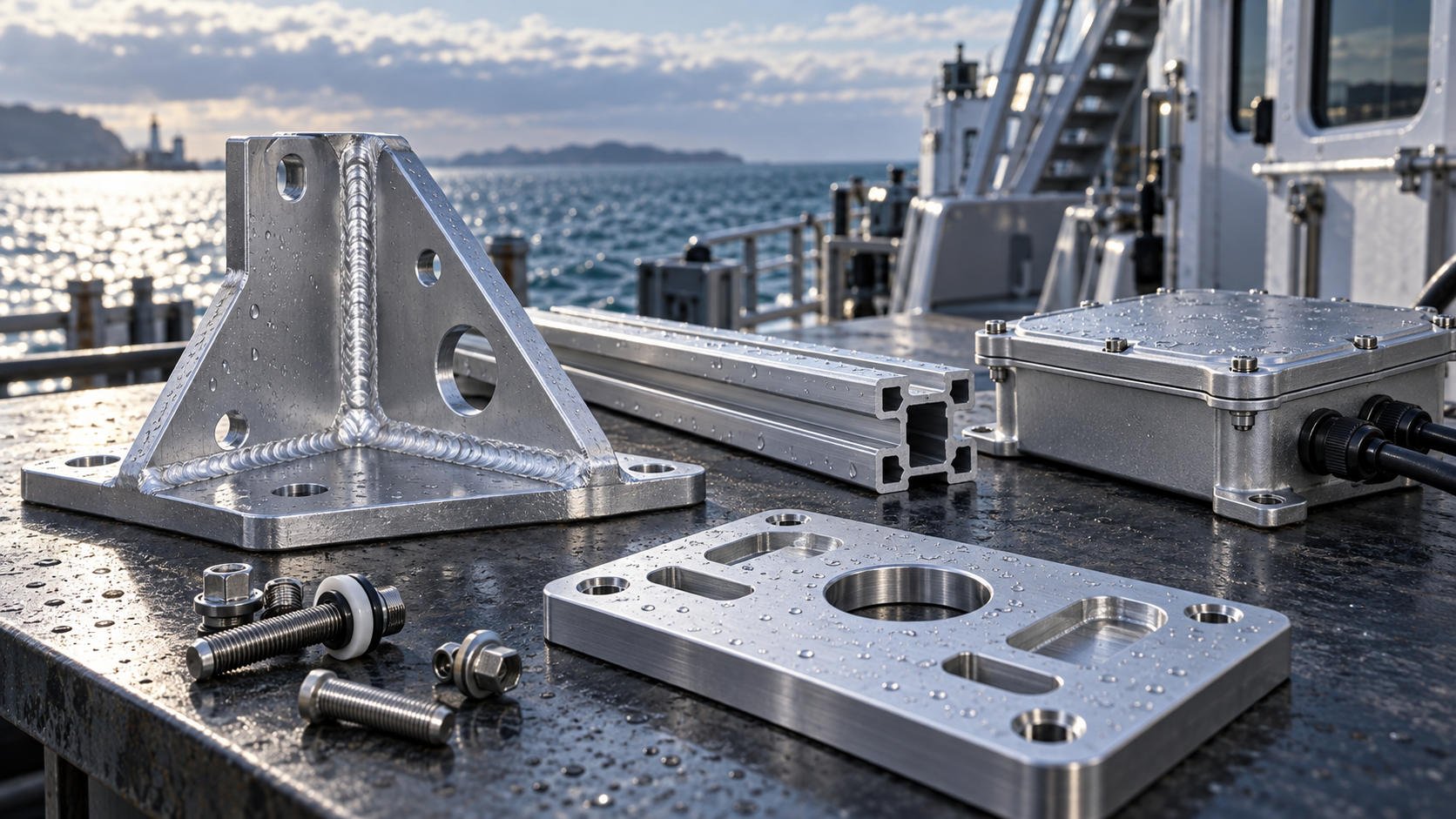
Replace the marketing term with a purchase specification
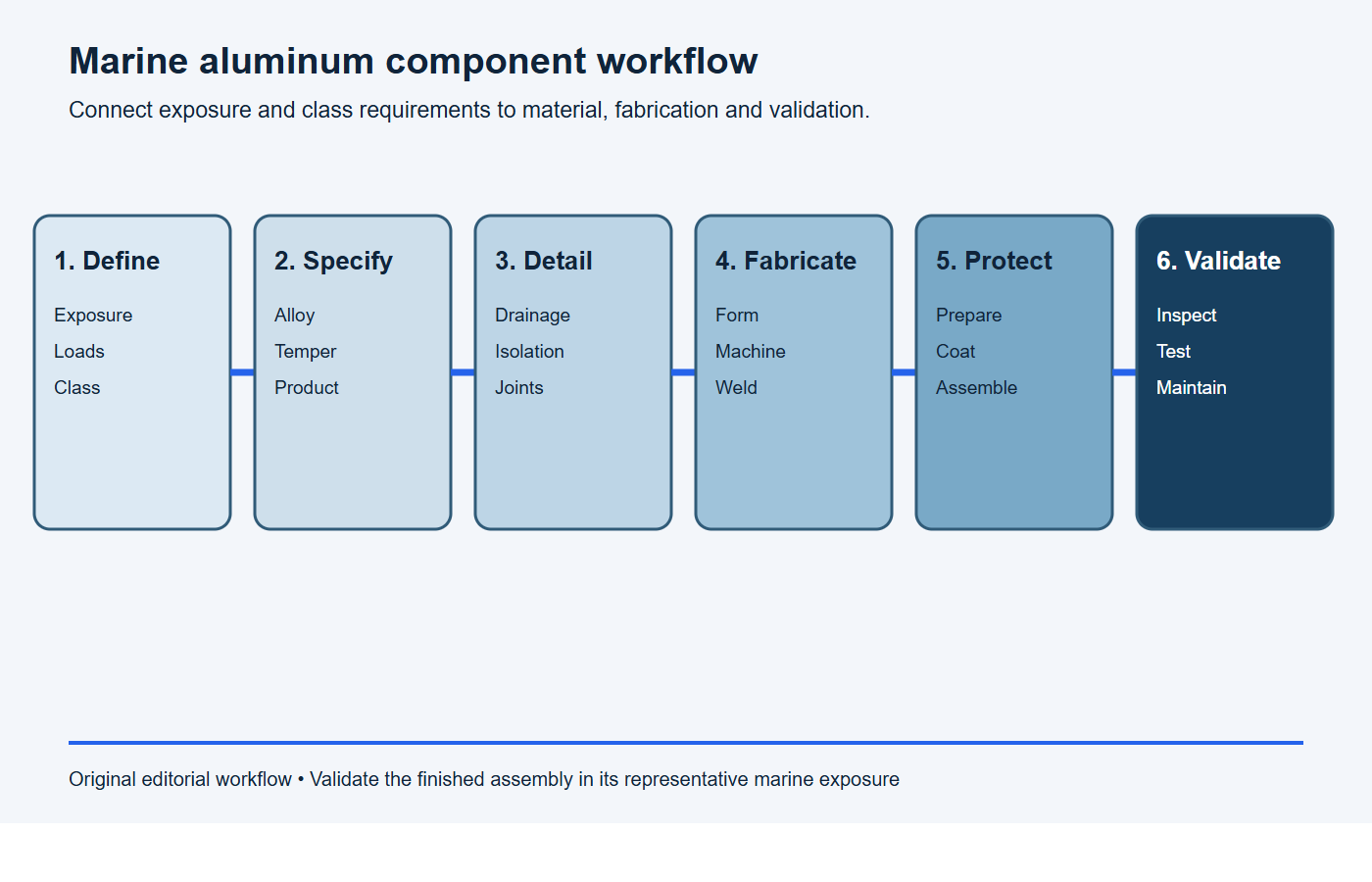
Use this sequence before selecting an alloy:
- Classify the exposure. Distinguish atmosphere, splash, tidal, immersion, bilge, enclosed condensation and cleaning chemicals.
- Define structural and regulatory inputs. Record loads, fatigue, temperature, class rules, standards and required certification.
- Select alloy, temper and product form together. Match plate, sheet, extrusion or machined stock to forming, welding, machining and final properties.
- Design the complete corrosion system. Control drainage, crevices, galvanic couples, fasteners, coatings, sealants and repair access.
- Validate the fabricated assembly. Inspect material, welds, geometry and finish, then test representative service conditions and maintainability.
The phrase “marine grade” does not identify chemistry, temper, thickness, mill-product tolerance, corrosion-testing requirement or certification. State whether the part begins as plate, sheet, extrusion, bar, forging or casting. Then cite the required material standard and edition, mechanical-property condition and documentation.
The Aluminum Association standards overview identifies 5083 as a marine application alloy and explains the broader 5xxx and 6xxx families. Its registration system also makes clear that alloy and temper designations carry defined meaning. Use mill certificates to confirm the ordered product, but do not treat a certificate as proof of a welded assembly’s performance.
Classed vessels and offshore equipment may need materials, welding procedures, fabricators and surveys accepted by a named society. The ABS Rules and Guides library demonstrates how classification connects design, construction, materials and survey. Confirm the current rule, vessel type and class notation with the owner and authority before quotation.
Compare candidate alloy families by the job they perform
| Candidate | Useful starting point | Main review |
|---|---|---|
| 5052 | Formed sheet covers, housings and moderate-strength parts | Temper, forming radius, joining and actual exposure |
| 5083 | Welded plate structures requiring marine corrosion performance | Temper, thickness, weld design and service temperature |
| 5086 | Welded marine sheet and plate structures | Product availability, specification and weld properties |
| 5754 | Formed and welded sheet components in corrosive environments | Required strength, temper and regional supply standard |
| 6061/6082 | Machined parts, extrusions, frames and fittings | Weld heat-affected zone, section form and galvanic details |
BAOSONG’s aluminum alloy selection guide for CNC machining explains how stock form and machining requirements affect a finished component. For marine work, shortlist only after the exposure, load path, welding and product form are known. Never substitute one temper because its tensile strength appears similar.
The Aluminum Association’s published comparative table notes that -H116 and -H321 tempers are used for marine applications requiring demonstrations of intergranular and exfoliation-corrosion resistance, and that an -H32 product should not simply replace them despite similar tensile properties. Put the required temper and corrosion-testing basis on the order.
Identify the corrosion mechanism, not just “salt spray”
Marine components may face atmospheric salt, splash, tidal wetting, immersion, stagnant bilge water, polluted harbor water or condensation. Each creates different oxygen, chloride, temperature and drying conditions. Define the exposure zone, design life, inspection access and cleaning practice.
Pitting attacks local areas after breakdown of the protective oxide. Crevice corrosion develops where stagnant solution forms beneath overlaps, gaskets, deposits or fastener heads. Galvanic corrosion accelerates aluminum dissolution when it is electrically connected to a more noble material in an electrolyte. Intergranular and exfoliation behavior can depend on alloy, temper and thermal history.
A salt-spray cabinet can compare certain coating or process variables, but it does not reproduce every marine mechanism or establish service life directly. Build acceptance around the governing standard, representative exposure and known failure mode. Record surface preparation and specimen geometry with results.
Design out water traps and inaccessible crevices
Orient channels, pockets and flanges so water drains. Add drain paths at true low points in every installed attitude, including vessel trim where relevant. Avoid blind cavities that trap saltwater and cannot be flushed. Keep inspection and coating access around joints.
Sealants can exclude electrolyte, but a discontinuous seal can create a tighter crevice. Define joint preparation, bead geometry, compatible primer, cure and inspection. Provide ventilation where a sealed volume would otherwise breathe humid air through uncontrolled gaps.
Round exposed edges enough for consistent coating coverage without changing functional fits. Design weld access so the fabricator can clean, shield and inspect the joint. A corrosion-aware shape often reduces maintenance more effectively than adding coating to a poorly drained detail.
Control galvanic couples and fasteners
Stainless steel, copper alloys, carbon composites and coated steel may be more noble than aluminum. In seawater, a small exposed aluminum area connected to a large noble area is particularly unfavorable. Break the electrical or electrolyte path with compatible washers, sleeves, gaskets, sealants or coatings as the design allows.
Isolation must survive assembly torque, movement, UV, temperature and maintenance. A plastic washer alone may not isolate threads or a fastener shank. Define coated contact area, edge sealing and replacement practice. Ensure required protective-earth or bonding paths remain intentional; corrosion isolation and electrical bonding must be designed together.
Choose fasteners for load, fatigue, galling, removal and corrosion compatibility. Control installation torque and joint preload. Avoid relying on threads cut into thin aluminum where repeated service can strip them; use suitable inserts or through-bolts when the load and access justify them.
Design welds around strength, distortion and corrosion
Welding changes local microstructure and mechanical properties. Heat-treatable 6xxx material loses strength in the heat-affected zone, while 5xxx products have their own temper and service constraints. Use the governing code’s welded allowables rather than parent-metal catalog values.
Develop and qualify the welding procedure for alloy, filler, thickness, joint type and position. Control oxide removal, cleaning, fit-up, shielding gas, heat input and interpass conditions. Prevent steel grinding dust, wire-brush contamination and shop debris from embedding in aluminum surfaces.
Plan weld sequence and fixtures to manage shrinkage. Do not machine precision datums before heavy welding unless the process accounts for later distortion. Machine critical faces after fabrication when practical, while preserving required wall thickness and corrosion protection. DNV’s subsea welding practice overview illustrates the role of procedure qualification, NDT, personnel and quality assurance in demanding marine fabrication.
Choose extrusion and CNC machining around geometry
Extrusion suits long rails, rub strips, frames, heat-dissipating housings and repeated channels. It can integrate screw ports, gasket lands and cable features, but deep hollows, uneven walls and tight tolerances need early review. Consult BAOSONG’s custom extrusion guide and extrusion tolerance guide.
CNC machining establishes bearing bores, seal faces, connector openings and assembly datums. Avoid machining away protective cladding or a required corrosion-resistant surface without design approval. Remove burrs that damage seals or concentrate coating loss, and specify surface roughness only where it affects function.
For repeated profiles with local precision, extrusion plus CNC machining can reduce material removal. The drawing should separate as-extruded features from machined features and state the final inspection condition.
Use coatings and anodizing with realistic expectations
Aluminum’s natural oxide supports corrosion resistance, but severe exposure, crevices and galvanic couples may require a coating system. Surface preparation determines adhesion and durability. Specify cleaning, conversion treatment or anodizing, primer, topcoat, film thickness, edge treatment, holidays and repair procedure as applicable.
Anodizing can provide wear and corrosion benefits for many components, but welded structures, electrical contacts and long assemblies need special review. Mask threads, bearing fits, grounding lands and sealing faces where required. BAOSONG’s anodizing page and surface-finishing overview support early selection.
Do not specify appearance alone. Define the marine exposure, substrate preparation, coating system and validation method. Protect finished components during storage and shipping; trapped moisture beneath packaging can damage an otherwise acceptable finish.
Inspection must follow the risk and fabrication route
| Evidence | Verify | Typical record |
|---|---|---|
| Material | Alloy, temper, product, heat and specified corrosion condition | Mill certificate and traceability map |
| Welding | Procedure, welder, fit-up, visual and required NDT | WPS/PQR, logs and inspection report |
| Dimensions | Datums, machined fits, flatness and final assembly | First article and calibrated results |
| Finish | Preparation, thickness, coverage, holidays and masking | Process certificate and test results |
| Assembly | Isolation, sealant, drainage, torque and bonding | Traveler, photographs and final test |
Use ASME Y14.5-2018 (R2024) where that GD&T system is invoked. Retain measurement uncertainty and setup; NIST’s discussion of dimensional calibration uncertainty supports defensible acceptance decisions.
Validate the finished assembly in representative service
Inspect drainage, isolation, coating continuity and fastener installation on the completed assembly. Test structural loads, vibration, sealing or ingress, thermal cycling and corrosion exposure as required by the product specification. Reinspect welds, joints and interfaces after environmental or fatigue tests.
Correlate accelerated tests with service inspection rather than converting test hours directly into years. Establish accessible inspection points and a maintenance plan for coating damage, anodes where used, sealants and fasteners. Feed field findings back into drawing revisions and process controls.
Packaging is part of corrosion control. Ship clean, dry components with separators that do not abrade the finish or trap moisture against aluminum. Keep stainless hardware and machining debris from moving across coated surfaces. Define storage humidity, maximum packaged duration and inspection after ocean freight. For assemblies delivered with protective film or desiccant, specify removal and replacement instructions so temporary protection does not become a crevice or contaminate later bonding and sealing operations.
RFQ checklist for marine aluminum components
Paste this scope into the RFQ and attach the controlled drawing, exposure definition, load cases and applicable class or customer requirements.
RFQ scope: Please quote [component part number and revision] for [prototype quantity] and [annual volume]. Service exposure is [atmosphere, splash, tidal, immersion or condensation], with [temperature, loads and fatigue duty]. Required alloy, temper, product form, material standard, welding and finish are [requirements]. Quote the proposed manufacturing route, joints, corrosion controls, tooling, unit price, lead time and capacity. List every assumption and deviation.
Required evidence: Provide material certificates, heat and lot traceability, weld procedure and personnel records where required, dimensional and NDT results, finish and repair records, galvanic-isolation verification, first-article documentation, packaging controls and change-notification triggers. Identify class approval and complete-assembly validation outside the supplier scope.
- Service zone: atmosphere, splash, tidal, immersion or enclosed condensation.
- Applicable class rules, standards, editions and survey requirements.
- Alloy, temper, product form, thickness and material certification.
- Structural loads, fatigue, vibration and service temperature.
- Welding code, procedure qualification, filler and NDT requirements.
- Dissimilar metals, electrical bonding and isolation details.
- Drainage, sealant, gasket, fastener and maintenance access.
- Surface preparation, coating or anodizing, masking and repair.
- Critical datums, inspection setup and traceability.
- Prototype and production quantities, packaging and validation plan.
Stop conditions: the marine aluminum component is not ready for release
Pause tooling or production release if any condition below remains unresolved.
- “marine grade” appears without alloy, temper, product form and governing standard;
- the exposure zone, electrolyte, service temperature or cleaning chemistry is undefined;
- loads, fatigue, weld condition or class requirements are missing;
- water traps, crevices or inaccessible joints remain in the design;
- stainless, copper, carbon or coated-steel contacts lack galvanic-isolation details;
- welding filler, procedure qualification, distortion and NDT requirements are unresolved;
- coating or anodizing lacks surface preparation, thickness, masking and repair instructions;
- material chemistry alone is being treated as proof of finished-assembly corrosion performance.
Frequently asked questions
Is 6061 marine-grade aluminum?
6061 is used for many marine frames, extrusions and machined components, but the word “marine-grade” does not prove suitability. Check temper, product form, weld condition, exposure, galvanic contacts and governing rules.
Is 5083 always better than 5052?
No. 5083 is common for higher-strength welded marine plate structures; 5052 can suit formed sheet components. Geometry, temper, joining, strength and certification determine the better choice.
Can stainless fasteners be used in aluminum?
They are commonly used, but the galvanic couple needs design control. Consider exposed area ratio, electrolyte, isolation, sealant, coating, drainage, preload and maintenance.
Does anodizing make aluminum seawater-proof?
No. Anodizing can improve surface performance, but damage, crevices, cut edges and galvanic contacts still matter. Qualify the complete finish and assembly for the actual exposure.
Request a marine aluminum manufacturing review
BAOSONG supports aluminum extrusion, machining and finishing. Send the controlled drawing, exposure, class requirements, material specification, loads, welding and finish requirements, inspection plan and quantities through the contact page for manufacturability and quotation review.
Recommended Downloads for Aluminum Alloy Selection
Use these BAOSONG references to compare alloy families, temper conditions, machinability, strength, corrosion resistance and design implications before quotation.
- Aluminum Alloy Comparison Chart (editable Excel)
- Tolerance Reference Guide (PDF)
- Aluminum CNC Machining Design Guide (PDF)
- Aluminum Part Design Checklist (editable Excel)
Need help choosing an alloy or temper for your application? Contact BAOSONG Precision.