
Quick answer: custom aluminum servo motor housings
BAOSONG manufactures a servo motor housing with the stator, bearing system and feedback interfaces planned as one mechanical chain. We recommend integral CNC machining for compact changing layouts and suitable repeat orders. Stable repeated sections can use extrusion with machined functional features; integrated stable bodies can justify a cast blank with critical interfaces finish-machined.
An aluminum servo motor housing provides a lightweight structure and a practical heat-conduction path while carrying precise mounting features. We coordinate the stator seat, bearing references, end-bell location, encoder and brake space, connector openings and finished surface zones. The proposal defines which component features are inspected and which assembled motor results require separate confirmation.
Send your housing drawing, motor outline, sample photo or fit and temperature problem. We will recommend the construction, interface priorities and quotation scope. Request your custom servo motor housing proposal.
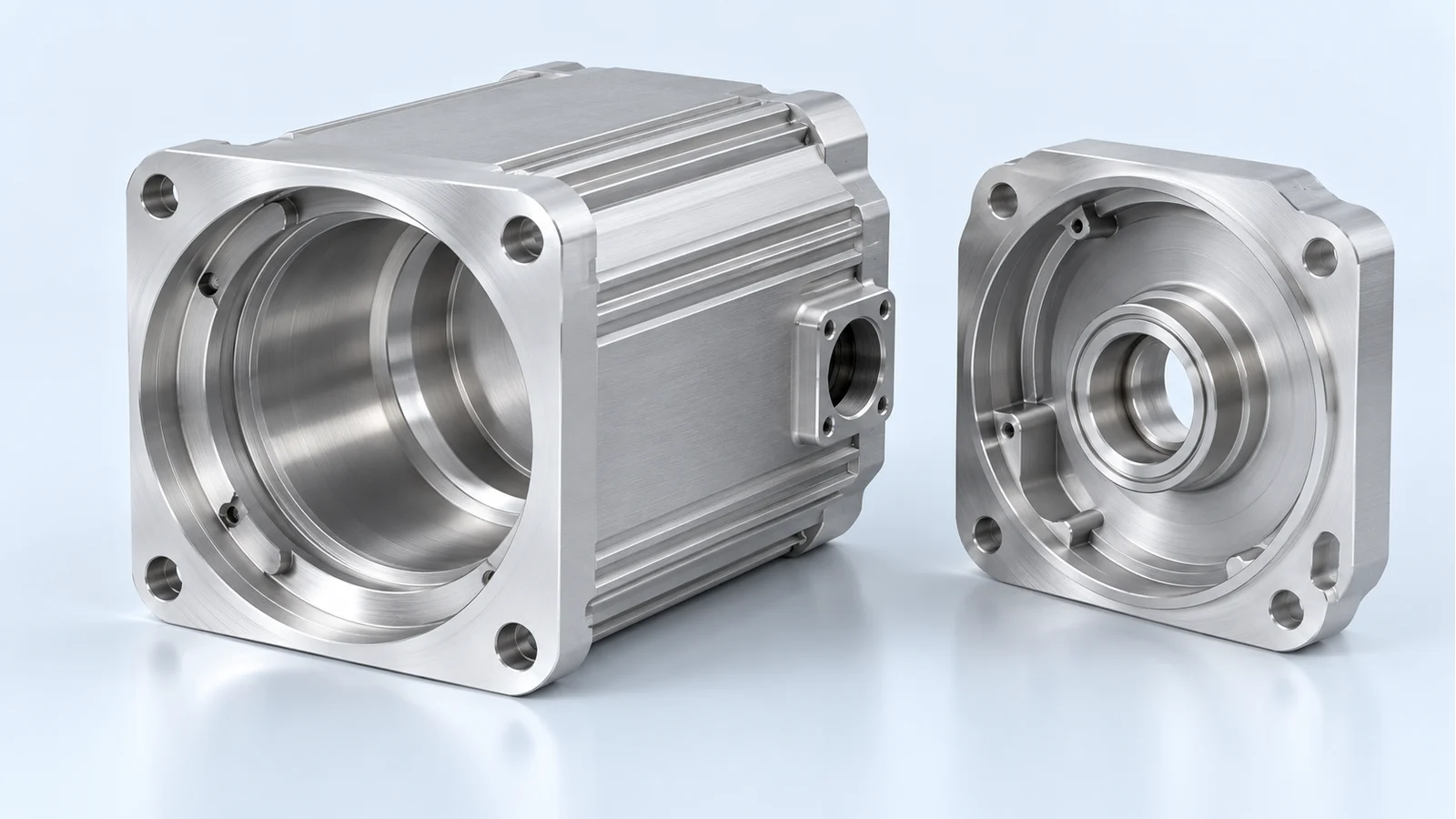
At a glance: select the housing around the motor stack
| Project condition | BAOSONG recommendation | Decision to settle |
|---|---|---|
| Motor or feedback layout is changing | Use an accessible CNC-machined body and end interface. | Selected motor outline and functional reference chain. |
| The motor body has a stable constant section | Compare extrusion plus machined seats, pilots and openings. | Profile allowance and completed interface geometry. |
| Stable geometry integrates several functions | Compare a cast blank with machined functional zones. | Tooling exposure, blank quality and critical allowances. |
| Assembly or service needs rear access | Use a positively located end-bell or feedback cover. | Added locating stack, seal and removal sequence. |
| Approved housing design is ready | Proceed directly to manufacturing review and quotation. | Finished state, representative first article and acceptance. |
What the servo housing must bring together
A precision motor housing for a servo application must relate its mechanical interfaces to the selected motor and feedback architecture. A robot servo housing may sit inside a joint assembly, but the motor body and the joint’s complete structural carrier have different functions. BAOSONG supplies the custom housing body, agreed end-bells and related mechanical housing components to their defined scope.
Our aluminum components for robotics and automation cover several positions in that assembly. For broader blank and feature planning, see our general aluminum motor-housing guide. This article focuses on the compact servo stack: stator, bearings, feedback, brake and their connected references. A bare housing is not a rated motor, drive or completed robot joint.
Build the functional chain before assigning tolerances
Identify what locates the stator, what establishes the rotor’s bearing axis and how the front and rear interfaces connect to those references. Include a separate end-bell wherever the architecture uses one. Then add encoder locating and adjustment, brake mounting, shaft shoulders and cable or connector space. An outside cosmetic surface need not control the entire stack.
BAOSONG translates that layout into a critical-feature map. It distinguishes bore diameter and form from the orientation and position between interfaces. A tight diameter can still leave the motor components incorrectly related. We concentrate machining and inspection on the actual function instead of tightening every drawing dimension equally.
Kollmorgen’s frameless motor installation guidance connects bearing-system stiffness and the model-specific outline requirements to maintaining rotor-to-stator clearance. Use the selected motor drawing and operating conditions for that relationship; a generic supplier’s machining tolerance is not a substitute.
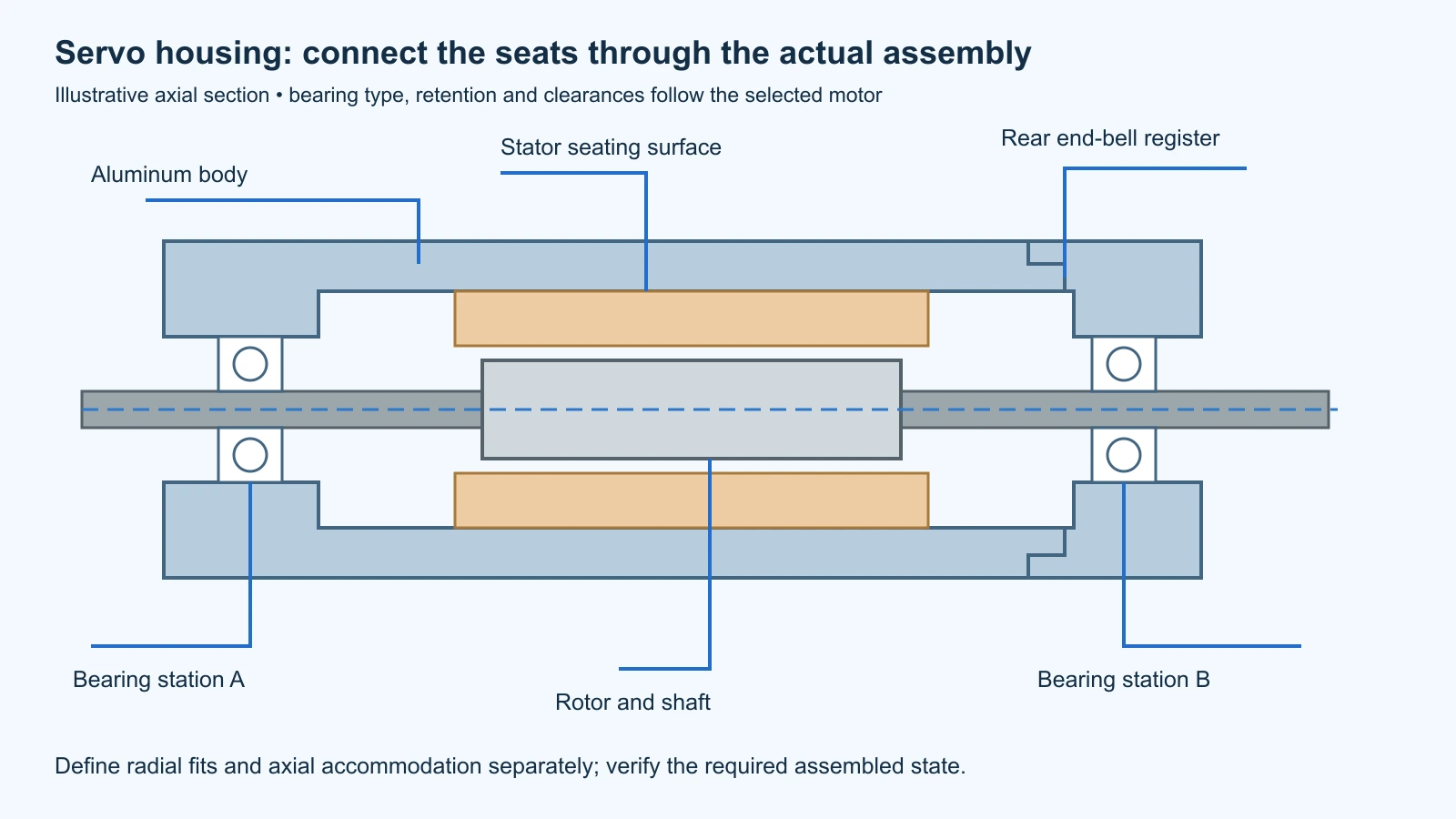
Set the bearing fit, axial location and thermal allowance together
We start with the bearing designation and arrangement, then define the housing seat. A bearing seat fit must reflect ring loading, housing support, material and temperature—not a generic H7 note copied from another motor. SKF’s shaft and housing fit guidance identifies these selection factors. We turn the selected fit into bore size, form, shoulder and inspection requirements that can be manufactured consistently.
Distinguish the fit between the outer ring and housing from the internal clearance or specified preload of the bearing. Tightening a seat indiscriminately can create a different problem inside the bearing; NSK explains how mounting and operating conditions change internal clearance. Our review checks the cold assembly and operating conditions before recommending a seat change. For an aluminum housing and steel ring, unequal thermal expansion and actual component temperatures must be included; room-temperature fit alone is insufficient.
| Decision | BAOSONG recommendation | Drawing or acceptance output |
|---|---|---|
| Radial seat and ring support | Use the bearing supplier’s application-based fit; preserve support around the seat instead of thinning it with an adjacent pocket. | Bore size/form, supported width and relation to the motor references. |
| Axial location and growth | Identify the locating and non-locating bearing functions, or the approved preloaded arrangement, before setting shoulders and retainers. | Axial stack, retention features and the intended accommodation path. |
| End-bell installation | Locate the end-bell on its register and seating face; do not use clearance screws as the alignment reference. | Pilot relationship, face condition and defined assembled inspection state. |
| Frequent bearing replacement | Provide extraction access; evaluate a replaceable seat insert only when wear, repair or fit control justifies its extra interface. | Service sequence; if used, insert retention and finished seat acceptance. |
For a locating/non-locating arrangement, preserve the specified axial accommodation; depending on bearing design it may occur at a ring seat or inside the bearing. Do not trap an intended moving ring between two shoulders. A deliberately preloaded design follows its own bearing arrangement and assembly procedure. BAOSONG carries that choice into the end-bell and retainer geometry, then identifies which dimensions are checked before and after assembly.
A bearing fits cold but becomes noisy or loose in operation? Send the bearing designation, housing section and observed temperatures or symptoms. Ask BAOSONG for a housing-interface review. We will focus the proposal on the seat, support, axial stack and delivered finish that can change the result.
Locate and retain the stator with an assembly method that fits
Start with the motor supplier’s allowed stator mounting methods and dimensions. Compare a defined clamped arrangement, an approved bonded interface or another specified retention method with torque reaction, heat transfer, installation and removal. A fit selected only for easy room-temperature assembly may not provide the required behavior over the operating range.
For a clamped construction, we propose accessible retention and a positive locating shoulder where the design requires it. For bonding, define the adhesive, gap, preparation, cure and inspection with the responsible motor design. A thermal assembly fit requires its own material and temperature review. We manufacture the interfaces to the accepted method rather than using the same press fit for every stator.
Kollmorgen’s clamping and bolting examples demonstrate one serviceable approach for specified motor families. Their example clearances and frame-size conditions must not become universal servo housing dimensions.
Why choose aluminum for the servo housing?
Aluminum supports low moving mass and machining of the compact seats, shoulders, ports and mounting faces. It can carry heat from a properly integrated stator toward the surrounding structure or cooling interface. External fins or a repeated hollow profile can be incorporated when they suit the actual heat-rejection arrangement.
For a compact body machined from solid, 6061 in a specified T6 or suitable stress-relieved stock condition is a practical initial candidate. We confirm the exact product form, machining removal and finished-interface requirements before release. For a repeated finned or hollow extrusion, we also evaluate 6063-T5 or T6 where the structural loads permit. Hydro’s 6063 guidance supports its extrusion and finish advantages while identifying cases that favor other alloys.
The material choice follows the housing’s job: a heavily loaded mounting flange may change the alloy, section or local support; a stable finned shell may favor extrusion. BAOSONG compares those choices with retention, heat contact, environment and finishing. A different alloy is not a substitute for correcting a weak bearing support or an interrupted heat path.
Reserve encoder, brake and connector space
The encoder mounting surface must match the chosen device’s locating and adjustment requirements. Distinguish the rotating reference from the stationary readhead or housing reference, and keep access for setting, connecting and servicing the device. A generic encoder pocket does not establish an installed feedback accuracy.
Define the brake and shaft axial stack from the actual device drawings. Specify whether the selected device is intended for holding, dynamic stopping or another defined duty. Its mounting, clearances, operating conditions and application verification follow the selected design. We coordinate the housing space and references without assigning a braking or safety rating to the component.
Review connector installation, cable bending space and strain relief alongside the rear cover and fasteners. We propose a removable rear section when it gives useful service access, with a defined pilot or locating scheme so removal does not leave the assembly position to bolt clearance.
Choose the blank process separately from the end-bell layout
| Route and fit | Benefit and tradeoff | Selection / verification |
|---|---|---|
| Integral CNC-machined body | Flexible stator, end and connector geometry; cutting access and material removal need planning. | Recommended for changing compact layouts or suitable recurring orders. Check the finished reference chain. |
| Extrusion plus CNC | Useful for a repeated section with cooling features; seats and end relations still require machining. | Select when profile geometry is stable. Define allowance and completed functional interfaces. |
| Cast blank plus machining | Integrates suitable walls, bosses and ribs; adds tooling and internal-quality requirements. | Compare for stable geometry and order economics. Verify blank quality and machined acceptance. |
Separate end-bells can work with any of these blank routes. We recommend a located removable end when it provides the assembly path for the rotor/bearings or practical feedback access. The housing pilot, end-bell register, seating face and retention then form a controlled assembly. An integral end is useful when it simplifies that relationship without obstructing installation or inspection. Neither architecture removes the need to verify the final bearing and stator references.
Our precision aluminum CNC machining connects the blank to the working features. CNC machining can remain the repeat-production route. A process change is worthwhile when it improves the accepted housing result, including finishing and inspection, rather than merely reducing the unfinished blank price.
Carry the references through machining and finishing
Plan the stator seat, bearing or end-bell pilots and mounting face through a controlled locating sequence. Where opposite-end access requires another setup, define how the functional references are transferred. Thin sections need support that limits cutting movement without forcing a distorted housing into an apparently acceptable position.
Separate locating fits from heat-transfer contact, electrical ground, sealing and visible finish zones. Specify masking or subsequent machining where a coating would change the required condition. Our aluminum surface-finishing planning makes those differences explicit before the component is coated.
Review end-bell seating and the specified fastener sequence before accepting the assembled bore relationship. Preserve the ground path required by the motor system rather than coating all contact surfaces alike. Electrical continuity and the final motor setup require their agreed verification in addition to the bare component record.
Agree the accepted support, temperature and assembly state. A bearing seat measured in a free body and the same seat after the end-bell is secured can answer different questions. We identify the relevant checks and records rather than treating one isolated bore reading as proof of the complete motor geometry.
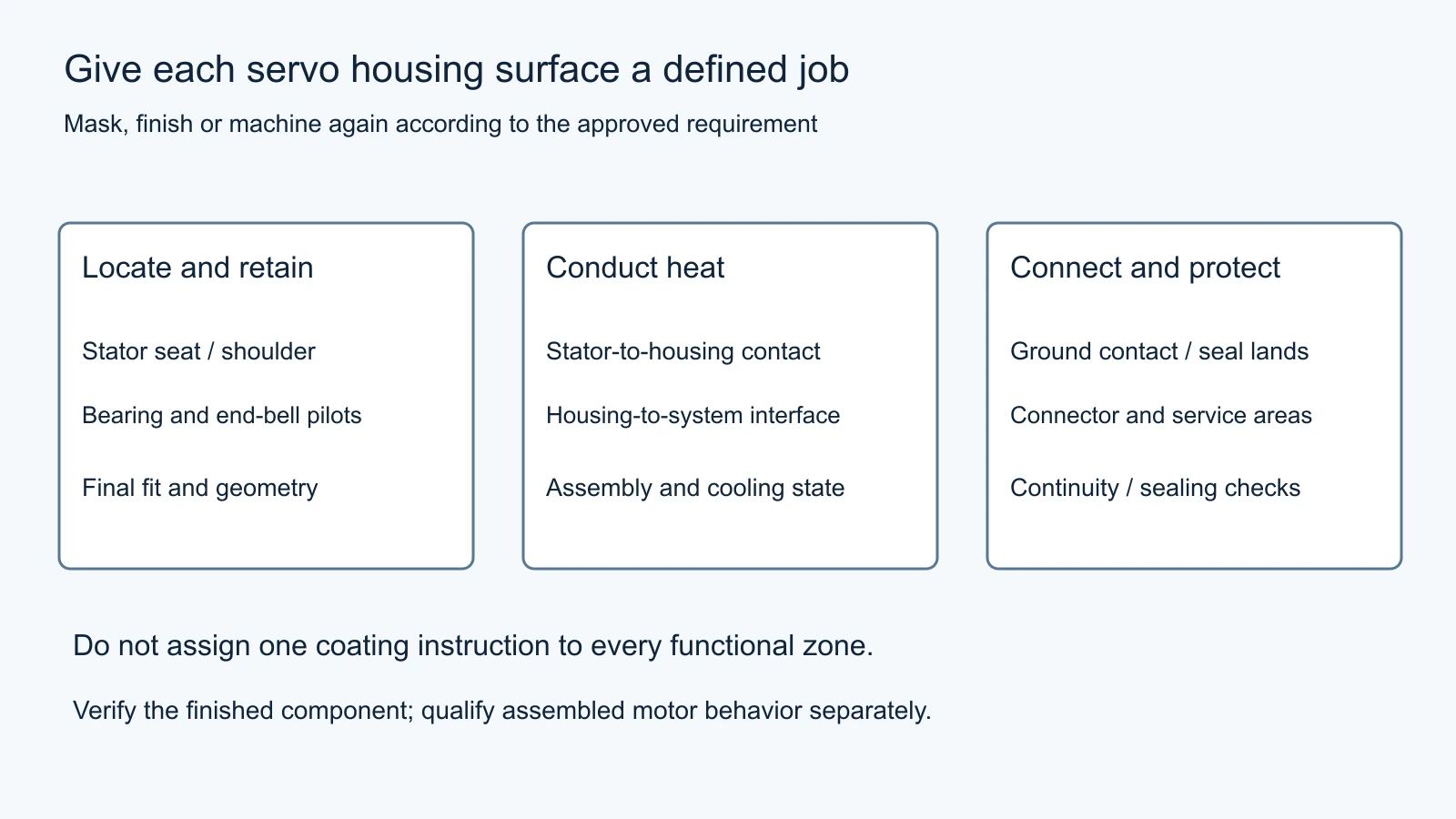
How BAOSONG resolves servo housing problems
| Problem | BAOSONG action | What you receive |
|---|---|---|
| Stator and bearing features pass separately but do not align | Review their common references and end-bell locating chain. | A critical-feature map and matching inspection plan. |
| Assembly fit changes with temperature | Review material pair, retention method and operating conditions. | A manufacturing definition for the approved fit. |
| Rear service access disturbs feedback location | Separate cover retention from device location where practical. | A located, serviceable rear-interface proposal. |
| A finish interrupts ground or thermal contact | Zone coating and final machining by surface function. | A clear finished-condition requirement. |
| Tightening an end-bell changes the measured shape | Review support, seating, fasteners and stated inspection state. | A relevant component and assembly check sequence. |
Specify what the housing evidence must demonstrate
Our component inspection planning links the drawing to methods, conditions and records. The supplied housing needs dimensional and material evidence appropriate to its requirements. Motor temperature rise, feedback performance, vibration and ingress protection belong to the defined assembled configuration and test plan.
| Requirement | Condition / record | Separate confirmation |
|---|---|---|
| Stator and bearing reference relationship | Functional datums, form and position in the specified finished state. | Actual rotor and bearing-system running clearance. |
| Bearing seat and axial arrangement | Selected bearing, finished fit, shoulder/retainer geometry and specified assembly temperature/state. | Required axial accommodation or approved preload and operating bearing behavior. |
| End-bell, brake and feedback interfaces | Selected device drawings, axial stack, seating and assembly condition. | Installed feedback, brake and motion behavior. |
| Retention and heat path | Approved mounting method, contact zones and supplied material condition. | Motor loading, temperatures and cooling arrangement. |
| Ground and sealing zones | Defined bare/contact surfaces, connector and seal requirements. | Electrical verification and assembled environmental testing. |
| Repeat component supply | Intended blank, machining, finish and inspection revision. | Representative first article and approved change baseline. |
Two practical starting points for servo OEMs
Illustrative compact motor package. A team has selected a motor kit and feedback device but is changing its rear connector layout. We recommend a machined body with an accessible rear section. Our proposal fixes the stator and bearing reference chain while preserving adjustment and service space for the chosen encoder.
Illustrative recurring motor family. Several accepted models share one external section but use different machined end features. We compare an extruded blank with the current body route, including stator seating, end-bell pilots, finishing and accepted dimensional relationships. The alternative proceeds through the agreed confirmation and change approval.
Keep the servo housing baseline consistent in volume supply
High-volume servo motor housing supply starts with the intended material condition, blank, locating sequence and final surface zones. A representative first article uses that route. Servo motor housing mass production must preserve the functional relationships and documented inspection condition, not just the outside dimensions.
BAOSONG reviews changes to the blank, stator retention, end-bell pilots, coating and inspection fixture against their effects on fit, heat and alignment. Approved drawings can proceed directly to manufacturing and quotation review; a transfer project receives a defined first-article and repeat-order proposal.
Why choose BAOSONG for servo motor housings?
| Your priority | BAOSONG action | What you receive |
|---|---|---|
| Connected mechanical references | Coordinate stator, bearing, end-bell and device interfaces. | A usable critical-feature and datum map. |
| A compact manufacturable construction | Compare access, blank, retention and service needs. | A recommended housing route with tradeoffs. |
| A finished part ready for integration | Define fit, heat, ground and seal zones together. | A delivered-state and inspection proposal. |
| Repeatable OEM supply | Establish representative first article and controlled changes. | An accepted component and process baseline. |
Request a servo motor housing quote
BAOSONG provides a formal quotation after reviewing your housing drawing or requirements, motor and device interfaces, material, finish, quantity and inspection scope. Send your current information; we will identify the remaining conditions needed for a clear proposal.
Frequently asked questions
What should I compare when sourcing a servo housing from China?
Compare the same drawing revision, included end-bells, material condition, retention method and final surface zones. Agree the functional references, measurement state and first-article records. A bare shell quote and a finished housing assembly are different scopes.
Can BAOSONG make a replacement end-bell from a sample?
Yes. Send the sample, motor identification and mating housing and bearing information you have. We separate intended geometry from wear or previous repair, establish the register and bearing relationships, and propose the replacement drawing and acceptance scope. A worn bore is evidence to investigate, not automatically the nominal dimension to reproduce.
When is a steel bearing-seat insert useful?
Consider it for repeated service, seat wear or a thermal-fit problem that the direct aluminum seat cannot satisfactorily address. We first compare it with correcting the original support and fit. An insert adds its own retention, wall thickness, thermal interface and machining sequence; the proposal must control those relationships rather than simply adding a sleeve.
Can one housing section serve different motor lengths?
A common extruded section can be useful when the stator diameter, mounting envelope and cooling concept remain compatible. BAOSONG compares the cut lengths and machined end variants, while retaining separate axial stacks, device locations and acceptance requirements for each model. A shared profile does not make the completed housings interchangeable.
Start with the housing drawing or motor layout
| What you have | BAOSONG next action | What you receive |
|---|---|---|
| Approved housing drawing | Review functional machining, finish and acceptance directly. | A drawing-based quote and stated deviations. |
| Motor kit and device outlines | Recommend body/end-bell split and critical references. | A manufacturable integration proposal. |
| Existing fit or temperature issue | Review retention, contact zones and measured condition. | A targeted component improvement plan. |
| Transfer or recurring demand | Compare the accepted configuration and intended route. | A first-article and supply proposal. |
Discuss your custom aluminum servo motor housing with BAOSONG. Send a drawing, sample photo, layout or brief description of the problem.