
Quick answer: should you choose clear or black anodized aluminum?
Choose clear anodizing when you want the aluminum’s natural metallic character to remain visible and the product does not require a dark color. Choose black anodizing when a controlled dark appearance, lower visual reflectance or product color integration is part of the requirement. Both can provide protective anodic oxide coatings when the same suitable process, coating thickness and sealing requirements are specified.
Color alone does not determine hardness, corrosion performance or coating thickness. Clear and black finishes may use the same base anodizing process, while the black result adds a coloring stage or uses another qualified coloring method. A black part is not automatically hard anodized, and a clear part is not automatically a thinner or lower-performing finish.
The final choice should include alloy and temper, original surface texture, pretreatment, anodizing type, coloring method, sealing, finished dimensions, masking, appearance limits and verification tests. For matched assemblies, approve production-representative samples rather than relying only on the words “clear” and “black.”
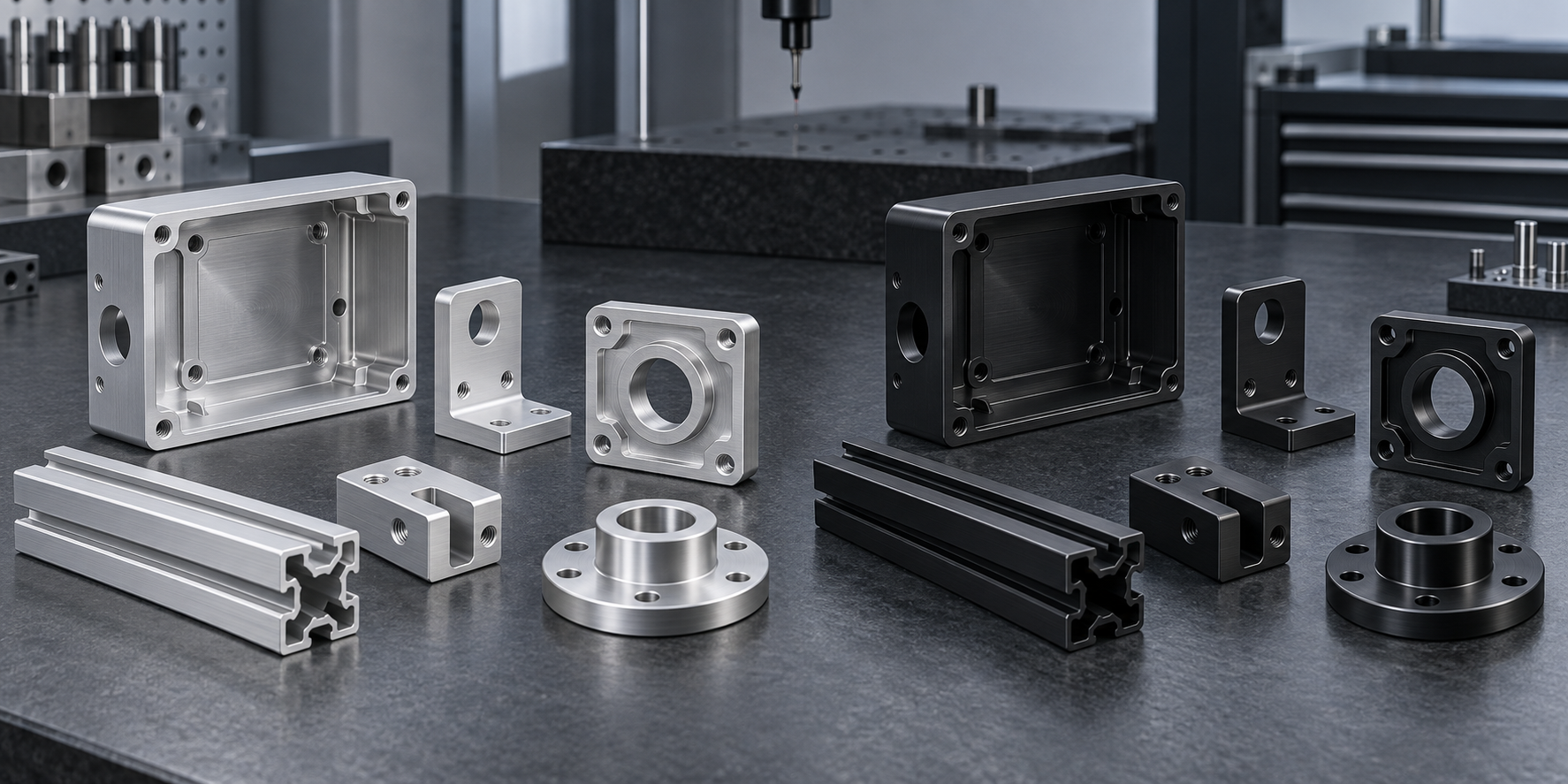
Use this four-step clear-versus-black decision
- Separate color from performance: define corrosion, wear, sealing and thickness before choosing clear or black.
- Control the substrate: fix alloy, temper, product form, machining direction and surface preparation for cosmetic parts.
- Map functional surfaces: identify fits, threads, grounding pads, thermal contacts, seals, masking and rack locations.
- Approve a real sample: compare production-representative parts under agreed lighting, viewing distance and lot criteria.
What is the actual process difference?
Anodizing converts the aluminum surface into an anodic oxide coating through a controlled electrochemical process. The porous coating can then be left substantially uncolored, colored by an additional method and sealed when the specification requires it.
Clear anodizing usually refers to an uncolored transparent or translucent anodic coating. It reveals the silver-gray character of the alloy and the texture produced by extrusion, machining, brushing, blasting, polishing or chemical pretreatment. “Clear” therefore does not mean optically invisible or identical to bare aluminum.
Black anodizing describes the visible result rather than one unique process. Black can be produced through absorbed dyes, electrolytic deposition, integral-color processes or a qualified proprietary system. The Aluminum Anodizers Council specification bulletin distinguishes uncolored, impregnated, integral and electrolytically deposited coloring methods. The drawing should name the required system when colorfastness or qualification depends on it.
| Decision factor | Clear anodized aluminum | Black anodized aluminum | What to specify |
|---|---|---|---|
| Visual result | Natural silver-gray metallic appearance remains visible | Dark appearance; metallic character can remain visible | Color target, gloss, texture and approved sample |
| Coloring step | Normally no added color | Requires a defined coloring method or qualified system | Dye, electrolytic, integral or project-approved method |
| Substrate visibility | Readily shows alloy, grain, machining and pretreatment | Dark color can reduce some visual contrast but does not hide all variation | Alloy, lot control, cosmetic surfaces and preparation |
| Protective performance | Governed by anodizing type, thickness, sealing and substrate | Governed by anodizing type, thickness, sealing and substrate | Performance class and test methods, independent of color |
| Dimensions | Oxide formation changes finished dimensions | Oxide formation changes finished dimensions | Post-finish dimensions, masking and measurement method |
| Color consistency | Tone varies with alloy and surface preparation | Shade and depth also depend on color uptake and processing | Acceptable range, comparison method and lot strategy |
Does black anodizing provide better protection?
Not solely because it is black. Corrosion and abrasion performance depend on the anodic coating specification, coating thickness, sealing condition, alloy, pretreatment and exposure. Two black parts can use different anodizing types or coloring systems and perform differently. A clear and black part made to equivalent protective requirements can have similar underlying performance even though their appearance differs.
The Aluminum Anodizers Council’s specification guide compares common anodizing systems and explains why process type, class, thickness and purchaser requirements must be stated. ASTM B580-25 covers porous anodic oxide coatings where appearance, abrasion resistance, electrical properties and corrosion protection are important.
Hard anodizing is a separate engineering choice intended primarily for demanding wear or abrasion requirements. It can be natural, gray, dark or colored depending on alloy and process. Do not write “black hard anodize” when the real requirement is only a decorative black finish, and do not assume a black appearance proves that hard anodizing was used.
Alloy and surface preparation control the final appearance
Anodic oxide is transparent or translucent enough for the substrate to influence the visual result. The AAC notes that alloy and temper affect both strength and anodized appearance, and that different alloy series can respond differently under otherwise similar processing. Extruded, rolled, machined, welded and cast surfaces may therefore finish differently.
Clear anodizing makes those substrate differences easier to see because there is no dark coloring step. Black can reduce the visual contrast of some marks, but it is not an opaque paint. Tool paths, extrusion lines, weld zones, polishing transitions and inconsistent blasting can remain visible.
Define the mechanical and chemical preparation: as-machined, brushed, blasted, polished, satin etched or another approved state. Our 6061 vs 6063 aluminum guide explains why alloy and product form belong in the finish decision. A sample made from a different alloy, stock form or preparation cannot reliably approve the final product.
Color consistency requires a controlled comparison
Clear-anodized parts may vary from bright silver to gray or another alloy-influenced tone. Black-anodized parts can vary in depth, undertone and gloss because of oxide structure, color uptake, bath conditions, sealing, alloy and surface preparation. “Jet black” or “natural” is not enough for a tightly matched product family.
Define appearance-critical surfaces and which parts must match when assembled. Agree on a reference sample, viewing direction, lighting, distance and permitted range. If components come from different material lots, processes or suppliers, acknowledge the increased matching risk before production.
For a repeat program, store an approved physical standard appropriately and set a replacement method as it ages. Use instrumental color or gloss measurements only when the method, geometry, calibration and acceptance range are defined. A single digital color code does not describe metallic anodized appearance by itself.
How anodizing affects dimensions, threads and fits
Oxide formation consumes part of the original aluminum and grows outward from the original surface. The relationship varies with the anodizing process, alloy and conditions; a universal “half in, half out” rule should not be used as a guaranteed allowance. Critical dimensions should be specified in their required finished state.
Review bearing seats, sliding fits, sealing faces, threads, dowel holes and electrical contacts before finishing. Decide which regions are anodized, masked, plugged, mechanically restored or machined afterward. The decision should follow function, not a general rule that all threads or holes are treated alike.
ASTM B244-09(2021) covers eddy-current measurement of nonconductive coatings on nonmagnetic basis metals and notes the importance of matching substrate conductivity to the calibration reference. The inspection plan should state where and how coating thickness is measured.
Coordinate the finish with the CNC machining datum strategy. A finished mating surface may need a different control method from a non-critical cosmetic wall.
Sealing and coloring must be specified separately
Many decorative and protective porous anodic coatings are sealed to reduce absorption and improve their protective behavior. Black coloring normally occurs before sealing so the color is retained within the pore structure. The selected sealing method can affect performance and appearance.
Seal quality should be verified when it matters to service. ASTM B680-24 describes an acid-dissolution test for the seal quality of porous anodic coatings intended for weather exposure, corrosive media or stain resistance, while also listing conditions where that method is not applicable. The project should choose tests that fit the actual anodizing system.
Do not transfer a sealing test written for one coating category to hard anodizing or another system without checking applicability. A compliant finish specification connects coating type, color method, sealing and verification.
Which color is better for UV, heat and optical control?
UV and colorfastness
Clear anodizing avoids a dye color that could fade, but its metallic appearance can still change with contamination, weathering or substrate condition. For black anodizing, outdoor color stability depends strongly on the coloring method, anodic coating and exposure. Some dyes are unsuitable for demanding sunlight exposure; qualified electrolytic or other systems may be selected when colorfastness is critical.
Thermal performance
Black surfaces can have different radiative properties from clear or bare-looking aluminum, but color alone does not predict the temperature of a working component. Conduction through the part, convection, surface emissivity, airflow, contact resistance and heat-source geometry all matter. Validate the complete thermal system instead of assuming black anodizing will solve a cooling requirement.
Optical reflection
Black anodizing can reduce visible reflections in optical housings, instruments and displays, but gloss and internal stray light depend on preparation and the complete surface treatment. Specify the optical or gloss acceptance requirement when it is functional.
Electrical contacts and grounding need deliberate masking
Anodic oxide is electrically insulating regardless of whether the finish looks clear or black. Grounding pads, bonding points, connector seats and contact threads may need controlled masking or later oxide removal. Mark the exact boundary and acceptable overspray or process edge on the drawing.
Rack and contact locations also interrupt the visible finish. Place them on agreed non-cosmetic areas and consider how the part will be held without damaging critical features. For an assembly, verify electrical continuity after finishing rather than assuming the mask worked.
Part geometry and manufacturing route influence the choice
Extruded profiles
Clear anodizing is common when a custom aluminum extrusion should retain a natural metallic appearance. Black can support product branding or reduce reflections, but long profiles require color and appearance control across length and between cut components.
CNC-machined components
Machining patterns remain visible through either finish. Consistent tools, cutting direction, deburring and surface preparation help create a coherent appearance. Coordinate masking with the secondary machining plan for critical holes and faces.
Welded assemblies and castings
Weld metal, heat-affected zones and mixed materials can respond differently and remain visible, especially with clear anodizing. High-silicon casting alloys may also produce challenging cosmetic results. If a uniform clear or black cosmetic surface is critical, evaluate production-representative coupons or parts before releasing the finish.
A practical selection and approval workflow
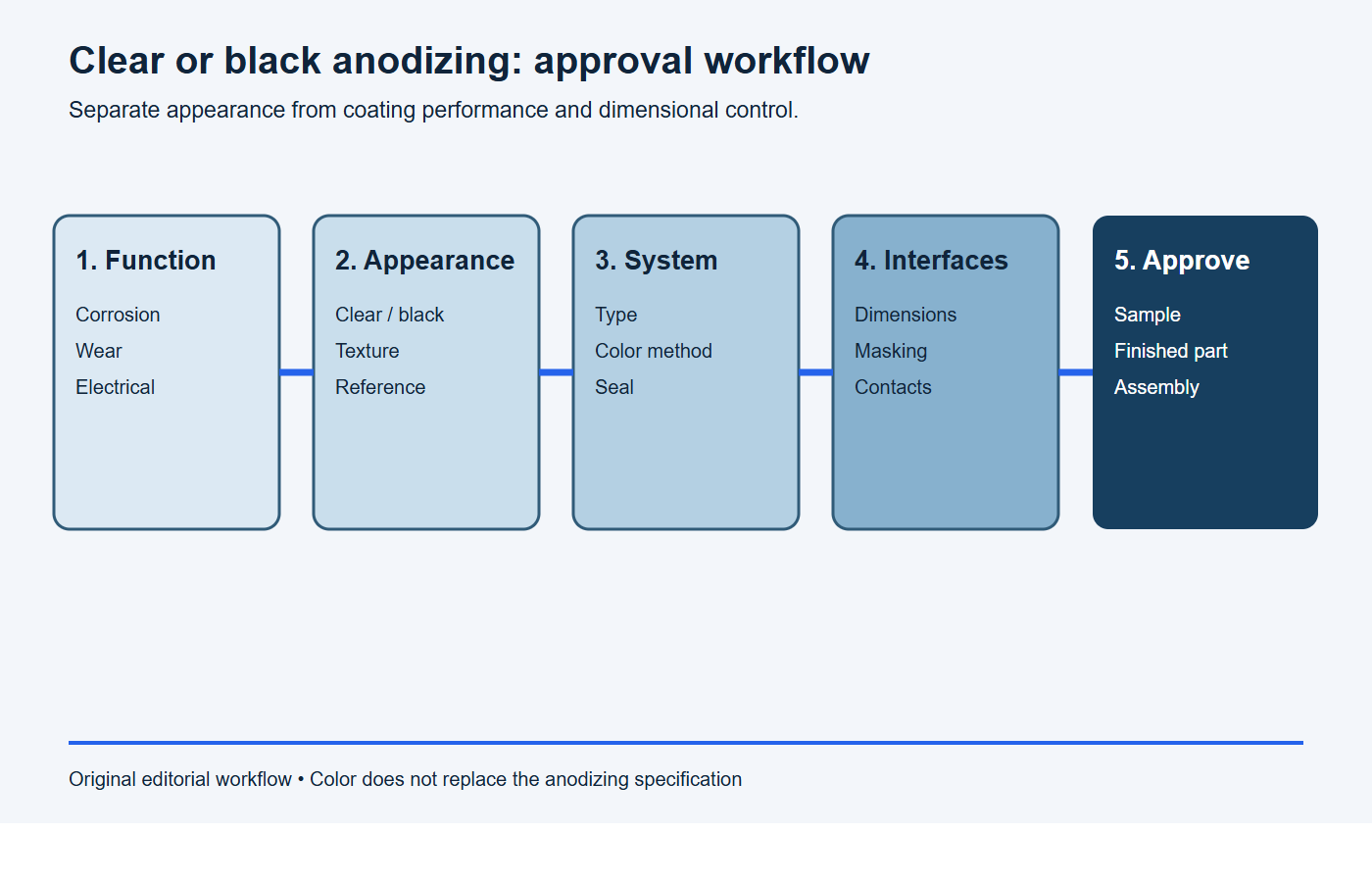
- Define function: document corrosion, wear, electrical, thermal and optical needs.
- Choose appearance: decide natural metallic or black, with preparation and reference sample.
- Specify the system: name anodizing type, thickness, coloring method, sealing and applicable standard.
- Map interfaces: mark post-finish dimensions, threads, fits, masks, contacts and rack locations.
- Validate production: inspect representative finished parts for coating, color, function and assembly.
Stop conditions: do not approve the color yet
- “Clear” or “black” is the only requirement and anodizing type, thickness, coloring method or sealing is undefined.
- The approval sample uses a different alloy, stock form, surface preparation or machining pattern from production.
- A matched assembly has no agreed color range, lot strategy, lighting or viewing conditions.
- Threads, fits, contacts, seals, masks and post-finish dimensions have not been reviewed.
- The design assumes black automatically provides hardcoat performance or hides substrate defects.
Copy-ready clear or black anodizing request
Please quote clear and/or black anodizing for part [number/revision], alloy/temper/product form [requirement] and preparation [as-machined, brushed, blasted or other]. State the anodizing type, thickness, coloring method, sealing, masking, rack locations and applicable tests. Define post-finish dimensions, electrical/thermal contacts and appearance-critical zones. Supply representative samples from the production route and propose measurable color, gloss and visual acceptance conditions for within-lot and lot-to-lot approval.
What should the drawing and RFQ include?
- alloy, temper, product form and drawing revision;
- anodizing standard, type, class or project specification;
- clear or black appearance and the allowed coloring method;
- mechanical and chemical surface preparation;
- coating thickness and measurement locations where required;
- sealing requirement and applicable verification;
- color, gloss, texture and approved reference sample;
- masked areas, electrical contacts, threads and rack locations;
- dimensions and tolerances that apply after anodizing;
- inspection reports, sample approval and packaging requirements.
Use BAOSONG’s anodized aluminum and surface-finishing pages as process-review starting points. Final feasibility and acceptance depend on the project drawing and the selected finishing specification.
Frequently asked questions
Is clear anodizing colorless?
It is normally uncolored, but it may not look completely colorless. Alloy, oxide thickness, pretreatment and the original surface can shift the final tone from bright silver toward gray or another subtle color.
Is black anodizing always dyed?
No. Absorbed dye is common, but black or dark colors can also come from electrolytic, integral or proprietary coloring methods. Specify the method when outdoor stability or qualification depends on it.
Is black anodizing the same as black oxide?
No. Black anodizing is an anodic treatment of aluminum. “Black oxide” commonly refers to a different conversion treatment used for ferrous materials and should not be substituted on an aluminum drawing.
Does black anodizing hide machining marks?
It may reduce some visual contrast, but anodizing is not an opaque filler coating. Tool paths, scratches, blasting variation and surface defects can remain visible. Control preparation and approve a representative sample.
Can clear and black parts use the same dimensions?
Potentially, if the underlying anodizing systems and dimensional requirements are equivalent. Do not assume this from color names. Compare coating type, thickness, masking and the required finished dimensions.
Request an anodizing review for the complete part
BAOSONG can review alloy, manufacturing route, visible surfaces, functional interfaces and inspection requirements before a clear or black anodized finish is released. Our engineering support and quality approach focus on a controlled finished component. Send the drawing and finish specification for a project-specific review.
Recommended Downloads for Aluminum Surface Finish Control
Use these BAOSONG references to select a finish, define cosmetic acceptance and prepare a production-ready requirement.
- Aluminum Surface Finish Selection Guide (PDF)
- Anodizing Guide: Color, Masking & Cosmetic Standards (PDF)
- Powder Coating, Brushing & Polishing Guide (PDF)
- Surface Finish Comparison Chart (editable Excel)
- Cosmetic Surface Requirement Template (editable Excel)
- Appearance Requirement Template (editable Excel)
Need help matching color, masking, gloss or cosmetic zones to your drawing? Contact BAOSONG engineering support.