
Quick answer: what do aluminum tempers T5, T6 and T651 mean?
T5 means the aluminum was cooled from an elevated-temperature shaping process and then artificially aged. T6 means it was solution heat treated and then artificially aged. T651 is a T6-type condition that also includes stress relief by controlled stretching.
These suffixes describe temper—the processing condition that helps establish mechanical properties—not the alloy chemistry. The complete material identity combines alloy, temper, product form and specification. For example, 6063-T5 extrusion, 6061-T6 bar and 6061-T651 plate are different purchasing and engineering descriptions.
T651 should not be described as a universally stronger T6. Its extra digits identify a stress-relief operation intended to reduce residual-stress effects. It can be valuable for heavily machined plate parts, but it does not guarantee zero movement after material removal.
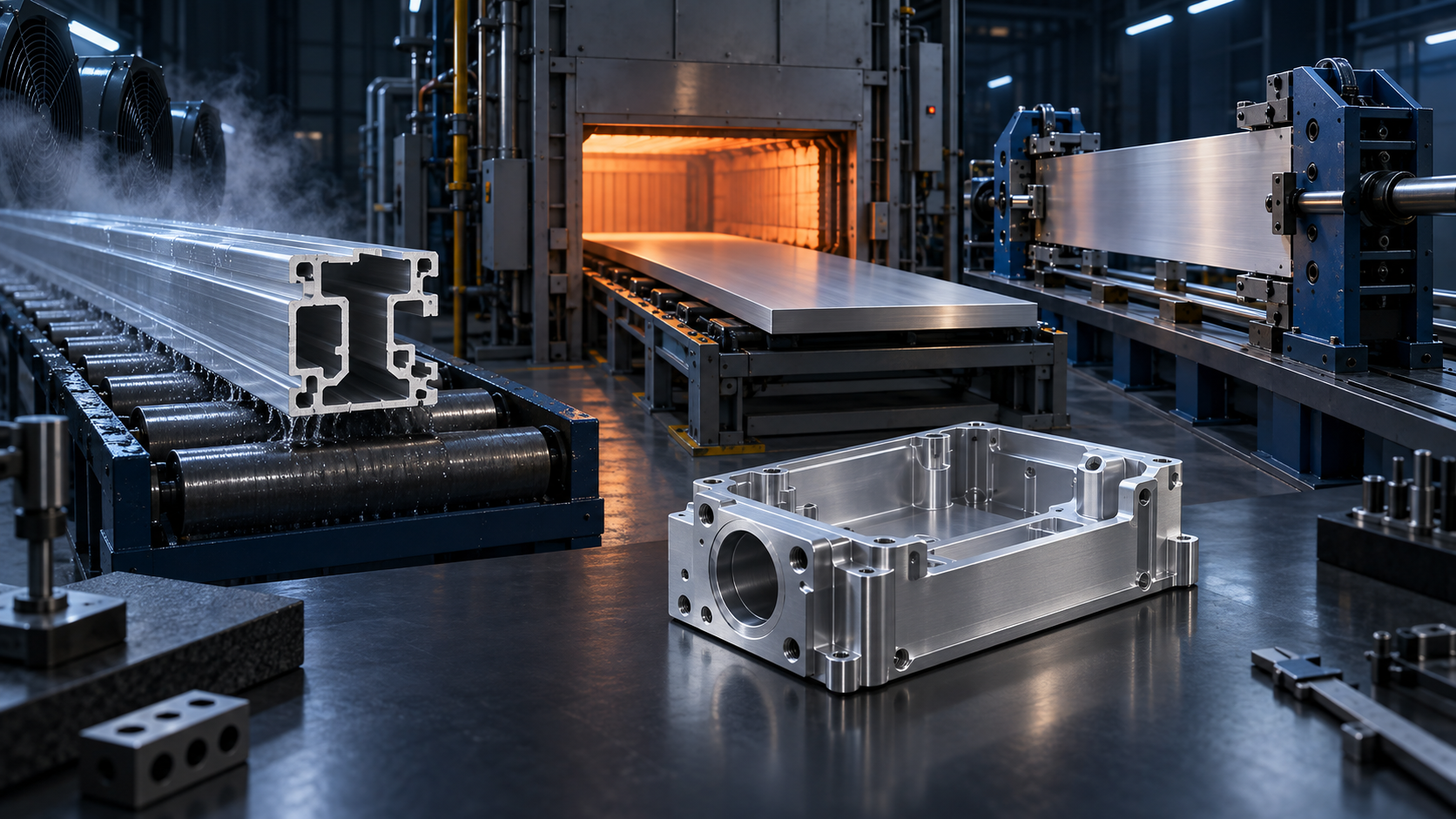
Seven-step aluminum temper review
| Step | Question | Required output |
|---|---|---|
| 1 | What alloy and product form are being purchased? | Registered alloy plus plate, bar, sheet, extrusion, forging or casting |
| 2 | Which strengthening route applies? | Confirmed O, H, T or other applicable temper family |
| 3 | Does T5 meet the section and property requirement? | Product-specific specification and certificate requirement |
| 4 | Does T6 meet strength, joining and temperature needs? | Approved property basis and downstream-process review |
| 5 | Is stress relief or a longer suffix required? | Exact T651, T6510 or T6511 callout |
| 6 | How will the condition affect machining, welding and finish? | Supplier DFM and process controls |
| 7 | How will the received and finished part be verified? | Drawing, certificate and first-article plan |
Step 1: decode alloy, temper and product form separately
The four-digit wrought alloy number identifies a registered chemical composition. Temper identifies the thermomechanical condition used to develop properties. The Aluminum Association administers the ANSI H35 alloy and temper designation systems and provides the official standards and registration-record entry points.
6061 and 7075 are different alloys even if both are ordered in T6. Likewise, 6061-T5 and 6061-T6 share nominal alloy chemistry but can have different mechanical requirements because their processing routes differ. Neither comparison is complete until product form, thickness or section, direction and governing specification are known.
Temper designations do not tell you:
- the exact minimum strength for every thickness and product form;
- the dimensional tolerance of the mill product;
- the residual stress remaining in a particular blank;
- the finished CNC-part tolerance;
- the effect of welding, anodizing or service temperature;
- whether the material meets a customer, aerospace, marine or other controlled specification.
Step 2: identify the strengthening route
The Aluminum Association explains that heat-treatable alloys can be strengthened through solution heat treatment, quenching and aging. Solution heat treatment brings alloying elements into solid solution. Rapid cooling retains a supersaturated condition, and subsequent aging allows strengthening precipitates to develop. Aging at room temperature is called natural aging; a controlled elevated-temperature step is artificial aging.
The exact temperatures, times, quench method and allowed delay are alloy- and specification-dependent. They are controlled process parameters, not values to infer from the T suffix alone. A finished part should be accepted against required material properties and records rather than a generic description of furnace temperature.
Not all aluminum alloys use T tempers. Many 5xxx alloys are non-heat-treatable and commonly use H designations associated with strain hardening. O denotes annealed material, F denotes as fabricated, and W is an unstable solution-heat-treated condition. This article focuses on the T5, T6 and T651 conditions commonly encountered in extrusions, plate and machined components.
Step 3: screen T5 for shaped products
T5 applies to products cooled from an elevated-temperature shaping process and then artificially aged. Extrusion is a common example: the profile leaves the press hot, is cooled under a controlled route and later aged to develop the specified condition. The designation does not mean “air cooled” in every case, and it does not define one universal aging cycle.
T5 is frequently associated with 6xxx-series extrusions, including 6063-T5 and product-specific 6061 or 6082 tempers. Its value is closely tied to the extrusion route and required properties. It can support attractive profiles, practical straightness and sufficient strength for many frames, covers, rails and industrial structures.
Do not assume that T5 is always weaker than T6 by a fixed percentage. For a given alloy and product, applicable tables often specify different property levels, but the difference varies with composition, section thickness, quench capability and registered temper. Use the actual extrusion specification and mill certificate.
When a project combines profile production and secondary machining, review aluminum extrusion requirements together with the machined interfaces. The raw profile’s section tolerance, twist, straightness and temper remain separate from the CNC tolerances applied to bores, faces or end features.
Step 4: screen T6 for strength and downstream processes
T6 identifies material that has been solution heat treated and artificially aged. It is widely used with heat-treatable 6xxx and 7xxx alloys, including 6061-T6 and 7075-T6. The designation defines the treatment class; the alloy and product specification define the required properties.
For the same alloy and comparable product form, T6 often provides a higher specified strength level than T5 because the solution heat treatment and quench are controlled to establish the required supersaturated condition before aging. That does not mean every T6 aluminum is stronger than every T5 product. A 6063-T6 extrusion and a 7075-T6 plate have entirely different chemistry and property bases.
Quenching can leave residual stress because different regions cool and contract at different rates. The amount and distribution depend on product size, geometry, quench conditions and subsequent processing. A small symmetric part may machine without a dimensional problem, while a wide, deeply pocketed plate can move as material is removed.
T6 also does not guarantee that properties remain unchanged after later manufacturing. Welding can alter temper and reduce strength in the heat-affected zone. Elevated-temperature service can change properties over time. Reheating a finished part without an approved procedure can affect strength, distortion, finish and dimensional accuracy.
Step 5: use T651 when stress-relieved stock is required
T651 includes solution heat treatment, stress relief by stretching and artificial aging. Controlled plastic stretching helps redistribute and reduce residual stresses introduced by quenching. This condition is commonly relevant to plate and other eligible wrought products intended for substantial machining.
The benefit is risk reduction, not immunity from distortion. A T651 plate can still move when:
- a large volume is removed from one side;
- thin walls or floors are released from a thick blank;
- the blank contains uneven residual stress;
- clamping force bends the workpiece;
- machining heat or tool pressure changes the local condition;
- features are measured while clamped but accepted after release.
For precision work, combine suitable stock with balanced roughing, stable datums, appropriate clamping, finishing allowance and inspection in the released condition. These decisions belong in the machining plan; the temper suffix cannot replace them.
Producer data from Kaiser Aluminum lists T6/T651 together for typical 6061 and 7075 sheet-and-plate properties, while actual specification minima depend on product and dimensions. See the producer’s 6061 technical data and 7075 technical data. These sheets are reference data, not design allowables or BAOSONG capability guarantees.
Check whether the drawing needs T6510 or T6511
Additional suffix digits are product-specific. T6510 and T6511 are commonly encountered on extruded products that have been stress relieved by stretching after solution heat treatment. Their straightening allowances differ: T6510 does not receive further straightening after stretching, while T6511 may receive minor straightening to meet standard tolerances.
Do not shorten T6511 to T651 on a drawing or assume an extrusion, plate and bar use the same suffix. Confirm the registered temper for the alloy and product form. Hydro’s 6082 extrusion data, for example, lists T5/T5511 and T6/T6511 families with standard temper definitions for that product context.
If straightness, machining allowance or distortion matters, identify the starting form and applicable standard explicitly. “6061-T6 aluminum” without sheet, plate, bar or extrusion information may still leave purchasing and manufacturing with incompatible interpretations.
Quick comparison for engineers and buyers
| Temper | Defined processing route | Common product context | Main purchasing question |
|---|---|---|---|
| T5 | Cooled from an elevated-temperature shaping process, then artificially aged | Frequently specified for 6xxx extrusions | Does the profile, section and registered temper meet the required properties and tolerances? |
| T6 | Solution heat treated, then artificially aged | Extrusions, bar, sheet, plate, forgings or castings where the designation is applicable | Which material and product specification controls properties for the actual size? |
| T651 | Solution heat treated, stress relieved by stretching, then artificially aged | Commonly relevant to plate and eligible wrought stock for machining | Will the stress-relieved stock and machining sequence manage the part’s distortion risk? |
“Common product context” is guidance, not a complete list of registered applications. Always verify the exact designation permitted by the material standard.
Step 6: review machining, welding, forming and finishing
Temper influences hardness, strength, chip behavior and residual stress, but it does not set an automatic machining tolerance. Cutter geometry, engagement, tool reach, coolant, machine condition, setup, workholding, part geometry and measurement all contribute to the result.
For a plate housing with deep pockets, T651 may reduce movement risk compared with an otherwise suitable non-stress-relieved condition, but the design can still demand balanced roughing and a separate finishing operation. For a machined extrusion, the raw profile’s straightness and twist may dominate long-range feature relationships. A T6511 extrusion should be evaluated against its own product requirements rather than treated as plate.
When requesting precision aluminum CNC machining, mark the datums, thin sections, sealing surfaces and feature relationships that make distortion consequential. Use the controls in our aluminum machining tolerance guide. A drawing and manufacturing review can then align stock form, temper, machining sequence and inspection condition.
How temper affects welding, forming and finishing
Welding
Welding adds a local thermal cycle and can change the properties of heat-treatable aluminum near the joint. The published parent-metal T6 value should not be assigned automatically to the heat-affected zone. Joint design, filler, procedure, post-weld condition and applicable design rules determine the accepted strength.
Forming
Higher-strength tempers generally allow less forming margin than softer conditions for the same alloy and product, but bendability depends on thickness, direction, bend radius and tooling. Some parts are formed in a softer condition and then heat treated under a controlled specification. That route must account for distortion and property verification.
Anodizing
Anodizing response is influenced by alloy chemistry, temper, surface preparation, weld zones and lot variation. T5 or T6 alone does not guarantee a particular color or gloss. Define the finish specification, approved appearance sample, masking and dimensions that apply after processing. The BAOSONG anodized aluminum overview explains the information needed for quotation and inspection.
Step 7: specify the complete temper on the drawing
Use a complete material callout with four elements:
- Alloy: the registered designation, such as 6061 or 7075.
- Temper: the full suffix, such as T6, T651 or T6511.
- Product form: plate, sheet, bar, extrusion, forging or casting.
- Specification: the governing material standard and revision required by the project.
Then add any certificate, traceability, ultrasonic inspection, grain direction, corrosion test or customer approval requirement that applies. ASTM B209/B209M is commonly associated with aluminum sheet and plate, ASTM B221/B221M with extruded products, and ASTM B211/B211M with rolled or cold-finished bar, rod and wire. Confirm that the current standard includes the desired alloy-temper-size combination before release.
Do not write “T6 equivalent,” “aircraft grade,” “hard aluminum” or “T651 preferred” without acceptance criteria. If alternatives are allowed, list them and define who can approve substitution.
Receiving and first-article verification checklist
| Gate | Check | Pass evidence |
|---|---|---|
| Certificate | Alloy, full temper, product form, specification and purchase-order revision match. | Reviewed material certificate |
| Traceability | Heat or lot identity remains linked to stock, work order and shipped parts. | Material traceability record |
| Stock | Dimensions, straightness, flatness and mill-product tolerances support machining allowance. | Incoming inspection result |
| Process | Heat treatment, forming, welding, machining and finishing follow the approved sequence. | Route and required process certificates |
| Finished part | Critical features are measured after unclamping and after the specified finishing stage. | Approved first-article report |
The level of documentation should match project risk. Review the BAOSONG quality overview and state the required reports in the RFQ rather than assuming every order includes the same record set.
Stop conditions: the temper callout is not ready
- The drawing says only “aluminum,” “6061” or “T6 equivalent.”
- The selected suffix is not registered or available for the required alloy and product form.
- Property data comes from a different thickness, direction or specification than the purchased stock.
- T651 is assumed to eliminate distortion without reviewing blank location, removal ratio, clamping and inspection state.
- Welding or later heating is planned, but its effect on the heat-treated condition has not been approved.
- T651, T6510 and T6511 are being treated as interchangeable.
- The certificate, traceability and first-article requirements are absent from the purchase order.
Frequently asked questions
Is T651 stronger than T6?
Not as a general rule. T651 adds stress relief by stretching to the T6 route. Strength requirements may be similar for some product specifications, while actual limits depend on alloy, thickness, direction and product form.
Is T651 always better for CNC machining?
No. It can be useful for plate parts with high material removal or distortion risk, but geometry, availability, specification and cost still matter. A suitable T6 bar or extrusion may be the correct input for another part.
Can T5 and T6 be substituted?
Only with engineering approval. They represent different processing routes and can have different mechanical properties, formability, dimensional behavior and availability. Recheck the product specification and design requirements.
Does machining change the aluminum temper?
Ordinary controlled machining should not be treated as a heat-treatment operation, but excessive heat, later welding or uncontrolled thermal processing can affect local condition. Machining also releases residual stress and can change geometry without changing the material designation.
What temper should I put on an RFQ?
Use the full alloy-temper-product-standard callout required by the design. If you are unsure, provide loads, environment, joining, geometry and critical features and request a documented material review before approving the drawing.
Copy-ready material and temper request
Material: [alloy]-[full temper], [plate/sheet/bar/extrusion/forging/casting], to [specification and revision]. Size and direction: [thickness/section/blank size and grain-direction requirement]. Processing: [forming, welding, machining, heat treatment and finish sequence]. Critical controls: [datums, thin areas, sealing faces, post-finish dimensions and distortion-sensitive features]. Documentation: [material certificate, lot traceability, process certificates and first-article report]. Substitution: [not permitted / permitted only after written engineering approval].
Send BAOSONG your drawing, model and application requirements for review and quotation. Include the full temper suffix and product form, and identify the features for which residual stress, welding, finishing or dimensional stability matters.
Recommended Downloads for Aluminum Alloy Selection
Use these BAOSONG references to compare alloy families, temper conditions, machinability, strength, corrosion resistance and design implications before quotation.
- Aluminum Alloy Comparison Chart (editable Excel)
- Tolerance Reference Guide (PDF)
- Aluminum CNC Machining Design Guide (PDF)
- Aluminum Part Design Checklist (editable Excel)
Need help choosing an alloy or temper for your application? Contact BAOSONG Precision.