
Quick answer: what should material traceability prove in aluminum manufacturing?
Material traceability should let a buyer connect each finished aluminum component to the approved alloy, temper, product form, source certificate and incoming heat or lot, then follow that identity through cutting, machining, outsourced processing, inspection and shipment. The required chain must be defined before material is purchased.
A strong system preserves both identity and status. It shows what the material is, where it came from, which production orders consumed it, what processes were applied, which records support acceptance and whether any quantity is on hold. A certificate stored in a folder is insufficient if the shop cannot link it reliably to the physical part.
The buyer should specify the depth of traceability needed: shipment-level, production-lot, heat or melt, individual serial number, or another project-defined unit. Greater detail adds marking, segregation, scanning and record effort, so the chosen level should follow product risk, regulation, customer requirements and the cost of containment.

Define the traceability unit before ordering material
“Full traceability” has no useful meaning without a defined unit and boundary. State whether finished parts must trace to a supplier lot, mill heat, cast, extrusion billet, coil, plate batch, forging lot or another source identifier. Also decide whether one finished-part lot may contain more than one material lot.
If mixing is allowed, the record must identify which finished quantities came from each source. If mixing is prohibited, purchasing, storage, cutting and work-in-process controls must prevent it. The drawing, purchase order and quality clauses should use the same terms.
Build the traceability chain in five practical steps
- Define the unit: choose heat, melt, coil, billet, extrusion lot, production lot, shipment lot or individual serial number.
- Define the source record: list the exact certificate fields, specification revision and actual test results required.
- Map every handoff: preserve the identifier through receiving, storage, cutting, machining, subcontract processing, inspection and packing.
- Control exceptions: quarantine unidentified material, split lots, mixed lots, returned parts and remnants until disposition is recorded.
- Prove retrieval: test both backward tracing from a shipped part and forward tracing from a suspect material lot.
Assign an owner and record at each handoff. A traceability plan fails when the certificate exists but the physical stock, work order or finished quantity loses the connection.
Specify alloy, temper and product form together
An aluminum designation is incomplete when product form and material condition affect properties. A record should identify alloy, temper, plate, sheet, bar, extrusion, casting or forging, the applicable material specification and its revision where required. “6061” alone does not distinguish 6061-T651 plate from 6061-T6 extrusion.
The Aluminum Association manages major alloy and temper designation systems, while its current international wrought-alloy registration record defines registered designations and chemical composition limits. BAOSONG’s alloy selection guide explains why the manufacturing route and temper must be resolved before release.
Use the correct material specification
The product specification tells the supplier what evidence and acceptance basis apply. ASTM B209/B209M covers aluminum and aluminum-alloy sheet and plate, while ASTM B221 covers extruded bars, rods, wire, profiles and tubes. Other regions and industries may invoke EN, ISO, SAE AMS or customer specifications.
Do not transfer requirements from one product form to another merely because the alloy number matches. The 6061 versus 6063 guide provides useful selection context, but contractual acceptance must use the specification identified on the order and drawing.
Define what the material certificate must contain
Tell the supplier whether the project requires a certificate of conformance, mill test report, inspection certificate or customer form. The names are often used inconsistently, so define required fields instead of relying on the document title.
| Record field | Purpose | Buyer decision |
|---|---|---|
| Producer and supplier | Identifies the issuing organizations | State whether distributor-only certificates are acceptable |
| Alloy, temper and product form | Connects the material to the released specification | Require exact designations and permitted substitutions |
| Heat, melt, cast, coil or lot identifier | Creates the source link for physical stock | Define the required traceability unit |
| Specification and revision | Identifies the acceptance basis | Resolve conflicting or superseded standards |
| Chemical and mechanical results | Provides actual or reported conformance evidence | State which results must be reported |
| Dimensions and quantity | Connects the certificate to received stock | Define receiving reconciliation and tolerances |
| Authorization and date | Supports document control | Define acceptable signature or digital validation |
Verify incoming stock before releasing it
Receiving should compare the purchase order, packing list, certificate, physical markings, quantity and condition. Quarantine stock when the alloy, temper, heat number, size or specification does not agree. A later paperwork correction should not silently replace the original discrepancy.
Positive material identification may be appropriate for selected risks, but it does not automatically verify temper, mechanical properties or every element required by the specification. Define the method, coverage, reference standards and acceptance criteria rather than treating a handheld analyzer as complete material approval.
Preserve identity through storage and cutting
Warehouse locations, racks and containers should prevent accidental mixing of similar-looking aluminum. Labels need to survive handling and remain legible. When a bar, plate or extrusion is cut, transfer the source identity to each remnant and work order before the original mill marking is removed.
The record should reconcile received quantity, issued quantity, remnants, scrap and finished output at the level required by the customer. For custom profiles, connect the extruder, alloy and temper, die or profile identity, production lot and cut batch. The aluminum extrusion service overview provides context for this route.
Carry traceability into CNC machining
Travelers, routers, barcode scans or electronic records should connect the material lot to the job, machine route, fixtures, CNC program revision and inspected quantity when those fields are required. Parts removed for rework, cleaning or secondary operations must retain their identity and disposition.
Individual serial marking may be justified for safety-critical or high-value parts, but many projects can use controlled production-lot traceability. Choose the smallest unit needed to contain risk without creating a marking system that is expensive, fragile or impossible to preserve after finishing. See BAOSONG’s CNC machining overview for relevant production routes.
Control split lots, merged lots and remnants
A split occurs when one source lot feeds several work orders. A merge occurs when several source lots feed one finished lot. Both relationships must be deliberate and recorded. Uncontrolled merging can expand the scope of a future recall or make source investigation impossible.
Define whether remnants can return to stock, how they are relabeled, who verifies the transfer and when small pieces must be scrapped. Digital records help, but the physical identifier on the remnant remains essential if it can become separated from its storage location.
Maintain the chain through outsourced processes
Anodizing, heat treatment, coating, welding, testing and other external processes create handoff risk. The purchase order to the processor should carry the customer part, revision, quantity, incoming lot or serial identity, process specification and required certificate fields.
On return, reconcile quantities and identities, including rejected, stripped, reworked or scrapped parts. The process certificate should link to the same production population. BAOSONG’s surface-finishing overview and anodized aluminum page show common finish routes whose documentation must remain connected to the material chain.
Link inspection results to the right material population
Dimensional, chemical, mechanical, coating and functional results should identify the inspected sample and its source lot or finished production lot. If a result fails, the traceability system must support immediate containment: affected stock, work in process, shipped quantity, sibling work orders and remaining raw material.
Material genealogy and measurement traceability are different concepts. NIST defines metrological traceability as a property of a measurement result connected to a reference through a documented calibration chain. NIST also explains that metrological traceability differs from chain-of-custody traceability. A sound quality record may need both.
Use status controls as well as identity controls
A tag that identifies the lot does not show whether it is accepted, awaiting inspection, on hold or rejected. Physical and electronic controls should prevent unauthorized material from entering production or shipment. Status changes need authority, date, reason and a preserved history.
Nonconforming stock should be segregated and linked to the original lot, affected quantities, review, disposition, rework and reinspection. Never create a new lot identity merely to hide a failed result or break the chain to a deviation.
Plan marking around the finished part
Define content, location, size, method and durability for part or package marking. Laser marking, engraving, dot peen, ink, labels and data-matrix codes affect cosmetic surfaces, fatigue-sensitive regions, coatings and readability differently. Some components should remain unmarked and trace through controlled containers.
Marking after anodizing may be visually clear but occurs late in the route; marking before anodizing must survive processing. Establish temporary identifiers and transfer checks so identity does not disappear between machining and final marking.
Choose record retention and data structure deliberately
State how long purchasing records, certificates, receiving evidence, travelers, process certificates, inspection reports, nonconformances and shipment links must be retained. Retention may depend on customer, regulatory, product-life and warranty requirements; it should not default to the convenience of the software system.
Electronic systems should control access, revisions, backups and audit history. A practical genealogy query should start from a shipped serial or lot and move backward to material and processes, or start from a suspect material lot and move forward to every affected shipment.
Test traceability with forward and backward exercises
A desk procedure can appear complete while physical labels and actual records disagree. Periodically select a finished shipment and reconstruct its material, process and inspection chain. Then select an incoming material lot and identify all remnants, work orders, finished inventory and shipments that consumed it.
Measure completeness and response time against the customer requirement. Investigate missing links, duplicate identifiers, quantity mismatches and manual overrides. The exercise should verify the real system, including outsourced processors and archived records.
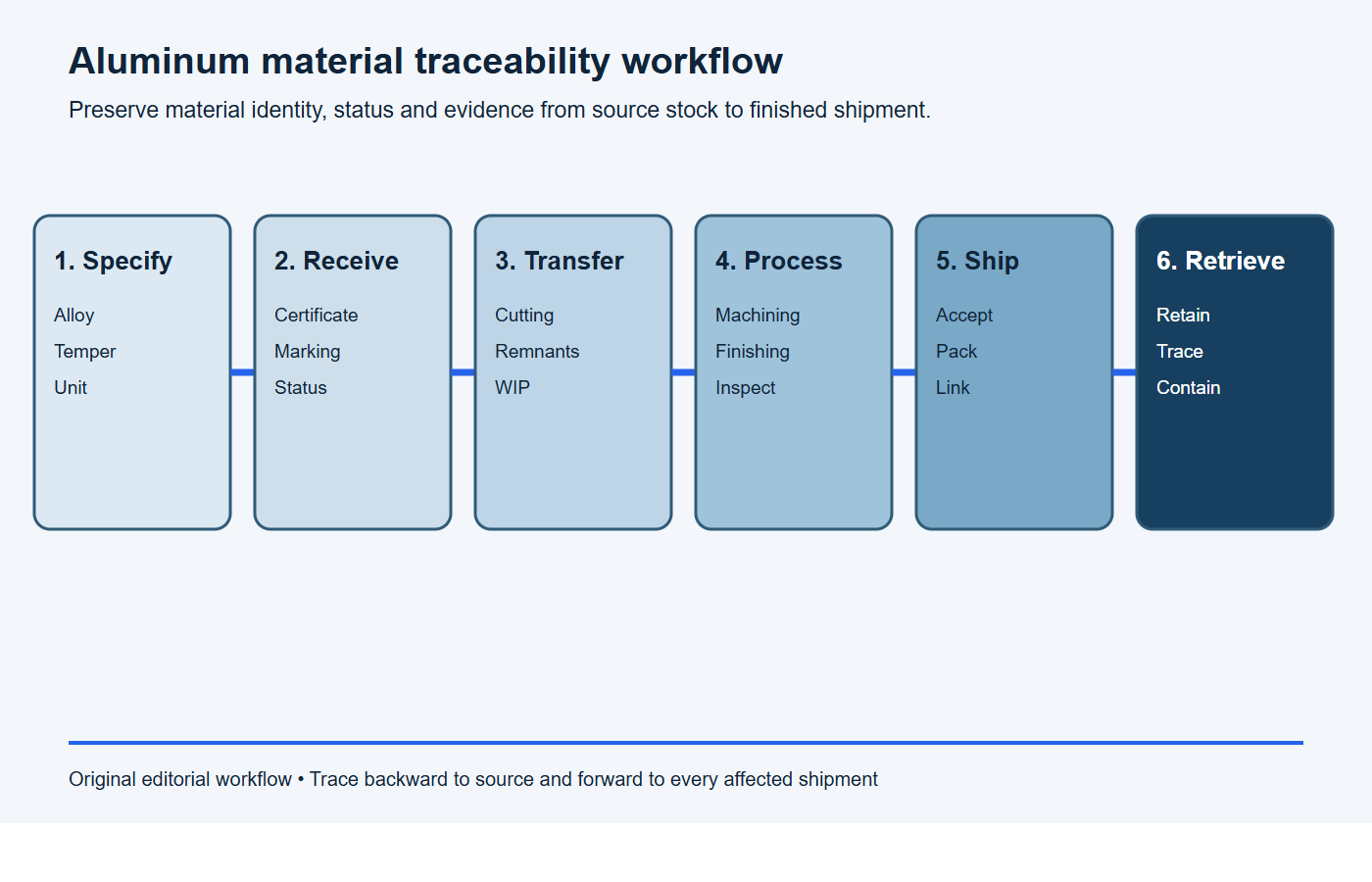
Use a controlled aluminum traceability workflow
- Specify: define the alloy, temper, product form, standard and traceability unit.
- Receive: reconcile order, certificate, physical marking, quantity and status.
- Transfer: preserve identity across storage, cutting, remnants and work in process.
- Process: connect machining, external processing, inspection and nonconformance records.
- Ship: link accepted quantity, packaging, shipment and customer documents.
- Retrieve: retain records and prove backward and forward traceability.
Copy-ready material traceability requirement
Traceability requirement: Finished part [part number/revision] shall be traceable to the aluminum [heat/melt/billet/coil/extrusion lot] and its original material certificate. Records shall identify alloy, temper, product form, governing specification and revision, source identifier, received quantity, production work order, split or merged quantities, outsourced processes, inspection status and shipment lot. Mixing of material lots is [prohibited/permitted only with separate quantity records]. Marking shall use [location/method] and remain readable through [process stage]. Unidentified material or work in process shall be quarantined. Retain records for [period] and provide them within [response time].
Replace every bracketed field and state any required certificate format, electronic data field, serial number rule or approved-source restriction.
Buyer checklist for traceable aluminum components
- Part number, drawing revision and applicable customer clauses.
- Alloy, temper, product form, specification and permitted substitutions.
- Required source unit: heat, melt, cast, coil, extrusion or supplier lot.
- Certificate type, required fields, test results and approved sources.
- Rules for mixed lots, split lots, remnants and quantity reconciliation.
- Production-lot or individual-part identification and marking method.
- External-process identity transfer and certificate requirements.
- Inspection, nonconformance, rework and shipment record links.
- Record format, retention period, access, backup and audit history.
- Forward and backward traceability test expectations.
Stop conditions: do not release or ship the lot
- The physical material identifier does not agree with the purchase order or certificate.
- The alloy, temper, product form, specification revision or heat/lot number is missing or ambiguous.
- A split, merge, remnant or rework quantity cannot be reconciled to its source lot.
- Parts returned from an outsourced process have lost their lot identity or processing records.
- Finished parts or packaging labels cannot be linked to the work order and accepted material.
- A forward or backward trace exercise cannot identify all affected quantities promptly.
Frequently asked questions
Is a material certificate enough to prove traceability?
No. The certificate describes a material population, but the manufacturer must preserve a reliable link from that document to physical stock, work in process, finished parts and shipments.
Does PMI prove aluminum temper?
Not by itself. Composition analysis may support alloy identification, but temper depends on thermal or mechanical processing and normally requires the specified documentary and test evidence.
Must every aluminum component have a serial number?
No. The required unit depends on risk and customer requirements. Lot-level controls may be suitable for many parts, while individual serialization can be necessary for selected high-risk or regulated applications.
What happens if a lot identifier is lost during machining?
Quarantine the affected material or parts and follow the documented nonconformance process. Do not recreate the identity from assumption; restore it only through objective records accepted by the responsible authority.
Request a material-traceability review
Send the drawing, aluminum specification, required traceability unit, certificate fields, marking method, outsourced-process requirements, retention period and expected production quantities through BAOSONG’s contact page. The quality overview provides additional context for aligning records and inspection with the project requirement.
Recommended Downloads for Inspection & Documentation
Use these BAOSONG references to align tolerances, inspection evidence, documentation and design review before release.
- Inspection & Documentation Guide (PDF)
- Tolerance Reference Guide (PDF)
- CNC Machining Tolerance Guide (PDF)
- Aluminum Part Design Checklist (editable Excel)
- Die Cast Part Drawing Review Checklist (editable Excel)
Need help choosing sampling, measurement methods or report fields? Contact BAOSONG engineering support.