
Quick answer: should you anodize or powder coat an aluminum part?
Choose anodizing when the project needs a metallic aluminum appearance, an oxide surface that does not peel like an applied film, or controlled coverage on detailed extrusions and machined parts. Choose powder coating when the priority is an opaque color system, a broad range of colors and textures, or a continuous organic film over a fabricated or architectural assembly.
Neither finish is inherently better for every aluminum component. Performance depends on the alloy, pretreatment, finish type, coating specification, thickness, sealing or curing, service environment and workmanship. Tight fits, threads, electrical contacts, grounding points, cosmetic zones and post-finish dimensions often decide the route before color does.
Specify the complete finished condition rather than writing only “black anodize” or “powder coat.” A production drawing or finish specification should identify the governing standard, class or system, color and gloss reference, appearance sample, masking, critical dimensions, test methods and acceptance criteria.
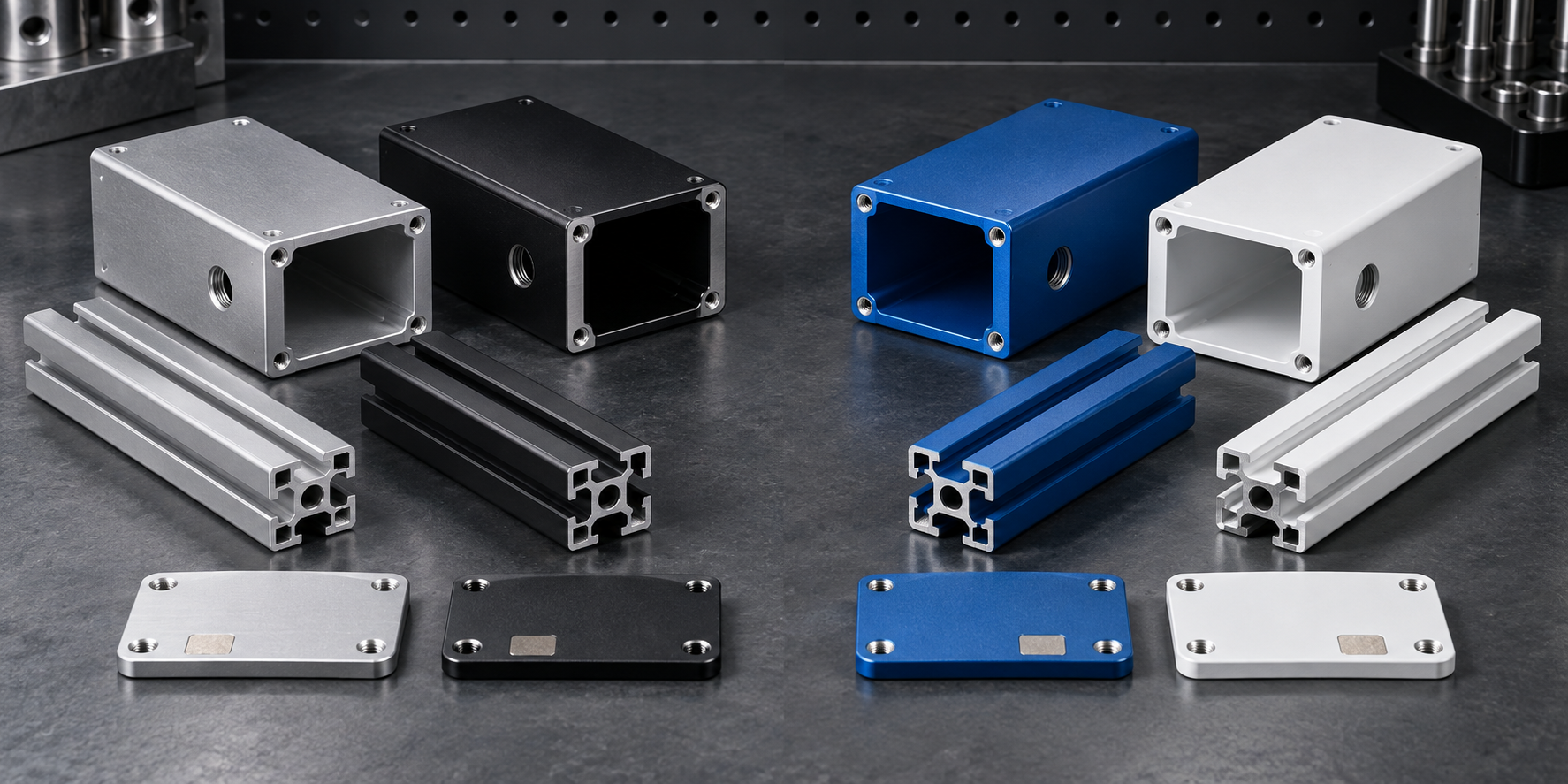
Use this four-question finish decision
- What must the finish survive? Define corrosion, UV, chemicals, wear, impact, cleaning and service life.
- What must remain functional? Mark fits, threads, seals, grounding pads, thermal contacts and post-finish dimensions.
- What must it look like? Specify metallic or opaque appearance, color, gloss, texture, viewing conditions and approved sample.
- How will it be accepted? Name the process standard, thickness or class, masking, tests, inspection records and lot criteria.
What is the fundamental difference?
Anodizing is an electrochemical conversion of the aluminum surface into an anodic oxide coating. The finish is formed from the substrate rather than applied as a separate sheet of material. Decorative and protective anodizing can be clear or colored and may retain a metallic visual character. Hard anodizing is a different engineering category and should not be substituted merely because a buyer wants a darker color.
Powder coating applies dry organic coating particles to a prepared conductive part and cures them into a continuous film. The visible result is generally more opaque and can offer a wide range of colors, gloss levels and textures. Its performance depends on the powder chemistry and the entire coating system, including cleaning and pretreatment.
| Decision factor | Anodizing | Powder coating | Buyer should define |
|---|---|---|---|
| Finish structure | Aluminum surface converted to anodic oxide | Organic coating film applied over prepared aluminum | Named process, standard and coating system |
| Visual character | Often shows metallic substrate character | Usually opaque; broad color and texture range | Color, gloss, texture and approved sample |
| Dimensional effect | Oxide formation changes finished dimensions | Applied film adds thickness and can bridge small details | Critical dimensions, masking and final measurement state |
| Damage mode | Cannot peel as a separate polymer film; can scratch or chip at severe damage | Can scratch, chip or lose adhesion if the system is unsuitable | Expected abrasion, impact, edges and repair policy |
| Electrical behavior | Anodic oxide is electrically insulating | Most powder films are electrically insulating | Bare contacts, bonding points and masking |
| Substrate visibility | Alloy, temper and surface preparation can remain visually apparent | Opaque film can reduce the visibility of minor substrate variation | Cosmetic surface grade and defect limits |
Choose by service requirement, not by a universal durability claim
“Durability” can mean corrosion resistance, abrasion resistance, UV color retention, impact tolerance, chemical exposure or resistance to edge damage. A finish can perform well in one category and still be unsuitable in another. Start with the actual environment: indoor handling, outdoor weathering, salt exposure, cleaning agents, temperature, contact wear and expected service life.
The Aluminum Anodizers Council’s guide to specifying anodized finishes compares common specification systems and explains why process type, class, thickness and purchaser requirements must be stated. Decorative sulfuric-acid anodizing and engineering hardcoat serve different purposes, so a darker color is not a reason to substitute one for the other.
For powder coating, the ASTM catalog of paint and coating standards shows that substrate preparation, coating properties and performance tests are separate subjects. A generic powder color name is therefore not a complete outdoor or corrosion specification; select the coating system and tests for the actual service environment.
How each finish affects dimensions and fits
Both finishes change the functional surface. Anodizing involves oxide growth and substrate conversion; the net dimensional change depends on process and alloy. Powder coating adds a separate film whose local thickness can vary with geometry, electrostatic behavior, spray access and cure. Do not apply a universal allowance to every project.
Review holes, threads, bearing seats, sealing faces, sliding interfaces, locating pads and connector openings before finishing. Decide whether each area will be coated, masked, plugged, chased, machined after finishing or accepted with a specified buildup. Internal corners, recesses and sharp edges may not receive the same coating behavior as broad open faces.
ASTM B244-09(2021) covers eddy-current measurement of nonconductive coatings on nonmagnetic basis metals and is particularly useful for anodic coating thickness on aluminum. The standard also notes that substrate conductivity must match the calibration reference. That is why the drawing must specify both thickness requirement and verification method rather than relying on an instrument reading without context.
If a dimension is critical after finishing, state that condition explicitly. Coordinate the drawing with the CNC machining and finishing plans so the supplier knows which operation creates the final datum and which surfaces remain coated.
Appearance begins with alloy and surface preparation
Anodizing tends to reveal the substrate. Alloy chemistry, product form, extrusion die lines, machining marks, welds and local polishing can affect the final shade and texture. Parts made from different lots or fabrication routes may not match even when processed in one nominal color.
Powder coating is more opaque, but it does not make preparation irrelevant. Oils, oxides, sharp burrs, poor pretreatment, weld residue and trapped contaminants can affect adhesion and appearance. ASTM D1730-09(2020) describes practices for preparing aluminum and aluminum-alloy surfaces for painting and emphasizes that service conditions and alloy influence the selected preparation.
For visible products, define viewing distance, lighting, allowable shade range, gloss or texture range, grain direction and which surfaces are appearance-critical. Use production-representative samples made from the real alloy and process route. A digital color value or catalog chip alone may not predict the result on a machined or extruded component.
Compare corrosion, wear, impact and UV exposure separately
Corrosion protection
Either route can protect aluminum when the system is correctly specified and processed. Anodizing quality involves coating type, thickness, sealing and substrate condition. Powder-coating performance depends strongly on pretreatment, powder chemistry, film integrity, edges and cure. Cut edges, drilled holes and damage during assembly can change the exposure condition.
Abrasion and repeated contact
Hard anodizing may be considered for engineered wear surfaces, but its type, thickness, sealing and finish-machining conditions must suit the actual contact. Decorative anodizing should not be assumed to provide the same behavior. Powder coatings can tolerate some impact and offer a continuous film, but sliding contact can polish, wear or remove the coating.
Impact and repair
Anodic oxide is integral with the aluminum surface, so it does not delaminate like an applied polymer film. Severe impact can still damage the oxide and substrate. Powder coating may chip or lose adhesion at damaged regions; localized touch-up can be possible, but color, gloss and durability may differ from the original cured film. Define whether cosmetic repair is acceptable.
Outdoor color and weathering
Color retention depends on the anodizing coloration method or the powder chemistry and qualification. Do not infer outdoor suitability from “black,” “polyester” or another short description. Specify the exposure class and required tests under the selected standard or customer specification.
Electrical contacts, grounding and thermal interfaces need masking
Anodic oxide and most powder films are electrical insulators. Grounding lugs, bonding pads, conductive threads and connector contact areas may therefore need controlled masking or a later material-removal step. A vague note such as “mask as required” transfers a functional design decision to production.
Mark each exclusion area on the drawing and define the acceptable boundary. Consider how racks, hooks or contacts will hold the part during finishing; those points can leave marks and need a non-cosmetic location. Verify continuity on the finished assembly where it is a functional requirement.
For heat-transfer interfaces, coating thickness, flatness, contact pressure and thermal-interface materials work together. Do not select a finish using a generic thermal-conductivity claim. Keep critical mating pads controlled and validate the assembled thermal path.
Part geometry and manufacturing route change the answer
Extruded profiles
Long aluminum extrusions can show die lines, handling marks and variation between exposed surfaces. Anodizing may emphasize these differences, while powder coating produces a more opaque appearance. Drainage, hanging orientation, cavities and cut ends still require finishing review.
CNC-machined parts
Machined faces can be visually attractive after anodizing when tool paths and preparation are controlled, but different cutting conditions can remain visible. Powder film can soften the visual sharpness of fine detail and build on threads or fits. Our anodized aluminum and broader surface-finishing pages provide starting points for a drawing review.
Fabricated and welded assemblies
Welds and heat-affected areas can differ visibly after anodizing. Powder coating often provides a more uniform opaque color across a fabricated assembly, provided that weld residue, joints, venting and pretreatment are controlled. Closed cavities may need drain and vent provisions for the actual finishing process.
Die-cast aluminum
Cast alloy chemistry and porosity can complicate cosmetic anodizing. Powder-coating cure can reveal trapped gas as surface defects if the casting and preparation are not suitable. Review the selected die-casting alloy, casting quality and finish trial together instead of assuming either coating will hide every substrate issue.
Use a finish-selection workflow
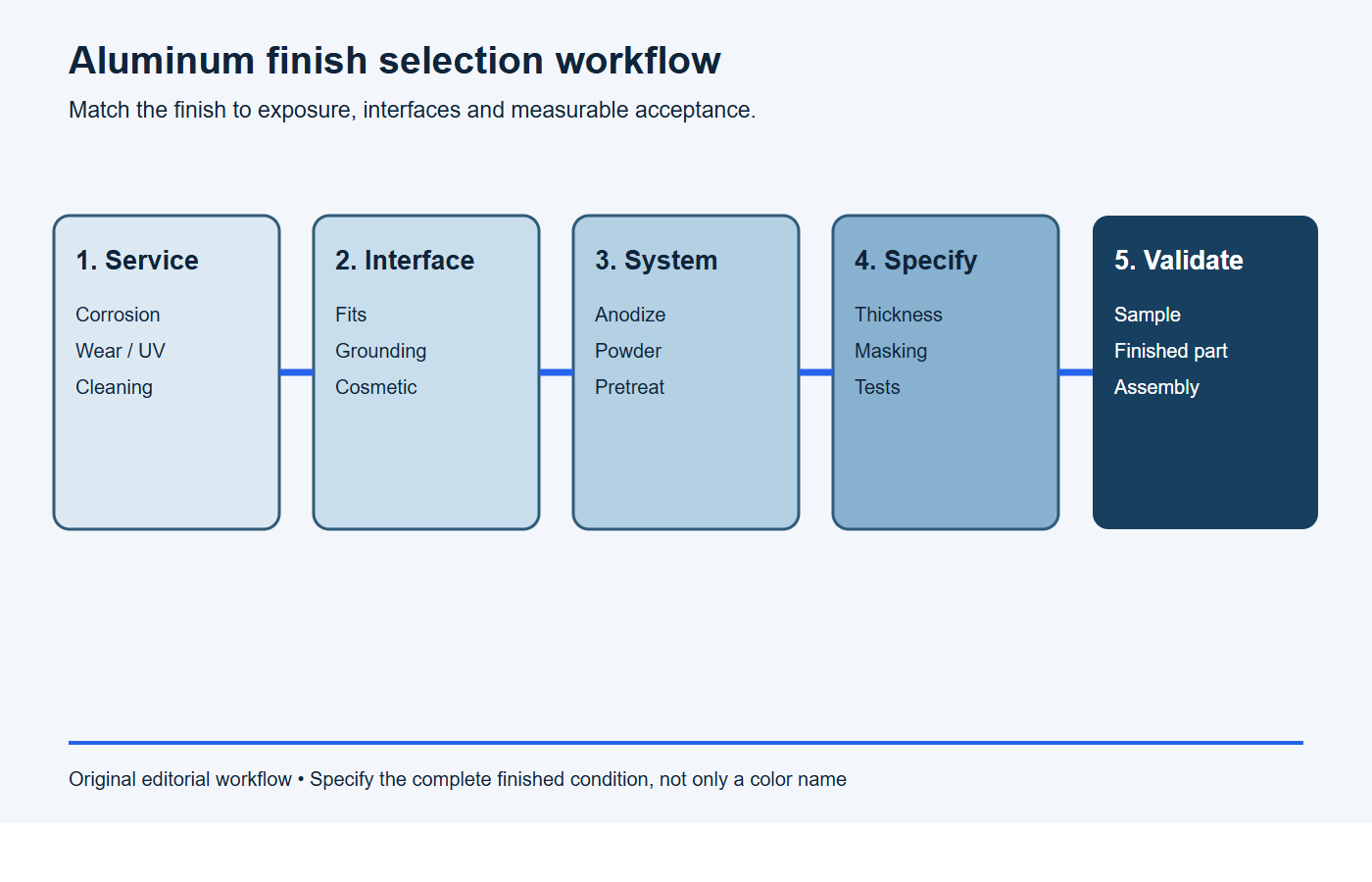
- Define service: list corrosion, UV, chemicals, wear, impact, temperature and cleaning exposure.
- Map interfaces: identify fits, threads, seals, grounding pads, thermal contacts and cosmetic zones.
- Shortlist systems: choose a named anodizing type or powder-coating system compatible with the alloy and geometry.
- Specify acceptance: state color, gloss, thickness, masking, appearance limits, tests and post-finish dimensions.
- Validate production: approve representative samples and verify the finished part and assembly, not an isolated color chip.
Stop conditions: the finish is not ready for release
- The drawing says only “black anodize” or “powder coat” without a process standard, class or coating system.
- The finish was chosen from color alone without defining corrosion, wear, UV, chemical or impact exposure.
- Threads, fits, grounding points, sealing lands or thermal contacts have no masking and final-dimension plan.
- Color and gloss acceptance relies on a digital image rather than a representative sample and stated viewing conditions.
- The selected alloy, fabrication route and surface preparation have not been included in the finish trial.
Copy-ready aluminum finish specification request
Please compare anodizing and powder coating for part [number/revision], alloy/temper [requirement] and service environment [details]. Evaluate corrosion, UV, chemicals, wear, impact, cleaning, electrical and thermal interfaces. Quote a named process standard and coating system, including color, gloss, texture, thickness/class, pretreatment, masking, rack/contact locations, post-finish dimensions, tests and inspection records. Provide representative finished samples on the actual substrate and identify the acceptance conditions before production release.
What should an RFQ and drawing specify?
- alloy, temper, product form and part revision;
- named finish process, standard, type, class or coating system;
- service environment and the performance tests that matter;
- color, gloss, texture and approved visual reference;
- target coating thickness and measurement method where required;
- masked, plugged, uncoated and rack-contact locations;
- dimensions and tolerances that apply after finishing;
- appearance-critical surfaces and permitted defects;
- sample approval, inspection records, packaging and handling requirements.
ASTM B580-25 covers porous anodic oxide coatings where appearance, abrasion resistance, electrical properties and corrosion protection are relevant. It also recognizes that project-specific modifications may require agreement between purchaser and manufacturer. Use the edition and requirements named by the project; do not combine unrelated standards merely to make a specification look stricter.
Frequently asked questions
Is anodizing thinner than powder coating?
Powder coating is commonly treated as a more substantial applied film, but a reliable design cannot use a generic thickness comparison. Anodizing type, powder system, geometry and specification control the actual result. State the required finished dimension and coating requirement.
Which finish gives a more premium appearance?
Anodizing often retains a metallic aluminum character, while powder coating offers an opaque, consistent color and broader texture choices. “Premium” is subjective; approve a representative sample under defined lighting and viewing conditions.
Can threads be anodized or powder coated?
They can be finished, masked or restored afterward depending on fit, conductivity, corrosion and assembly needs. The drawing must identify the required condition. Do not assume all internal threads should be coated the same way.
Can a powder-coated part be repaired more easily?
Localized touch-up may be more practical than recreating an anodized finish on one damaged area, but the repaired color, gloss and protection may not match the original cured coating. Define whether touch-up is allowed and how it will be inspected.
Should finishing happen before or after CNC machining?
Most projects finish after the required machining, but selective post-finish machining may be used for bare contacts or critical interfaces. The sequence should follow the drawing, masking plan and final functional state.
Request a finish review for the complete component
BAOSONG can review the aluminum alloy, manufacturing route, critical interfaces, cosmetic surfaces and inspection requirements as one component specification. Our engineering support and quality approach focus on translating the drawing into a controlled finished part. Send the drawing and finish requirements for a project-specific review.
Recommended Downloads for Aluminum Surface Finish Control
Use these BAOSONG references to select a finish, define cosmetic acceptance and prepare a production-ready requirement.
- Aluminum Surface Finish Selection Guide (PDF)
- Anodizing Guide: Color, Masking & Cosmetic Standards (PDF)
- Powder Coating, Brushing & Polishing Guide (PDF)
- Surface Finish Comparison Chart (editable Excel)
- Cosmetic Surface Requirement Template (editable Excel)
- Appearance Requirement Template (editable Excel)
Need help matching color, masking, gloss or cosmetic zones to your drawing? Contact BAOSONG engineering support.