
Quick answer: should you choose 5052 or 5754 aluminum?
Choose 5052 when you need a widely specified corrosion-resistant sheet alloy with excellent forming and welding characteristics for enclosures, covers, tanks, brackets and light-duty marine equipment. Choose 5754 when the applicable EN or international supply chain calls for it, or when its combination of slightly higher magnesium content, formability and available temper better matches a formed or welded component.
Neither alloy is automatically correct for a hull, permanently immersed structure or class-approved vessel. “Marine use” can mean a dry cabin enclosure, a splash-zone cover, a welded tank, an exposed deck component or primary hull plating. Those conditions impose different load, corrosion, fatigue, welding and certification requirements.
For a reliable decision, compare the exact alloy-temper-product combination under the same thickness and governing specification. Then review drainage, crevices, galvanic couples, coating, weld details and inspection. In many real projects, those design controls influence service life more than the small composition difference between 5052 and 5754.
Seven-step 5052 vs 5754 selection process
| Step | Decision input | Evidence before release |
|---|---|---|
| 1 | Atmosphere, splash, immersion or contained fluid; temperature and cleaning | Written service-exposure definition |
| 2 | Alloy, temper, product form, thickness and specification system | Exact purchase description and permitted substitutions |
| 3 | Loads, fatigue, bends and welded heat-affected zones | Calculation using applicable minimum properties |
| 4 | Drainage, crevices, dissimilar metals and contamination | Assembly-level corrosion review |
| 5 | Code, class, hull or customer approval requirements | Approved material list and required records |
| 6 | Forming, welding, final machining and inspection state | Supplier DFM and process plan |
| 7 | Finish, sealing, maintenance and delivered cost | Validated finish system and comparable quotation |
Step 1: define the real service exposure
Write down where water or chemicals come from, how long they remain, whether the part dries, the temperature range, cleaning agents, salt deposition and maintenance access. Identify conductive contact with stainless steel, copper, carbon fiber or other metals. State whether a leak, cosmetic stain, pitting or structural loss defines failure.
For an enclosure, add the gasket path, venting, drain locations and required ingress test. For a welded tank, record the contained fluid, pressure or leak criterion, weld-inspection method and cleanability. This input determines whether 5052, 5754 or a different approved alloy belongs on the shortlist.
Step 2: compare alloy, temper and product form
Both 5052 and 5754 are wrought 5xxx-series aluminum-magnesium alloys. They are non-heat-treatable: their strength is controlled mainly through strain hardening and annealing rather than a T6-style precipitation heat treatment. A welded heat-affected zone can therefore lose some of the strength associated with a work-hardened H temper.
The Aluminum Association’s current International Alloy Designations and Chemical Composition Limits registers both alloys but gives them different composition limits. Its standards and registration resources provide the designation context. A drawing should not use “5052/5754” as an informal either-or callout unless substitution criteria and approval responsibility are defined.
| Selection item | 5052 | 5754 | Why it matters |
|---|---|---|---|
| Magnesium limit | 2.2–2.8% | 2.6–3.6% | Composition contributes to strength and fabrication behavior but does not define the finished part alone. |
| Other distinguishing limits | Chromium 0.15–0.35%; manganese 0.10% max | Chromium 0.30% max; manganese 0.50% max | The grades are chemically distinct and must match the required material standard. |
| Calculated nominal density | 2.68 g/cm³ | 2.67 g/cm³ | The weight difference is negligible for most like-for-like designs. |
| Common sheet conditions | O, H32 and H34 are common examples | O/H111, H22, H24 and H32 are common examples | Available temper and thickness must be confirmed with the mill or stockholder. |
| Typical sourcing context | Frequently called out under AA/ASTM-oriented drawings | Frequently called out as EN AW-5754 in EN-oriented drawings | Use the project’s recognized designation and acceptance standard rather than translating casually. |
Composition and density source: Aluminum Association Teal Sheets, December 2025. Temper examples describe common market forms, not a complete availability statement.
Step 3: compare strength for the actual temper and thickness
A statement that “5754 is stronger than 5052” is incomplete. Strength depends on temper, thickness, product form and test direction. For one thin-sheet reference, 5052-H32 under the cited EN 485-2 dataset has minimum 0.2% proof strength of 130 MPa and tensile strength of 210–260 MPa. A 5754-H22/H32 sheet dataset lists a minimum proof strength of 130 MPa and tensile strength of 220–270 MPa for material over 0.2 to 0.5 mm thick. These examples suggest overlap, not a universal ranking.
The 5052 values come from a current supplier summary based on EN 485-2; the 5754 values come from a separate supplier’s EN AW-5754 sheet data. Because the producers and ranges differ, use them only for early screening. Final design must use the minimum properties in the applicable purchase specification for the actual thickness, temper and direction, supported by the material certificate.
H32 and H22 do not describe the same processing route even when their final strength levels overlap. H32 is strain hardened and stabilized; H22 is strain hardened and partially annealed. If bending, welding or subsequent forming is planned, select the starting temper around the fabrication sequence, not just the highest catalog yield value.
Step 4: treat corrosion resistance as a system property
Both alloys are valued for resistance to marine atmosphere and many industrial environments. Aluminum’s surface oxide supports general corrosion resistance, while the relatively low copper limits of these grades are helpful in corrosive service. However, an alloy table cannot predict a finished assembly’s life.
Review the actual exposure:
- Atmospheric: coastal salt deposition, wet-dry cycling, pollutants and cleaning frequency.
- Splash zone: repeated saltwater wetting, deposits and mechanically damaged finishes.
- Immersion: water chemistry, temperature, flow, fouling, oxygen differences and inspection access.
- Contained fluid: chemical concentration, pH, contamination, temperature and cleaning process.
ASTM G52-20 warns that seawater exposure tests have defined limits and highlights the risk of copper or copper-alloy proximity when evaluating aluminum. This is a useful design lesson: electrically isolate dissimilar fasteners and fittings where required, control conductive paths, avoid copper contamination, and consider the complete wet assembly rather than the aluminum panel by itself.
Crevices under gaskets, trapped water, sharp recesses and unsealed lap joints can create locally severe conditions. Provide drainage and ventilation where the product allows it. Keep coating and sealant details inspectable, and define maintenance assumptions during design.
Step 5: identify the governing marine or product standard
ASTM B928/B928M-15(2023)e1 covers selected high-magnesium aluminum products intended for marine hull construction and frequent or constant direct seawater contact. It adds corrosion-performance and lot-control requirements for the alloy-tempers within its tables. The standard also notes that other products covered by general sheet and extrusion specifications can be suitable for marine environments without requiring the B928 testing.
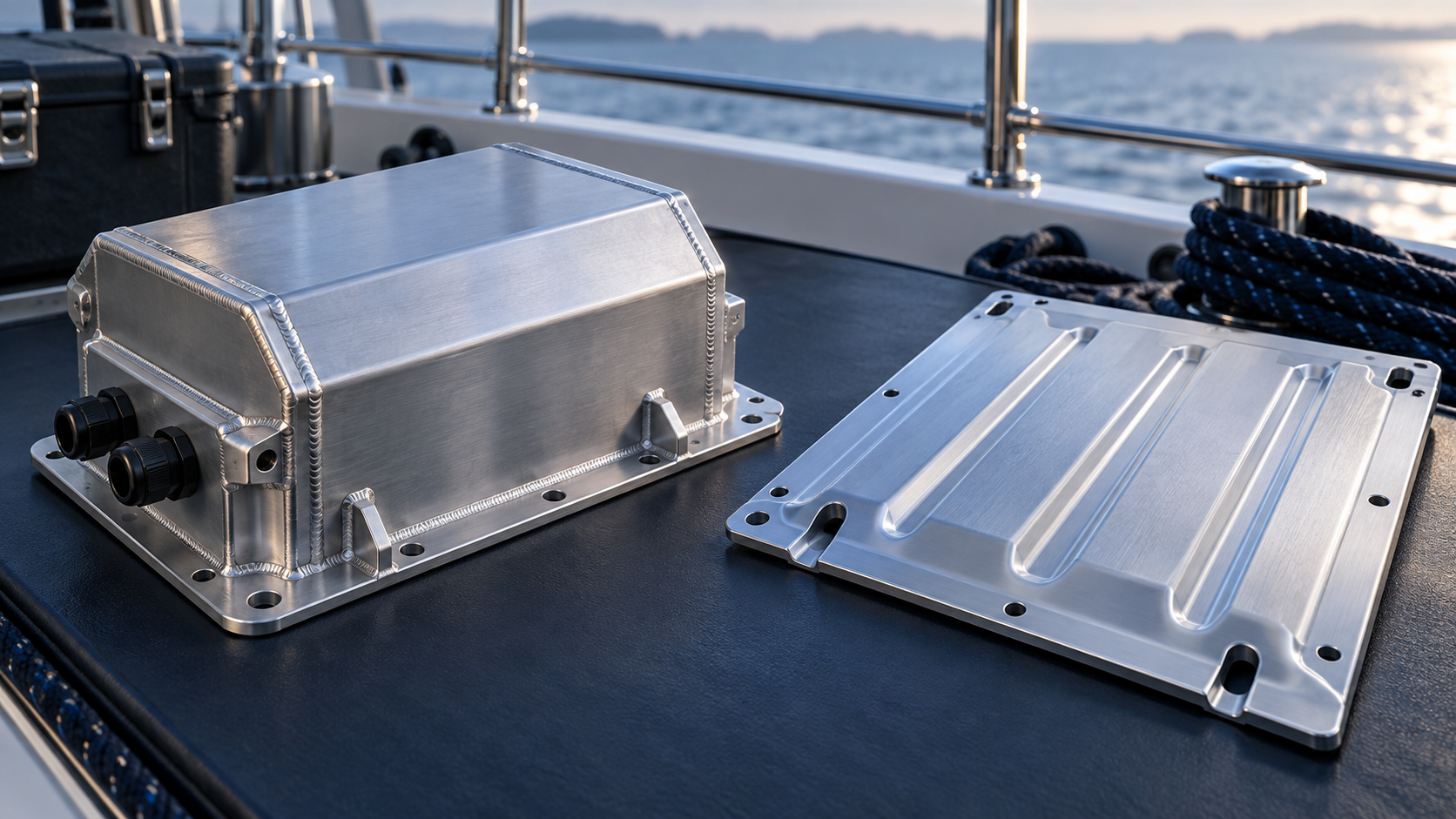
That distinction matters. A 5052-H32 electronics enclosure used above deck and primary hull plate are both “marine,” but they do not carry the same structural and documentation obligations. Likewise, EN AW-5754 may be suitable for a formed equipment cover without being the automatically approved hull alloy for a classified vessel.
For hulls, pressure-retaining parts, offshore structures or class-controlled equipment, start with the governing design code, class rule and approved material list. Specify any required corrosion test, certificate, traceability, weld procedure and inspection. ISO 12215-3 addresses material requirements for small-craft hulls, superstructures and appendages up to 24 m, but its applicability and edition must be confirmed for the project.
Step 6: plan forming, welding and final machining
Bending and deep forming
5052 and 5754 are both practical sheet-forming alloys. The softer O or H111 conditions generally provide more forming margin than stronger work-hardened conditions. Bend radius also depends on thickness, grain direction, tooling, edge quality and surface requirements. Use the applicable supplier or standard bend data for the exact temper rather than copying one radius across all gauges.
For a corrosion-resistant enclosure or cover, coordinate bend direction, corner relief, weld access, gasket compression and drainage before release. BAOSONG’s sheet metal fabrication page shows the relevant manufacturing route; the drawing still determines material, bend acceptance and final interfaces.
Welding
Both alloys are generally weldable by suitable aluminum processes. Welding changes the microstructure and local strength of strain-hardened sheet, so a design based on H-temper parent-metal strength must account for the weld and heat-affected zone. Filler alloy, joint design, cleaning, shielding, heat input and distortion control must follow the governing procedure.
A visually smooth bead is not proof of structural performance or corrosion durability. State whether the weld requires dimensional inspection, penetrant testing, leak testing or procedure qualification. For a sealed enclosure, distinguish a cosmetic continuous weld from a verified pressure or leak requirement.
Machining and assembled interfaces
These formable 5xxx alloys can machine differently from common free-machining aluminum choices. Thin sheet may deflect or develop burrs, and a welded assembly may move during final machining. Place close-tolerance bores, sealing faces and datum features into a deliberate post-weld CNC machining plan when function requires it. A drawing and manufacturing review can align the datum scheme, welding sequence and inspection condition.
Step 7: define surface protection, isolation and sourcing
Bare 5052 or 5754 may be acceptable in some atmospheric applications, but “corrosion resistant” does not mean maintenance-free. Coatings, conversion treatments or anodizing may be required for appearance, electrical behavior, wear, cleaning or added environmental protection. Define the governing finish specification, pretreatment, thickness or coating class, color tolerance, masking and acceptance condition.
Do not assume anodizing alone fixes poor joint design. Edges, welds, threaded contacts and trapped electrolyte need specific attention. The FAA’s corrosion-control guidance explains how dissimilar metals can form a galvanic couple when moisture is present. When stainless-steel fasteners, copper conductors or carbon-fiber components are present, review electrical isolation, sealants, washers, coatings and drainage as one corrosion-control system.
If anodizing is selected, identify dimensions that apply after finishing and surfaces that must remain conductive or coating-free. The BAOSONG anodized aluminum overview explains the information needed to quote and inspect the finish.
Selection guide by application
| Application condition | Practical starting point | What must be verified |
|---|---|---|
| Formed electronics or instrument enclosure in coastal air | 5052-H32 or a suitable 5754 sheet temper | Bend severity, gasket design, drainage, coating, fastener isolation and ingress requirements. |
| Welded tank or fabricated housing | Either may be evaluated | Fluid compatibility, weld procedure, HAZ properties, distortion and leak-test acceptance. |
| EN-specified formed transportation or marine-equipment panel | EN AW-5754 in the required temper | Exact EN product standard, thickness properties, surface and certificate. |
| AA/ASTM-specified general marine sheet component | 5052 in the required temper may be convenient | Purchase specification, exposure, structural demand and availability at quote time. |
| Hull, continuously immersed or class-controlled structure | Begin from the governing approved alloy list | Class/code approval, B928 or other specified corrosion testing, weld qualification and traceability. |
If strength, direct seawater exposure or hull rules exceed what either candidate can document, evaluate other specified marine alloys and tempers rather than forcing a 5052-versus-5754 decision.
How to compare cost and sourcing
There is no durable universal price difference between 5052 and 5754. Regional stock programs, temper, width, thickness, finish, certification, quantity and metal-market conditions change the quote. Material substitution can also create hidden engineering, qualification and inventory costs.
Compare total delivered-part cost using the same drawing revision and acceptance scope:
- sheet or plate size, nesting yield, remnant use and minimum order;
- forming, tooling, weld preparation, weld length and distortion control;
- post-weld machining, deburring and sealing features;
- pretreatment, coating, masking and cosmetic requirements;
- material certificates, weld records, inspection and corrosion testing;
- packaging that prevents contact damage or contamination in transit.
A current quotation is more useful than an online alloy price ratio. If both grades are acceptable, state the substitution approval process so the supplier can compare locally available material without weakening the engineering requirement. Ask the supplier to show the proposed fabrication route, because welding, forming and finishing can outweigh the base-metal difference.
How to verify the alloy and process before production
| Gate | Verification | Release record |
|---|---|---|
| Incoming material | Match alloy, temper, form, thickness, specification and heat/lot identity. | Certificate and traceability record |
| Forming trial | Inspect bend cracking, springback, surface marking and dimensional recovery on representative stock. | Approved first-off part and setup record |
| Welded assembly | Verify distortion, joint acceptance and any leak or nondestructive test after the defined weld sequence. | Weld and inspection report |
| Machined interfaces | Measure datums, bores and sealing faces in the specified unclamped, post-finish state. | Critical-dimension report |
| Corrosion system | Test the complete finish, fastener isolation, seals and drainage under a representative exposure. | Approved validation result and maintenance assumption |
Stop conditions: the material decision is not ready
- The requirement says only “marine grade” without alloy, temper, product form and governing specification.
- Strength values come from a different temper, thickness or product form than the quoted stock.
- The assembly can trap electrolyte, but drainage, sealing and dissimilar-metal isolation are unresolved.
- A welded H-temper part is sized from parent-metal strength without reviewing the heat-affected zone.
- A hull, immersed or class-controlled part has no approved material list or certification plan.
- Finish acceptance, masking, contact points or post-finish dimensions are undefined.
- 5052 and 5754 quotations use different thickness, test scope, finish or documentation.
Copy-ready RFQ checklist for 5052 or 5754 parts
- 2D drawing and 3D model with matching revision.
- Alloy, temper, product form, governing material standard and permitted substitutions.
- Service environment: atmospheric, splash, intermittent wetting, immersion or contained fluid.
- Structural load, fatigue, temperature, design life and applicable class or code.
- Weld process, joint acceptance, leak test and any qualified-procedure requirement.
- Finish specification, masking, galvanic isolation and cosmetic sample.
- Critical dimensions, datums and whether acceptance applies before or after finishing.
- Quantity, inspection report, certificate and traceability requirements; see the BAOSONG quality overview for useful project inputs.
Send BAOSONG your drawings and application requirements for a manufacturing review and quotation. Describe the real exposure and functional interfaces so material, fabrication, finishing and inspection can be considered together.
Frequently asked questions
Is 5754 stronger than 5052?
Not in every comparison. 5754 contains a somewhat higher magnesium range, but mechanical properties overlap and depend heavily on temper, thickness and product form. Compare specification minimums for the actual stock being purchased.
Is 5052 suitable for saltwater?
5052 has good service history and supplier documentation for marine atmosphere and saltwater-related components. Suitability still depends on whether the part is atmospheric, splash-zone, immersed or structural, plus joint design, galvanic isolation, finish and the governing standard.
Can 5052 and 5754 be welded?
Both are generally weldable with an appropriate process. The design must account for heat-affected-zone properties, distortion, filler selection and the inspection or qualification required by the application.
Can 5754 replace 5052 on a drawing?
Only through an approved substitution. Confirm composition standard, temper, thickness properties, forming, welding, corrosion exposure, finish, certification and any code or customer approval before revising the material callout.
Which alloy is better for a marine enclosure?
Either may work. 5052-H32 is a common practical starting point for formed sheet enclosures, while 5754 can fit EN-oriented supply and forming routes. Enclosure durability depends equally on seals, drainage, dissimilar-metal isolation, coating and inspection.
Recommended Downloads for Aluminum Alloy Selection
Use these BAOSONG references to compare alloy families, temper conditions, machinability, strength, corrosion resistance and design implications before quotation.
- Aluminum Alloy Comparison Chart (editable Excel)
- Tolerance Reference Guide (PDF)
- Aluminum CNC Machining Design Guide (PDF)
- Aluminum Part Design Checklist (editable Excel)
Need help choosing an alloy or temper for your application? Contact BAOSONG Precision.