
Quick answer: what is the difference between prototype and production CNC machining?
Prototype CNC machining is organized to learn quickly; production CNC machining is organized to repeat an approved result. A prototype may validate geometry, assembly, material behavior or a finish using flexible workholding and a rapidly prepared program. Production requires a controlled revision, repeatable fixtures, managed tools, stable process checks and an inspection plan suited to recurring batches.
The machine type may be the same, and both stages can produce high-quality aluminum parts. The difference is the manufacturing system around the machine. Prototype success proves that a specific part was made and tested; it does not automatically prove that the route is capable, economical or controlled for continuing production.
There is no universal quantity at which a job becomes “production.” Design maturity, order frequency, setup effort, documentation, risk and expected lifetime demand matter alongside part count. Plan the transition when repeatability and supply continuity become more valuable than rapid design change.
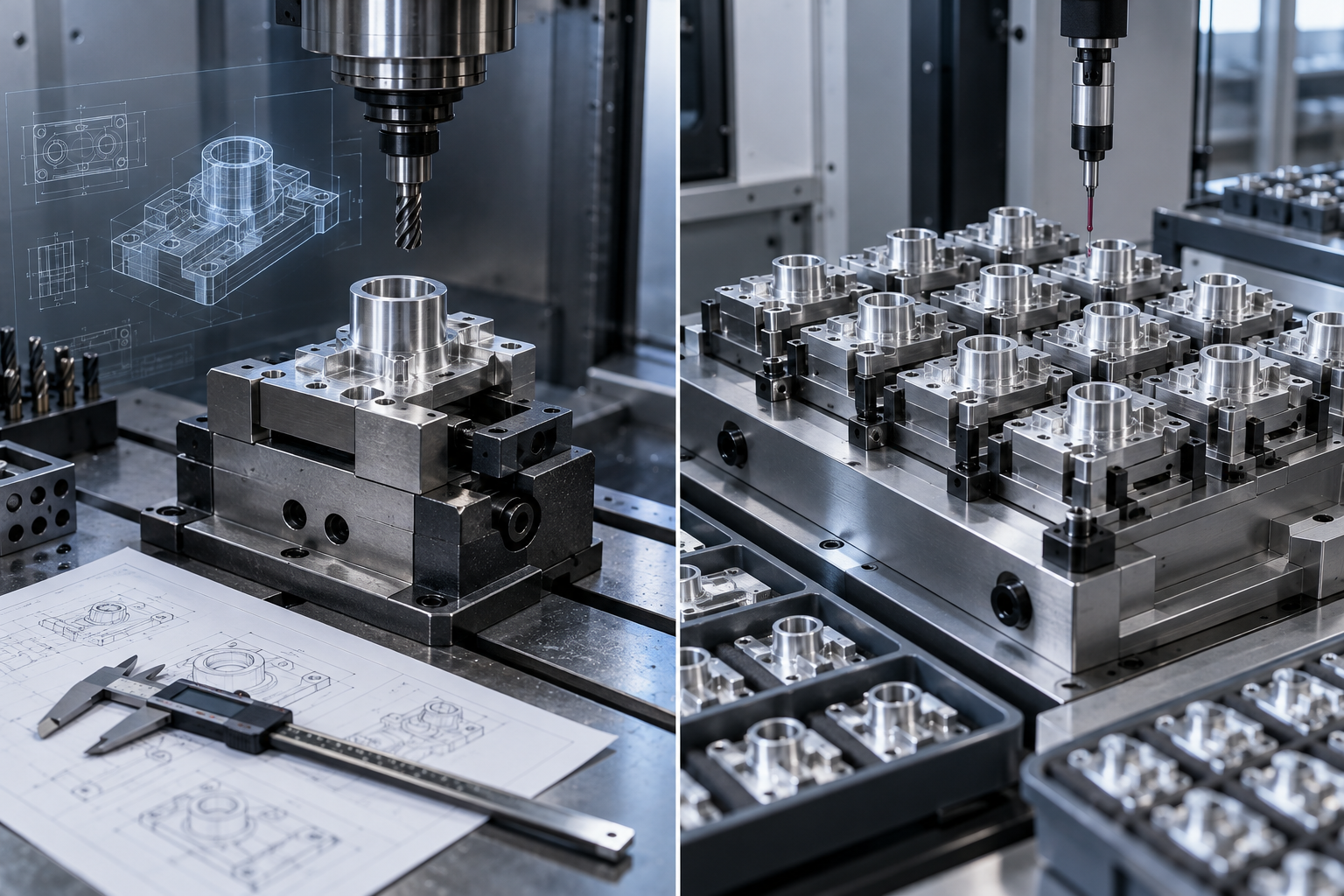
Use this guide as a production-readiness review
- Name the prototype question: record whether the build is proving fit, load, sealing, thermal behavior, appearance or the manufacturing route.
- Close the design gaps: reconcile the model and drawing, then approve material, temper, finish, datums and acceptance criteria.
- Run a production-intent pilot: use the intended fixture, tools, finish, inspection and packaging wherever the risk justifies it.
- Release repeat supply: approve the process evidence, reaction plan and change-control rules before treating the route as production.
Prototype vs production CNC machining at a glance
| Decision area | Prototype machining | Production machining | Transition question |
|---|---|---|---|
| Primary objective | Learn about fit, function, geometry, material or finish. | Repeat the released product at a controlled rate and quality. | Which learning questions are closed? |
| Product definition | May change between iterations under design control. | Frozen revision with formal change management. | Is one model/drawing package approved? |
| Workholding | Flexible vises, soft jaws or modular fixtures. | Repeatable fixture strategy justified by demand. | Will location and clamp force remain stable? |
| Process control | Close observation and direct adjustment may be practical. | Tool-life rules, offsets, checks and reaction plans are documented. | What changes as tools and temperature drift? |
| Inspection | Focused on learning and design validation. | First article, in-process and lot acceptance matched to risk. | What evidence must accompany every order? |
Prototype machining should maximize useful learning
A prototype is valuable when it answers a defined question. A form model may confirm envelope and assembly access. A functional aluminum prototype may evaluate stiffness, heat transfer, sealing, thread retention or surface treatment. The drawing should distinguish features needed for the test from features that are provisional.
Do not spend prototype time perfecting noncritical cosmetic details if the immediate question is mechanical fit. Conversely, do not remove the production alloy, heat treatment or interface finish when those conditions control the test. Record deviations so test results are not attributed to a production configuration that was never built.
Flexible tooling and direct communication can be sensible for a small learning batch. The goal is a traceable decision, not a falsely low production unit price.
Production machining needs a repeatable system
Recurring supply requires more than replaying the prototype program. The production route must define stock, workholding, tool list, cutting strategy, in-process checks, finishing, inspection, cleaning, packaging and reaction to nonconformance. It should survive normal variation in material lots, tool wear, operators and environmental conditions.
NIST guidance on process capability distinguishes an in-control process from its relationship to specification limits. One acceptable prototype does not provide a capability distribution. Production evidence must come from the controlled process and an appropriate amount of data.
Freeze the product definition before optimizing production
Dedicated fixtures, automation and validated inspection are difficult to justify while datums, hole patterns or finishes keep changing. Release one matching 3D model and 2D drawing, identify the authority of each, and establish formal revision control.
ASME describes Y14.5-2018 (R2024) as a common language for dimensional and geometric requirements. Use the governing standard and edition required by the project. Functional datums and tolerances should remain consistent from prototype test through production inspection.
Re-evaluate material and stock form
A prototype may begin from readily available plate or bar. Production volume can justify a closer blank, extrusion, forging or casting, but a route change can alter material properties, residual stress, surface condition and feature allowance. It may require new qualification.
Specify alloy, temper, product form and material standard. Use the aluminum alloy selection guide and compare extrusion with machining from billet before locking a long-term supply route.
Move from flexible fixtures to repeatable workholding
Prototype fixtures favor speed and adaptability. Production fixtures favor repeatable location, controlled clamp force, chip clearance, quick loading and durable contact surfaces. A dedicated fixture should reference the drawing datums or a deliberate manufacturing datum transfer.
Check whether thin walls or open frames distort under production clamping. Add supports without hiding burrs or blocking measurement. Define fixture maintenance and what happens when locating surfaces wear.
Optimize programs only after geometry stabilizes
A prototype program may use conservative paths and extra handling because revision risk is high. Production planning can reduce air cuts, combine tools, balance roughing and finishing, and load several parts when the approved geometry is stable.
Do not remove process margin merely to shorten cycle time. Tool engagement, chip evacuation, thermal behavior and part stiffness must remain controlled. Use the aluminum CNC milling page for machining context and review time reduction against the approved function.
Manage tools, offsets and process drift
A skilled machinist may watch one prototype closely and adjust it directly. Production needs agreed rules for tool life, sister tools, offset changes, in-process measurements and reaction limits. The first piece, middle of the run and last piece should belong to the same controlled process.
Critical features may need staged control: verify stock and datum contact, inspect after roughing where distortion risk is high, then confirm final geometry after release and finishing. The controls depend on feature risk and batch size.
Change the inspection plan as the objective changes
Prototype inspection should confirm the characteristics needed for the test and reveal design or process risk. Production inspection must support acceptance across repeat parts and repeat orders. Define first-article scope, critical-feature frequency, lot sampling, report format and traceability.
NIST’s work on measurement uncertainty explains why a result is an estimate with associated uncertainty. Match the device, fixture, environment and decision rule to the tolerance. Connect these requirements to the quality and inspection plan.
Prototype finishes do not automatically qualify production appearance
A hand-selected prototype can look excellent without proving lot-to-lot color and texture consistency. Production finishing requires defined specifications, cosmetic zones, approved samples where relevant, masking, racking, handling and final acceptance criteria.
State which dimensions apply after processing and which electrical, sealing or bearing interfaces are protected. Coordinate surface finishing and anodized aluminum requirements before releasing production tooling.
Use pilot builds as a controlled bridge
A pilot batch tests the production-intent route before recurring supply. It can reveal fixture loading issues, tool wear, chip accumulation, inspection bottlenecks, finish variation and packaging damage that a one-off prototype does not expose.
Define the pilot’s questions and acceptance criteria. Record changes to program, fixture, tooling and inspection. A pilot is useful evidence for readiness, but its scope must match the process and risks.
Decide when to invest in production tooling
Quantity alone is insufficient. Consider expected repeat demand, revision stability, setup time, fixture complexity, machine capacity, inspection effort and the consequence of failure. A modest recurring order may justify dedicated soft jaws; a larger but unstable program may still need flexible tooling.
Compare nonrecurring engineering and tooling with the total lifetime route. Include replacement fixtures, spare tools, validation and inventory. The lowest prototype quote may not be the best production plan.
Do not use a fixed quantity threshold
Public supplier guides often publish volume bands, but those ranges reflect their own equipment, commercial model and definitions. RivCut’s prototype-versus-production guide, for example, distinguishes flexible standard workholding from optimized production fixtures. Matrix Manufacturing’s buyer planning guide emphasizes the change from feedback-oriented work to repeat demand. These are useful comparisons, but neither establishes an industry-wide unit threshold.
A complex safety-critical part ordered ten at a time may need production-level process control and traceability. A simple bracket ordered in a larger but one-time development batch may still benefit from flexible tooling. Decide from revision stability, repeat forecast, process risk, documentation and the cost of rebuilding the route.
Protolabs’ CNC machining guide also covers both prototypes and end-use production parts. Treat any supplier’s published quantities, turnaround or capability limits as service-specific; request a quotation for the controlled BAOSONG project package.
Plan change control for recurring orders
Production readiness includes the ability to manage change. Define who can revise the model, drawing, material source, finish, inspection method, fixture or program. Evaluate whether the change requires a new first article, partial requalification or customer approval.
Keep the released revision linked to purchase orders, material records and inspection reports. When a corrective action changes a process parameter or tool, record the reason and confirm that approved product requirements remain satisfied. This protects repeatability across batches without freezing useful improvement.
Define the retention period and access for production records according to customer and regulatory requirements. A repeat order should be traceable to the same approved product definition even when personnel, material lots or scheduled machines change.
Use a prototype-to-production gate
The diagram and checklist below show the evidence needed before changing from learning-oriented machining to controlled repeat supply.
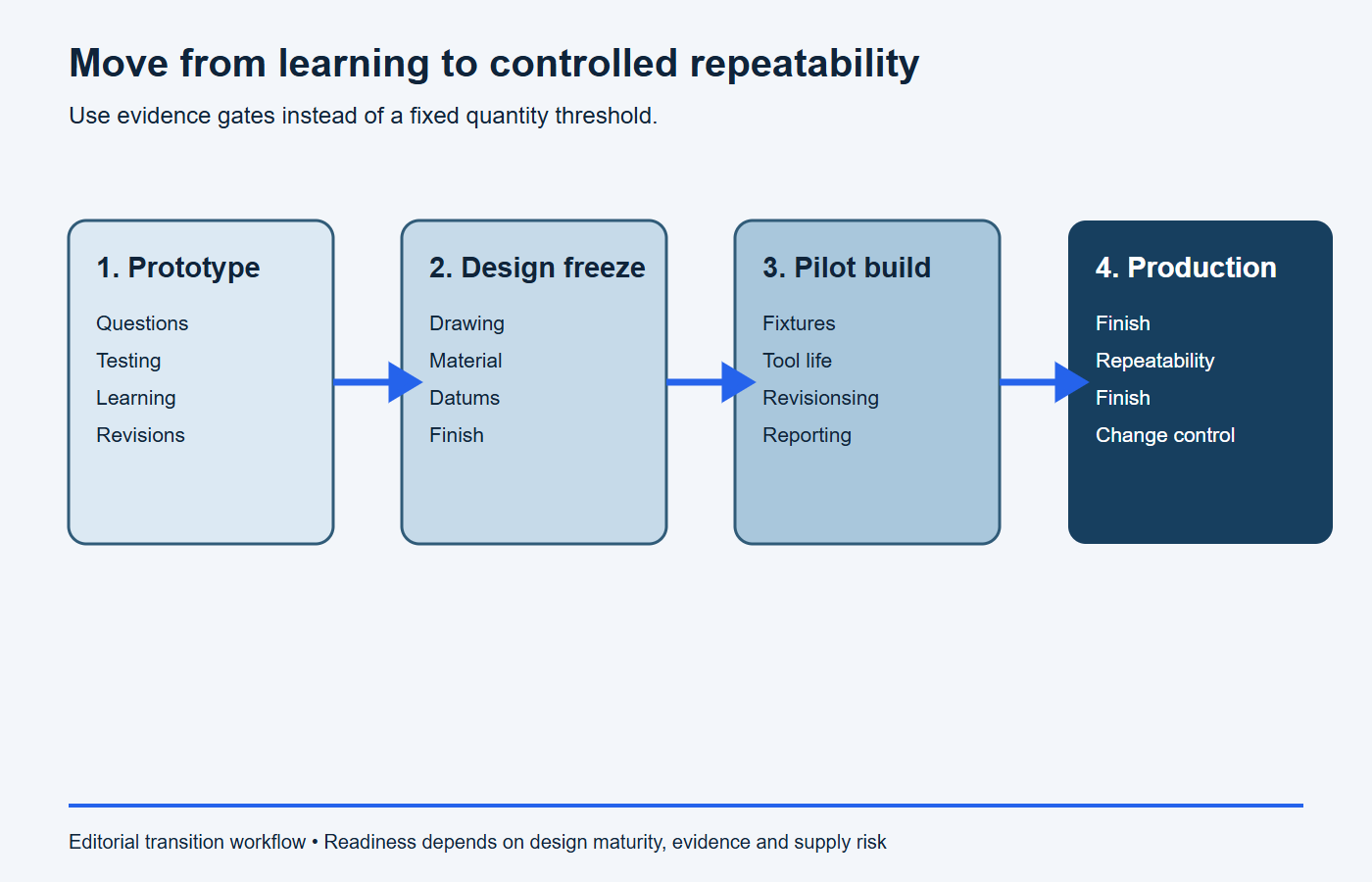
| Gate | Question | Evidence | If incomplete |
|---|---|---|---|
| Function | Has the prototype answered fit, load, seal, thermal and lifecycle questions? | Test record and approved conclusions. | Run targeted design validation. |
| Definition | Are model, drawing, material and finish frozen? | Released revision and change authority. | Keep flexible tooling. |
| Process | Are fixtures, tools, sequence and controls documented? | Production-intent router and setup. | Complete pilot planning. |
| Quality | Are inspection, sampling, traceability and reaction rules approved? | Control and inspection plan. | Resolve acceptance before shipment. |
| Supply | Are material, finish capacity, packaging and repeat demand understood? | Approved supply route and forecast. | Identify capacity and continuity risks. |
Stop conditions: the job is not ready for recurring production
- The prototype passed, but its alloy, temper, stock form, finish or geometry differs from the released product.
- The 3D model, drawing and purchase order identify different revisions or conflicting requirements.
- Dedicated fixtures or automation are proposed while critical interfaces are still changing.
- The pilot did not use the intended production process, inspection method or outside finishing route.
- Acceptance, sampling, traceability, nonconformance response or supplier-change approval remains undefined.
Copy-ready prototype-to-production request
Paste this text into the RFQ or supplier review and replace the brackets:
Part [number/revision] is moving from [prototype stage] to [pilot/recurring production]. Expected demand is [batch size, annual quantity and forecast]. The prototype has verified [functions], while these questions remain open: [list]. Please propose a production-intent route covering stock, fixtures, tools, process checks, finishing, inspection, traceability and packaging. Separate one-time engineering/tooling cost from recurring unit cost. Identify which pilot evidence is required before release and which later changes require notification, first-article inspection or customer approval.
What to include in your RFQ
- Project stage: prototype, pilot, bridge or recurring production.
- Matching model and drawing revision.
- Alloy, temper, stock form and material documentation.
- Functions being tested and criteria already approved.
- Annual demand, batch size and forecast confidence.
- Critical datums, tolerances and finished-state requirements.
- Inspection, reports, sampling and traceability.
- Finish, masking, cosmetic zones and approved samples.
- Packaging, cleanliness and change-control requirements.
Use BAOSONG’s engineering-support resources or send the drawing, stage and quantity requirements. A useful quotation should show which costs support learning and which investments support repeat production.
Frequently asked questions
Can production parts use the prototype program?
Possibly, but it should be reviewed for fixtures, tool life, process checks, cycle time and revision status before recurring use.
Does a successful prototype prove process capability?
No. It demonstrates one result under its conditions. Capability requires an in-control process, specification comparison and suitable data.
When should a pilot run happen?
After major design questions are closed and before committing to recurring production, especially when fixtures, finish, inspection or supply route changed.
Should prototype and production use the same material?
Use production-intent material when its properties affect the test. Any substitution or product-form change must be recorded and evaluated before production approval.
Recommended Downloads for CNC Machining Design
Use these BAOSONG references to improve tool access, feature geometry, practical tolerances and CNC process planning before release.
- Aluminum CNC Machining Design Guide (PDF)
- CNC Milling Guide: Pockets, Walls, Corners & Tool Access (PDF)
- CNC Turning Guide: Diameters, Threads & Concentric Features (PDF)
- CNC Machining Tolerance Guide (reference sheet)
- Aluminum Part Design Checklist (editable Excel)
Need help reviewing a machined part or feature stack? Contact BAOSONG Precision.