
Quick answer: how should aluminum parts be protected for packaging and transport?
Protect aluminum parts with a layered system: clean and dry the part, isolate every critical surface, prevent part-to-part contact, immobilize the load, control moisture where required, and place the protected parts in a container that carries stacking and handling loads. The package should be designed for the actual transport route and storage time.
Choose direct-contact materials for the specific finish. Bare machined, polished, brushed, anodized and powder-coated aluminum can react differently to films, papers, foams, adhesives, cleaners and corrosion inhibitors. Validate that the protection does not scratch, stain, transfer residue, trap moisture or interfere with later bonding, painting or assembly.
Verify the complete packed unit through a risk-based transport test and inspect both package and parts afterward. A box that remains intact can still allow micro-movement, fretting, dents or water staining inside. Packaging acceptance should include cosmetic surfaces, critical dimensions, threads, cleanliness, corrosion condition, labels and lot traceability.
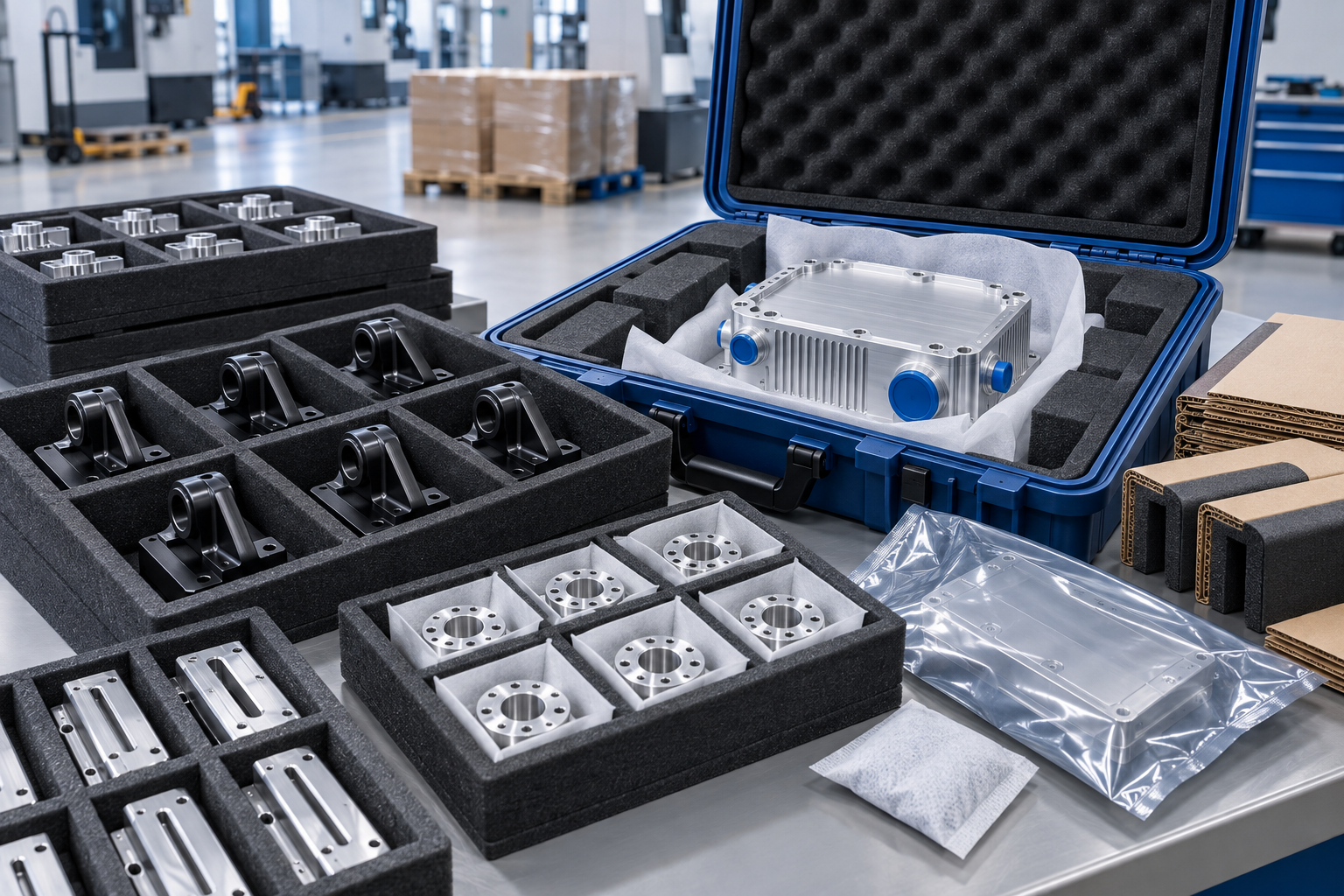
Use this five-step packaging release process
- Define the delivered condition: list cosmetic, dimensional, cleanliness, corrosion and traceability requirements.
- Map distribution hazards: record shipment mode, transfers, stacking, shock, vibration, humidity, storage and customs opening.
- Build protection in layers: select compatible surface contact, individual separation, restraint, moisture control and outer structure.
- Pack production-equivalent parts: follow the real cleaning, drying, counting, labeling, sealing and palletizing method.
- Test and inspect: run the selected transport sequence, then inspect both package and every protected product characteristic.
Start with the delivered requirement, not the box
Packaging protects the characteristics the customer will inspect. A structural bracket may tolerate a minor visual rub but cannot arrive bent. A polished enclosure may remain dimensionally correct yet fail because of one scratch. A seal face, bearing bore or electrical contact needs cleanliness and geometry in addition to cosmetic protection.
List the conditions that must survive:
- primary and secondary cosmetic surfaces;
- precision fits, seal faces, datums and flat mounting lands;
- external and internal threads, thin fins, sharp corners and protruding bosses;
- anodized, polished, brushed, painted or powder-coated appearance;
- cleanliness, residue, particle and corrosion requirements;
- part identity, orientation, revision, finish lot and matched sets;
- customer unpacking, kitting and line-side presentation.
Connect the list to the controlled drawing and purchase specification. The package cannot compensate for an undefined cosmetic class or a missing final inspection requirement. Early review through engineering support can align contact zones, inspection criteria and packing inputs before production release.
Build a transport-risk profile
The correct system depends on distribution hazards, not only part value. Define shipment mode, parcel versus pallet network, number of handling transfers, expected stacking, vibration, shocks, temperature and humidity changes, route duration, storage time, opening for customs or inspection, and whether the package will be returned or reused.
ASTM D4169-23e1 provides a uniform basis for laboratory evaluation of shipping units through sequences representing anticipated distribution hazards. It does not replace the product’s material or preshipment requirements. Select the distribution cycle and assurance level from project evidence rather than using the same test for every shipment.
Small parcel, air freight, truck, rail, ocean container and internal factory transfer expose the package differently. A system proven for one route should not be assumed suitable for a longer route, different pallet pattern or extended warehouse storage without review.
Use a layered packaging architecture
| Layer | Primary job | Typical design questions | Evidence |
|---|---|---|---|
| Part condition | Clean, dry and released product | Which cleaner, dryness and handling rules apply? | Final inspection and packaging release |
| Direct-contact protection | Prevent abrasion, residue and local damage | Which film, interleaf, cap or sleeve is compatible with the finish? | Compatibility and aging trial |
| Separation and cushioning | Stop movement and absorb shocks | Where may the part be supported and how much load can the material carry? | Fixture check and transport test |
| Moisture control | Limit condensation, water and corrosive exposure | Is a sealed barrier, desiccant or inhibitor required? | Seal and environmental validation |
| Outer container | Carry compression, puncture and handling loads | Carton, crate, case or reusable tote; how is it closed? | Compression, impact and handling test |
| Unit load and marking | Maintain pallet stability and communicate handling | Stacking, center of gravity, lift points, orientation and traceability? | Pallet audit and label verification |
Clean and dry parts before packaging
Packaging can trap coolant, rinse water, fingerprints, abrasive particles and cleaning residue against aluminum. A part that looks dry on an open bench may still hold liquid in blind holes, capillary gaps, threads or porous packaging contact. Seal only after the approved drying process is complete.
Define the final cleaner and whether any protective oil or inhibitor is allowed. Residue can interfere with adhesive bonding, painting, electrical contact, vacuum use or customer cleanliness requirements. If a removable protector is used, specify the approved removal method and whether the customer accepts that step.
Use clean gloves and fixtures that contact non-critical zones. Do not place a finished part back into a tray contaminated with chips from machining. The packing area, interleaf and air supply should support the required cleanliness class.
Prevent aluminum water staining
Aluminum can develop water stains when moisture is trapped between closely contacting surfaces and cannot evaporate. Condensation can occur when cold metal enters warm, humid air or when packages experience temperature cycles. The outer carton may remain dry while moisture develops inside a barrier.
The Aluminum Association’s water-staining guidance focuses on shipping, handling and storage practices that minimize this risk. Its in-plant handling guide warns that trapped water between wraps, sheets or mating surfaces can stain aluminum and that interleaving paper does not eliminate normal moisture precautions.
Allow temperature equalization before opening cold packages in humid areas when the validated process requires it. Keep parts off wet floors and away from roof or door leaks. If a barrier bag is used, control the atmosphere at sealing and verify closures rather than assuming the word “barrier” guarantees dryness.
Separate every part and stop relative movement
Most cosmetic scratches begin with ordinary vibration, not a dramatic drop. If two aluminum parts can touch, small repeated movements can rub through protective layers or create bright witness marks. Interleaf alone may not stop sliding if the stack is loose.
Use cells, dividers, sleeves, nests or retainers that keep parts separated and carry their loads through approved support surfaces. The part should not be able to escape its pocket when the container is tilted, inverted or vibrated within the expected route. Avoid point loads on polished faces, thin fins and sharp edges.
For cosmetic aluminum parts, surface zoning should guide contact locations. Place the controlled contact map in the packaging specification rather than relying on an unpublished reference or informal packing knowledge.
Select direct-contact materials by finish compatibility
Foam density alone does not establish compatibility. Cell structure, surface skin, additives, plasticizers, particles, compression set and aging can affect the finish. A soft foam can collapse under a heavy part and permit impact; a firm foam can emboss or polish a matte anodized surface during vibration.
Test paper, nonwoven interleaf, film, bags, caps, tapes and adhesives against the actual final finish. Include temperature, humidity, storage duration and cleaning in the trial. Watch for lint, color transfer, adhesive residue, gloss change, imprinting, abrasion and chemical staining.
Do not apply adhesive film across a cosmetic anodized or powder-coated face without validating peel behavior after aging. Define when film is applied, maximum dwell time, storage limits, removal direction and who removes it.
Protect different aluminum finishes differently
| Surface condition | Main packaging risk | Protection focus | Verify after trial |
|---|---|---|---|
| Bare as-machined | Staining, oxidation, chip scratches and residue | Cleaning, drying, separation and compatible corrosion control | Cleanliness, critical texture and dimensions |
| Polished | Fine scratches, fingerprints, haze and pressure imprint | Non-abrasive direct contact and minimal movement | Reflection, gloss, waviness and residue |
| Brushed | Cross-grain rubbing and inconsistent direction | Keep contact clean and movement parallel only if validated | Grain continuity and isolated marks |
| Anodized | Rub marks, color transfer, water spots and edge damage | Compatible interleaf, dry packing and contact-zone control | Color, gloss, scratches and rack/mask areas |
| Powder-coated or painted | Blocking, scuffing, edge chips and foam imprint | Confirm full cure and compatible non-marring supports | Coating adhesion, gloss, texture and edges |
| Conversion-coated or bond-ready | Contamination and loss of downstream adhesion | Clean barrier and approved materials | Surface condition and process time window |
Coordinate packaging with surface finishing and anodized aluminum requirements. The packaging release should reference the same final finish revision used for inspection.
Protect threads, bores, edges and protrusions
External threads, connector bosses and thin ribs can punch through flexible packaging or concentrate impact loads. Internal threads and precision bores can collect particles. Use caps, plugs, sleeves or rigid guards whose fit is validated for the feature and finish.
A plug should not distort a thin wall, damage a thread or leave residue. A cap must remain installed through vibration and removal without scratching the finished edge. If the feature is sealed for moisture protection, verify that trapped process liquid was removed before closing it.
Edge protectors should transfer load around, not into, a critical corner. Keep straps and bands from bearing directly on finished aluminum. For CNC-machined aluminum, identify packaging contact zones beside the cosmetic and dimensional callouts.
Support heavy parts through structural surfaces
Heavy parts compress foam and corrugated materials over time. If the cushion collapses, the component can move, strike the container or load a precision face. Design a clear load path from the part through supports to the outer container and pallet.
Cradles, blocking and bolted or strapped fixtures may be appropriate for large parts, but they must contact strong approved regions. Restrain motion in every direction expected during handling. Verify fastener retention and prevent metal hardware from loosening onto a cosmetic surface.
Account for stacking and forklift handling. A pallet deck or crate base should not deflect into the product space. Mark lift and center-of-gravity information when needed and ensure the package can be handled without placing forks, slings or clamps against the part.
Keep long extrusions straight and isolated
Long aluminum extrusions can bend, twist, dent at supports or rub along their length. Short blocks placed too far apart may create sag; tightly bundled profiles can fret if the separator system allows longitudinal movement.
Support the profile at validated intervals and protect ends, corners and visible faces. Unitize the bundle so loads are distributed without crushing thin walls. Maintain grain or finish orientation where matched visible extrusions will be assembled.
For aluminum extrusion services, packaging should preserve straightness, surface class, cut-end condition and lot identity. Validate the full bundle, not only a single wrapped sample.
Use moisture barriers, desiccants and inhibitors correctly
A desiccant is effective only within a sufficiently closed moisture-barrier system and for the specified environment and duration. Size, placement, barrier permeability, initial humidity, package volume, storage and opening frequency all matter. Loose desiccant cannot compensate for an unsealed or punctured bag.
Corrosion-inhibiting papers or films are product-specific. Confirm that the chemistry is intended for the aluminum alloy and finish and does not contaminate later bonding, painting, electronics or clean assembly. Do not assume a protector designed for ferrous metal is suitable for every aluminum application.
Moisture indicators or data loggers can support validation when the consequence warrants them. They do not replace sealing, drying or physical inspection. Define disposition if the indicator exceeds its agreed condition.
Choose outer containers and closures for the load
Corrugated cartons, plywood crates, molded cases and reusable totes serve different mass, route and reuse needs. Select wall strength, closure, puncture resistance and internal clearance from the complete packed weight and hazards. The internal pack should not rely on the outer wall touching the part for restraint.
ASTM D3951-18(2023) establishes commercial packaging requirements for supplies and equipment within its stated scope. Project contracts, export rules, dangerous-goods regulations and customer standards may impose additional requirements; identify them before packaging design.
Tape, staples, straps and fasteners must remain secure without entering the product space. Reusable containers need inspection criteria for worn foam, broken latches, contamination, water ingress and missing components before each cycle.
Mark packages for handling and traceability
ISO 780:2015 defines graphical symbols used to communicate handling and storage instructions on distribution packages. A symbol is useful only when package design and logistics practice support the instruction.
Label the shipment with part number, revision, quantity, lot or heat identity when required, finish lot, purchase order, package sequence and matched-set information. Keep labels readable through the expected route and avoid adhesives or inks that can transfer to the product.
Use orientation, stacking, keep-dry, lift-point or center-of-gravity markings only as applicable. Do not use “fragile” as a substitute for internal restraint or a validated container.
Validate packaging with representative parts
Testing should use production-equivalent part mass, center of gravity, finish, trays, separators, barrier, container, closures and pallet pattern. Substituting a smooth dummy weight may miss sharp features, pressure points, rubbing or finish interactions.
Condition packages when temperature and humidity affect materials or the route. ISO 2233:2000 addresses conditioning of complete filled transport packages and unit loads for testing. The ISTA test-procedure guidance distinguishes screening, partial-simulation and general-simulation approaches; select the route and conditions from actual distribution hazards rather than applying one generic test.
A risk-based sequence may include compression, vibration, shock, drop or handling events. Record the setup and package orientation. Development testing may justify opening between stages to locate a failure; final performance qualification should follow the selected standard’s rules.
Inspect the product after transport testing
Passing means the delivered product still meets its requirements, not merely that the container looks acceptable. After the sequence, inspect packaging deformation, restraints, separators, barrier seals, moisture condition and labels before removing parts.
Then inspect:
- scratches, scuffs, dents, edge impacts and finish transfer;
- water stains, corrosion, haze, fingerprints and residues;
- critical dimensions, flatness or alignment where transport can affect them;
- threads, bores, caps, plugs and protruding features;
- cleanliness and any bond-ready or electrical-contact surface;
- part count, orientation, matched sets and traceability.
Connect results to the project’s quality records. If a failure occurs, preserve its location in the pack; the pattern often reveals inadequate support, movement, moisture or a weak container direction.
Common packaging failures and corrective direction
| Observed failure | Investigate first | Corrective direction | Do not assume |
|---|---|---|---|
| Parallel rub marks on adjacent parts | Relative movement, separator collapse and pack looseness | Individual cells, improved restraint and compatible interleaf | A thicker bag alone will stop motion |
| Dents at one corner | Point load, drop orientation and insufficient clearance | Structural support and energy-absorbing space | Soft foam anywhere is sufficient |
| Water spots after ocean or winter route | Drying, condensation, barrier seal and temperature transition | Validated barrier and moisture-control process | Aluminum cannot corrode in packaging |
| Foam pattern on anodized face | Contact pressure, vibration, heat and material compatibility | Change support zone or direct-contact material | Soft touch means non-marring |
| Thread caps loose in carton | Fit, installation, vibration and temperature | Qualified cap design and retention check | One cap size fits every tolerance |
| Outer box intact but part scratched | Internal restraint and debris | Cleanliness audit and movement control | Container condition proves product condition |
| Labels correct but matched sets mixed | Tray and package-level identity control | Serialized positions and packing verification | One outer label controls internal arrangement |
A practical packaging-development workflow
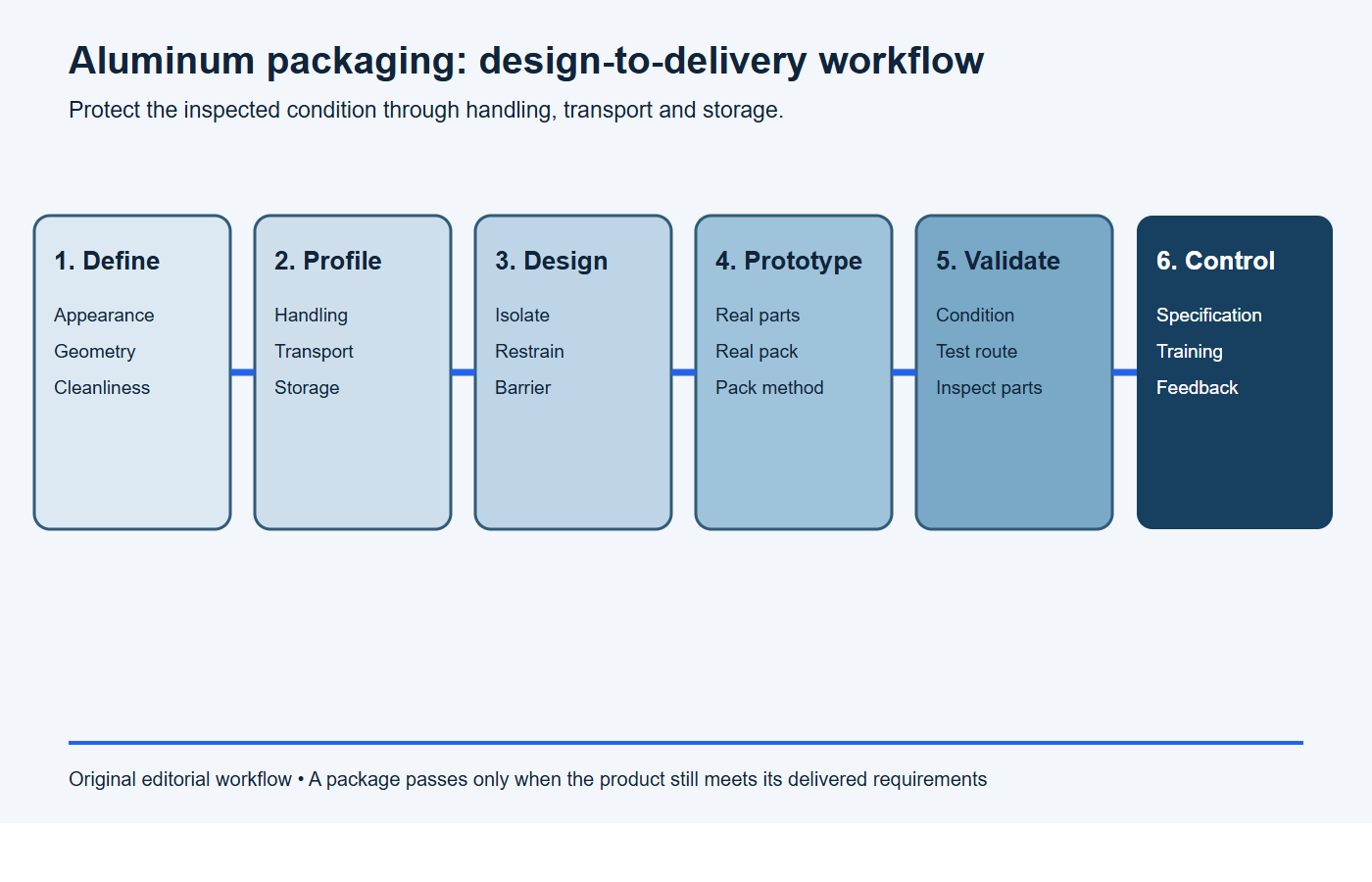
- Define: list cosmetic, dimensional, cleanliness and traceability requirements.
- Profile: map transport, handling, stacking, storage and environmental hazards.
- Design: select compatible direct contact, restraint, barrier and outer container.
- Prototype: pack representative parts using the production method.
- Validate: run the selected sequence and inspect package and product.
- Control: release specifications, train packers and monitor incoming results.
Stop conditions: the package is not ready for shipment
- Finished parts can touch, shift, rub or transmit load into cosmetic faces, thin fins, threads or precision interfaces.
- Direct-contact film, paper, foam, adhesive or corrosion inhibitor has not been tested on the final finish.
- Parts enter the package with trapped chips, cleaner residue or moisture, or the barrier and desiccant system is undefined.
- The outer carton or crate carries stacking and strap loads through the product instead of approved support zones.
- Transport testing checks the container only and omits cosmetic, dimensional, cleanliness and traceability inspection afterward.
Copy-ready aluminum packaging work instruction
For part [number/revision/finish], clean and dry using [approved method]. Inspect [critical surfaces/features], then place one part in each [cell/tray/bag] with contact only at [approved zones]. Install [caps/plugs/interleaf/film], prevent movement in every direction and apply [barrier/desiccant] for [validated environment and duration] when required. Pack [quantity] per carton and [quantity] per pallet using [closure/unitization]. Label part, revision, lot, quantity and orientation. Validate to [transport test and cycle], then reinspect package, appearance, dimensions, cleanliness, corrosion and identification.
Packaging specification checklist
- part number, drawing and finish revisions;
- quantity per cell, tray, carton and pallet;
- approved contact and support zones;
- direct-contact material, supplier and cleanliness requirement;
- caps, plugs, film, interleaf, separators and retention method;
- moisture barrier, desiccant or inhibitor system when required;
- outer container, closure, pallet and unitization;
- package dimensions, mass, stacking and handling limits;
- labels, orientation, lot control and matched-set rules;
- storage environment and maximum validated duration;
- transport route, test standard, cycle and acceptance criteria;
- packing photos, work instructions and receiving inspection.
Send these inputs through the BAOSONG project review form. Packaging should be reviewed with machining, finishing and inspection before the first production shipment.
Frequently asked questions
Can aluminum parts touch each other inside a package?
They should not touch when appearance, edges or precision features can be damaged by movement. Use individual cells or validated separators and restraint.
Is bubble wrap enough for CNC aluminum parts?
It may provide limited separation for suitable light parts, but it does not automatically control load, movement, cleanliness, moisture or sharp features. Validate the complete pack.
Do anodized aluminum parts need moisture protection?
They can still develop water spots, stains or packaging marks. Select moisture and direct-contact controls for the actual finish, route and storage period.
Should desiccant be placed in every carton?
Not automatically. Desiccant needs a defined sealed barrier, quantity, environment and duration. An open carton does not provide a controlled dry volume.
Can protective film damage aluminum?
Yes. Adhesive residue, gloss changes, imprinting or difficult removal can occur after heat or aging. Test the film on the final finish and define removal conditions.
How do we know the package is strong enough?
Develop a risk profile, select an applicable packaging test standard and test production-equivalent packed units. Inspect the product as well as the container afterward.
Request an aluminum packaging review
BAOSONG can review part geometry, finish sensitivity, support zones, moisture risks, packing instructions and receiving evidence as one delivery-quality system. Share the drawing, route and packaging requirement through contact us for project-specific feedback.
Recommended Downloads for Packaging & Cosmetic Protection
Use these BAOSONG reference files to define protection, appearance acceptance and release documentation for aluminum components.
- Packaging & Cosmetic Protection Guide (PDF)
- Packaging Requirement Template (editable Excel)
- Cosmetic Surface Requirement Template (editable Excel)
- Appearance Requirement Template (editable Excel)
- Inspection & Documentation Guide (PDF)
Need help matching the files to your drawing or packaging route? Contact BAOSONG engineering support.