
Quick answer: which aluminum should you choose for an EV battery enclosure?
Start with the enclosure architecture and its verified load cases. For extruded perimeter rails and cross-members, 6xxx-series alloys such as 6061, 6082 or an OEM-approved crash alloy are common candidates. For formed trays and covers, suitable 5xxx- or 6xxx-series sheet may be evaluated. For machined sealing interfaces, brackets and prototypes, 6061-T6/T651 is a practical starting point. Cooling plates may use 3xxx-, 5xxx- or 6xxx-series products depending on whether they are roll-bonded, brazed, welded, extruded or machined.
No single alloy is best for the complete pack. A battery enclosure must contribute to crash and intrusion resistance, stiffness, fatigue life, sealing, corrosion control, electrical safety, thermal-event management, manufacturability and service access. A cooling component must also manage heat flux, temperature uniformity, coolant compatibility, pressure drop, leak integrity and connection loads.
Choose the alloy, temper, product form and joining route together, then verify the component and complete rechargeable energy storage system under the standards, regulations and OEM requirements for the target vehicle.
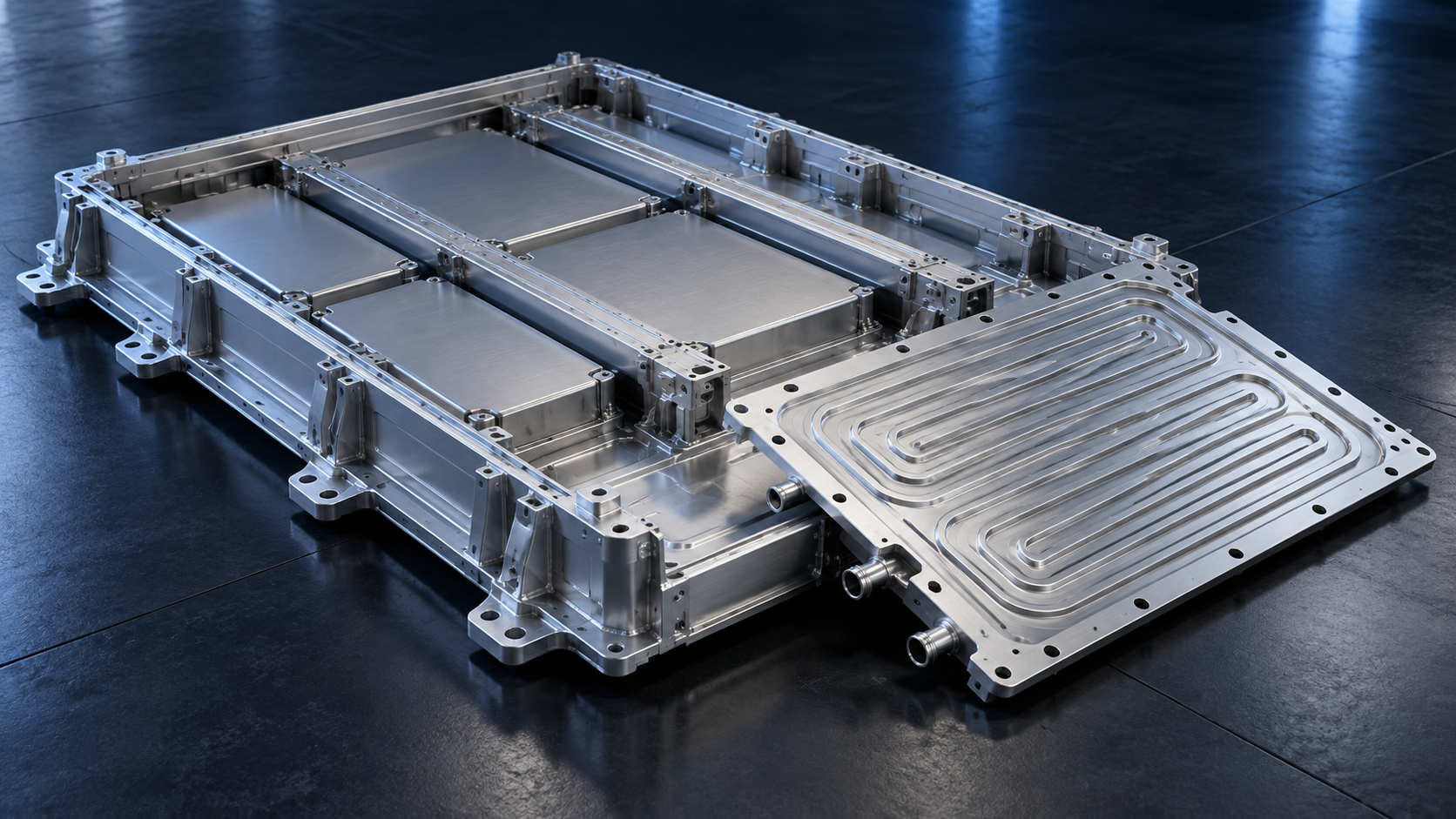
Seven-step EV battery aluminum selection process
| Step | Decision | Release output |
|---|---|---|
| 1 | Allocate structural, sealing, cooling and interface functions | Component boundary and measurable requirements |
| 2 | Screen frame, tray, cover and node material routes | Alloy-family and product-form shortlist |
| 3 | Evaluate crash, stiffness, fatigue and joints | Section and joint concept tied to load cases |
| 4 | Select cooling-plate construction | Channel, alloy system and joining route |
| 5 | Resolve joining, corrosion, isolation and safety interfaces | Approved protection and system-test responsibilities |
| 6 | Choose the manufacturing route | Extrusion, sheet, CNC or casting process concept |
| 7 | Define inspection, validation and change control | First-article and system-release plan |
Step 1: allocate functions before choosing aluminum
Modern enclosures can combine extruded side rails, roll-formed or stamped cross-members, a formed bottom tray, cast nodes, a machined or formed cooling plate, top cover, fasteners, adhesives, welds, seals, thermal barriers and electrical-isolation components. Each element has a different function and may need a different alloy family.
Novelis describes aluminum-intensive battery systems using sheet tubs, roll-formed frames and integrated thermal-management bottom plates. Constellium lists rolled and extrusion-based products from 3xxx, 5xxx and 6xxx families for enclosure and cooling applications. These producer examples show why “battery aluminum” is a material system rather than one universal grade.
Break the assembly into functional zones before specifying material:
- Perimeter crash frame: load transfer, intrusion resistance, energy absorption and joint continuity.
- Bottom protection: impact, puncture, road debris, corrosion and interface with underbody protection.
- Cross-members: module or cell support, local stiffness and crash-load distribution.
- Top cover: sealing, pressure response, service access, electromagnetic and thermal-barrier interfaces.
- Cooling plate: heat collection, flow distribution, pressure containment and leak isolation.
- Machined interfaces: datums, gasket lands, ports, fastener seats and vehicle mounting points.
Step 2: screen materials for frames, trays and covers
The table is a screening guide, not an approved-material list. Final selection must use the OEM drawing, material standard, temper, product form, minimum properties, joining procedure and validation plan.
| Component and route | Candidate family | Why it is considered | What must be verified |
|---|---|---|---|
| Extruded perimeter rail or cross-member | 6xxx alloy such as 6061, 6082, 6005A or approved proprietary crash alloy | Complex constant section, structural properties, joining and integrated mounting features | Crash mode, ductility, temper, quench capability, section tolerances, weld/HAZ properties and corrosion |
| Formed or roll-formed tray | Suitable 5xxx or automotive 6xxx sheet | Formability, corrosion resistance, strength and scalable blank-forming routes | Forming limit, springback, seam strategy, coating, fatigue and thickness-dependent properties |
| Cover | 5xxx sheet or another OEM-approved sheet alloy | Formability, corrosion resistance and low-mass panel construction | Pressure response, stiffness, sealing flange, fastener spacing, barrier system and service cycle |
| Machined interface or prototype frame | 6061-T6/T651 as a common starting point | Balanced machining, strength, corrosion resistance and availability | Material removal, residual stress, joint loads, finish and whether prototype behavior represents production |
| Cast node, corner or integrated housing | Application-specific casting alloy | Near-net complex geometry and feature integration | Porosity, fatigue, ductility, sealing, joining, machining datums and casting-specific qualification |
Constellium’s battery enclosure component work emphasizes both structural and thermal functions, while its HSA6 family illustrates how producers develop specific high-strength 6xxx extrusion products. A proprietary alloy claim cannot be converted into a generic property promise for 6061 or 6082.
The Aluminum Extruders Council design resources provide additional guidance on extrusion alloys, profile design, fabrication and tolerances.
Step 3: choose crash behavior, not tensile strength alone
A side rail that carries static weight and a rail designed to manage pole intrusion are different components. Yield and tensile strength matter, but crash performance also depends on ductility, strain-rate behavior, section geometry, local buckling, joining, heat-affected zones, material direction and the complete load path into the vehicle.
Higher strength does not automatically mean better energy absorption or pack protection. A very strong but poorly controlled section may fracture, transfer load into a weak joint or create an unfavorable deformation mode. Extrusion design can tune wall thickness, cells and triggers, but these features must be assessed by simulation and physical tests under the required load cases.
Likewise, stiffness is not proportional to alloy yield strength. Common aluminum alloys have broadly similar elastic moduli. Pack torsional stiffness and bottom-panel deflection are often improved through section depth, closed cells, cross-members, beads, bonding and attachment layout rather than alloy substitution alone.
Step 4: select the cooling-plate construction
A cooling plate is a pressure-containing thermal component. Candidate material depends on how channels are created and sealed. A machined two-piece cold plate, an extruded multi-port profile, a roll-bonded panel and a brazed plate use different stock, joints and process temperatures.
| Cooling route | Possible aluminum product | Design value | Critical validation |
|---|---|---|---|
| Machined and sealed cold plate | 6061 plate or another specified machinable alloy | Flexible prototype channels, ports and mounting interfaces | Joint method, flatness, pressure, leakage, cleanliness, corrosion and thermal cycling |
| Extruded channel plate or manifold | Suitable 6xxx extrusion alloy | Continuous channels and reduced machining for repeated lengths | Die feasibility, channel-wall consistency, end closure, burst mode and port joining |
| Brazed plate assembly | Approved brazing-sheet/core alloy system, often involving 3xxx cores and clad layers | Thin passages and scalable heat-exchanger construction | Braze cycle, clad compatibility, erosion, corrosion, cleanliness and joint integrity |
| Roll-bonded or formed plate | Process-qualified sheet alloy system | Low-profile flow path and large-area heat exchange | Channel inflation consistency, bond integrity, forming, pressure and fatigue |
Do not choose only by bulk thermal conductivity. The complete thermal path includes cell or module interface, thermal-interface material, plate thickness, channel placement, local contact pressure, coolant flow, fouling, ambient rejection and controls. Producer battery-component portfolios likewise treat cooling plates as integrated thermal and structural elements.
Cooling performance and leak integrity must be designed together
A channel layout that produces low cell temperature may create excessive pressure drop, stagnant zones, weak ligaments or difficult venting. A very thin wall may reduce conduction distance but increase deformation, joining sensitivity and burst risk. Port geometry and hose loads can dominate local stress even when the central plate is lightly loaded.
Define the coolant, concentration range, contamination limits, operating and proof pressure, flow range, inlet temperature, allowable pressure drop, heat-load map, maximum cell temperature and temperature-uniformity target. Then specify validation across production tolerance, aging and environmental cycles.
Leak testing needs a clear boundary and method. State the test medium, pressure, stabilization, temperature, allowable leakage, test duration and whether acceptance applies before or after coating, welding and final assembly. A component leak result does not prove complete-pack sealing, and a pack ingress test does not prove the internal coolant circuit.
For machined channels and sealing interfaces, precision aluminum CNC machining can create prototypes and functional features. The drawing must still define datums, flatness, surface texture, gasket or weld land, port thread and inspection condition.
ASME Y14.5-2018 (R2024) provides the GD&T language for stating functional datum relationships on machined pack interfaces.
Step 5: resolve joining, corrosion and safety interfaces
Battery enclosures can use arc welding, laser welding, friction stir welding, mechanical fastening, self-piercing rivets, flow-drill screws, adhesives, brazing or hybrid joints. Each route changes heat input, distortion, galvanic paths, access, repair and inspection.
For heat-treatable 6xxx products, welding can reduce local properties in the heat-affected zone. For work-hardened 5xxx sheet, welding can also soften the local condition. Design allowables must reflect the joint and post-process state rather than parent-metal catalog strength.
Adhesives can contribute sealing and load distribution, but bond performance depends on surface preparation, cure, gap, aging and process control. Mechanical fasteners require attention to bearing, pull-out, preload, isolation and sealing. Review aluminum welding and joint requirements as part of the material selection, not after the sections are frozen.
Corrosion, electrical isolation and sealing
The pack may see water, road salt, mud, cleaning chemicals, stone impact and repeated wet-dry cycles. Aluminum alloy resistance helps, but joint crevices, fasteners, coolant leaks, dissimilar metals, coatings and trapped electrolyte can govern durability.
Define the galvanic system. Stainless fasteners, copper busbars, steel vehicle structure and carbon-containing materials may require isolation, coatings, sealants or controlled drainage. Electrical grounding and electromagnetic requirements can conflict with full insulation, so conductive interfaces and coating breaks need deliberate locations.
A sealing flange must work as a system with the gasket, adhesive or formed seal. Flatness, surface texture, fastener spacing, joint stiffness and cover deflection affect compression. State whether dimensional and leak acceptance applies before or after paint, conversion coating, e-coat or another finish.
Thermal runaway protection is a system requirement
The enclosure contributes to a layered safety concept that can include cell spacing, barriers, vent paths, pressure management, detection, controls, underbody protection and vehicle structure. Aluminum’s melting behavior, conductivity and mechanical properties at temperature must be considered in the complete event, but choosing a thicker or higher-strength grade does not by itself prove propagation control.
UL Solutions identifies UL 2580, UNECE R100 and other regional requirements for EV battery testing. ISO 6469-1:2019 specifies RESS safety requirements, while SAE J2464_202108 describes abuse test procedures without establishing universal pass/fail criteria. The NHTSA Battery Safety Initiative also treats crash, fire, immersion, vibration and other battery risks through system-level research and safety standards.
These documents govern systems and tests, not a universal aluminum grade. Confirm the market, vehicle category, current edition, OEM requirements and component-to-pack validation responsibility at project start.
Step 6: choose the manufacturing route
| Route | Best-fit geometry | Main production value | Main risk to control |
|---|---|---|---|
| Extrusion plus CNC | Long rails, cross-members, multi-port cooling sections | Integrated constant-section features and repeatable cut lengths | Die feasibility, quench/temper, straightness, joining and end closure |
| Sheet forming plus joining | Large trays, covers, stamped channels and panels | Material-efficient thin construction at production scale | Springback, seams, weld distortion, sealing and coating |
| CNC from plate | Prototype frames, manifolds, ports and precision interfaces | Fast design iteration and complex local geometry without production tooling | Material waste, cycle time, residual stress and prototype-to-production transfer |
| Die casting plus CNC | Complex nodes, covers or integrated housings at repeat volume | Near-net feature integration | Tooling, porosity, ductility, fatigue, sealing and secondary datums |
Match the sourcing path to the geometry: review aluminum extrusion services for rails and multi-port profiles, sheet-metal fabrication for trays and covers, and aluminum die casting for complex near-net nodes or housings. BAOSONG’s automotive and EV application page provides component-manufacturing context. Its engineering support page outlines useful design-review inputs. These pages should not be read as evidence that a particular battery pack or vehicle system has passed an OEM, regulatory or certification test.
Step 7: make inspection and validation follow the failure mode
- Structure: material certificate, dimensions, weld or joint inspection, coupon/property evidence where required, and component load tests.
- Sealing: flange geometry, surface condition, joint continuity and defined component or assembly leak tests.
- Cooling: channel dimensions, cleanliness, flow/pressure response, leak integrity, thermal mapping and cycling.
- Electrical: isolation, grounding, creepage/clearance and coating continuity under the applicable design.
- Durability: vibration, shock, fatigue, corrosion, thermal cycling and service-representative aging.
- Safety: pack- or vehicle-level tests required by the current regulation, standard and OEM validation plan.
NIST’s paper on uncertainty and dimensional calibrations explains that every dimensional result is an estimate with uncertainty. Select equipment and decision rules appropriate to the tolerance.
Inspection scope, sampling and records should be agreed before production. See the BAOSONG quality overview for useful RFQ inputs; no single inspection method proves every function above.
Production release workflow
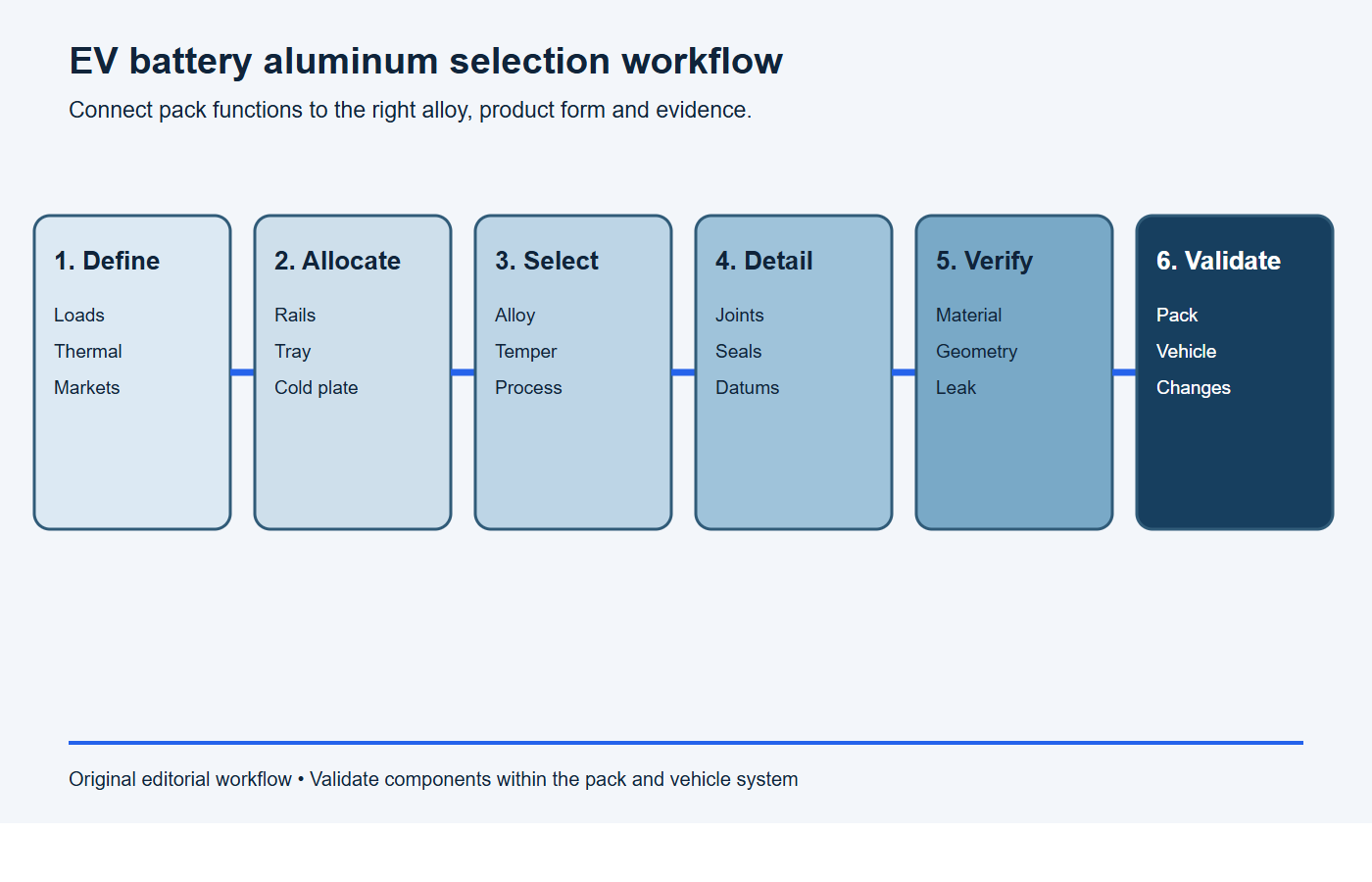
- Define: pack loads, thermal system, environment, markets and OEM requirements.
- Allocate: structural, sealing, cooling and interface functions to specific components.
- Select: alloy, temper, product form, manufacturing route and joining process together.
- Detail: datums, tolerances, joints, seals, coatings and test boundaries.
- Verify: material state, geometry, joint quality, leakage and thermal performance.
- Validate: the completed pack and vehicle, then control production changes.
Stop conditions: do not release the component yet
- The pack requirement has not been allocated to a defined rail, tray, cover, node, cold plate or interface.
- The alloy is selected from tensile strength without crash mode, ductility, joint and heat-affected-zone review.
- The cooling plate has no agreed coolant, pressure, flow, heat-load map, leak boundary or cleanliness requirement.
- Component leakage and complete-pack ingress are treated as the same test.
- Dissimilar-metal contact, grounding, coating breaks, drainage or trapped electrolyte remain unresolved.
- A prototype machined from plate is assumed to represent a production extrusion, sheet assembly or casting without correlation.
- Component inspection is being used as evidence of pack-level regulatory or OEM validation.
Copy-ready EV battery-component RFQ checklist
- 2D drawings and 3D models with matching revisions and interface-control information.
- Component boundary: rail, tray, cover, node, cold plate, manifold or complete subassembly.
- Alloy, temper, product form, material standard and approved substitutions.
- Load cases, stiffness, fatigue, crash/intrusion role and applicable design allowables.
- Coolant, heat-load map, flow, pressure, temperature and leakage requirements.
- Sealing, ingress, venting, electrical isolation, grounding and galvanic controls.
- Joining procedure, heat-affected-zone basis, coating and post-process dimensions.
- Prototype and production quantities, traceability, report format and validation responsibility.
Send BAOSONG your component drawings and requirements for a manufacturing review and quotation. Identify which pack-level requirements flow down to the supplied component so the material, process and inspection plan can be evaluated accurately.
Frequently asked questions
Is 6061 aluminum suitable for an EV battery enclosure?
It can be a practical candidate for machined frames, brackets and some extruded structures, but suitability depends on temper, section, joining, crash behavior, corrosion, sealing and OEM requirements. It is not a complete pack specification.
Which aluminum is best for an EV cooling plate?
The manufacturing route decides the shortlist. Machined plates often begin with a machinable 6xxx alloy, while brazed, roll-bonded and extruded designs use process-specific alloy systems. Validate conductivity, corrosion, pressure, fatigue, joining and cleanliness together.
Can a cooling plate and enclosure use the same alloy?
They can, but they do not need to. The frame may prioritize crash and joining while the cold plate prioritizes thermal path, formability, channel integrity and coolant compatibility. Separate requirements usually produce a better decision.
Does an aluminum enclosure stop thermal runaway?
No material choice alone proves that outcome. Propagation mitigation depends on the complete cell, module, barrier, venting, controls, enclosure and vehicle system, followed by testing under the applicable validation plan.
Does a leak-tested cooling plate prove the battery pack is sealed?
No. The coolant circuit and external pack enclosure have different boundaries and failure modes. Define separate tests for channel leakage, enclosure ingress and completed-assembly sealing.
Recommended Downloads for Aluminum Alloy Selection
Use these BAOSONG references to compare alloy families, temper conditions, machinability, strength, corrosion resistance and design implications before quotation.
- Aluminum Alloy Comparison Chart (editable Excel)
- Tolerance Reference Guide (PDF)
- Aluminum CNC Machining Design Guide (PDF)
- Aluminum Part Design Checklist (editable Excel)
Need help choosing an alloy or temper for your application? Contact BAOSONG Precision.