
Quick answer: what should an aluminum battery enclosure for an energy storage system achieve?
An aluminum battery enclosure for a stationary energy storage system must support battery modules and electrical equipment, manage normal heat and abnormal-event hazards, resist the installation environment, maintain controlled bonding and sealing interfaces, and remain serviceable throughout its declared life. The enclosure is one part of the complete safety system.
Begin with the cell chemistry and system architecture, module mass, thermal-management method, site conditions, applicable codes, fire and explosion test evidence, electrical clearances, installation loads and maintenance plan. Then develop the frame, panels, doors, seals, vents, cooling interfaces and cable entries around those requirements.
Do not treat a strong metal cabinet as proof of thermal-runaway containment or certification. Fire propagation, gas generation, deflagration, pressure relief, detection and suppression must be addressed through system hazard analysis and representative testing. The production drawing should control the interfaces that allow the qualified configuration to be reproduced.
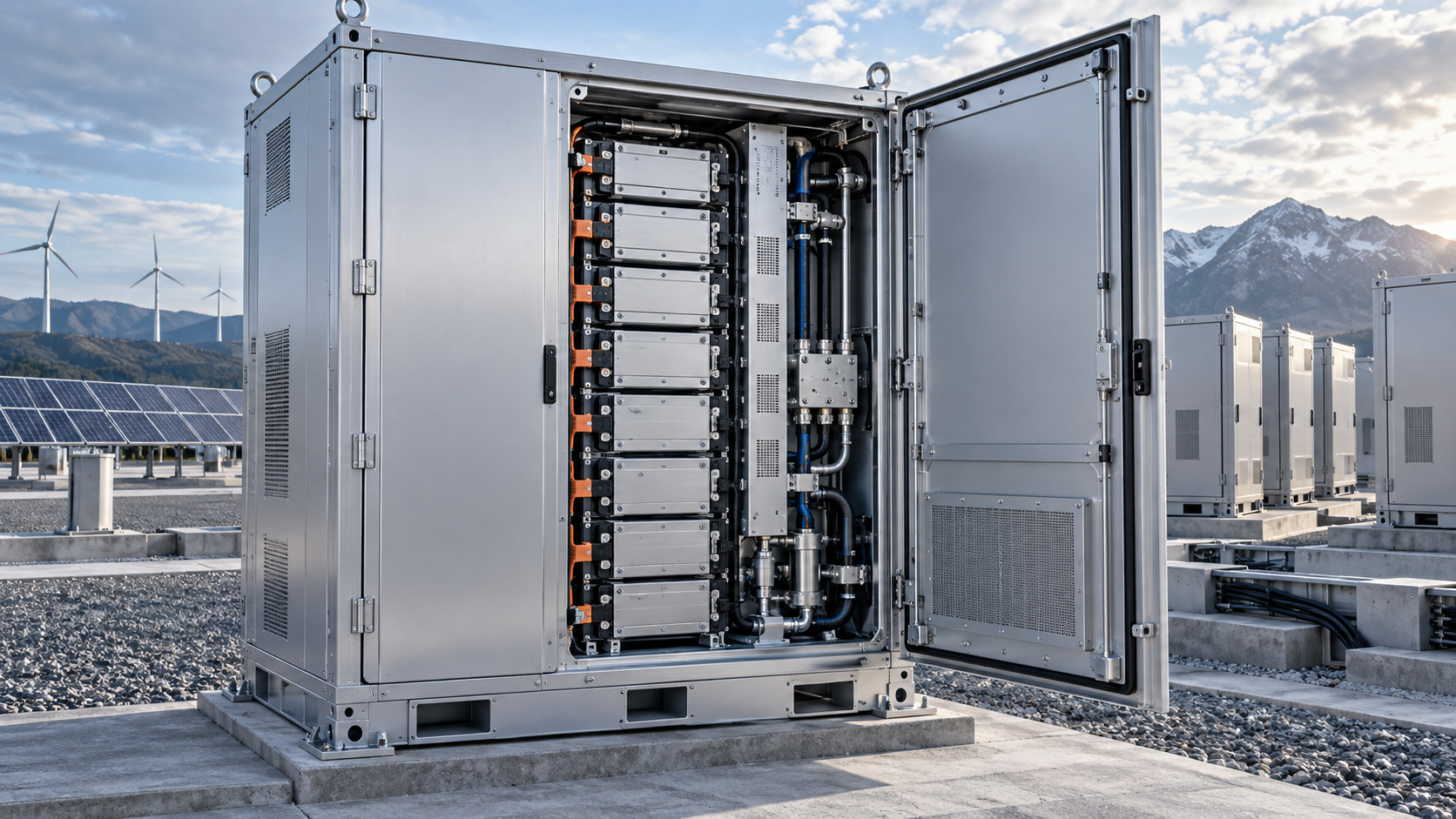
Separate the product enclosure from the installation
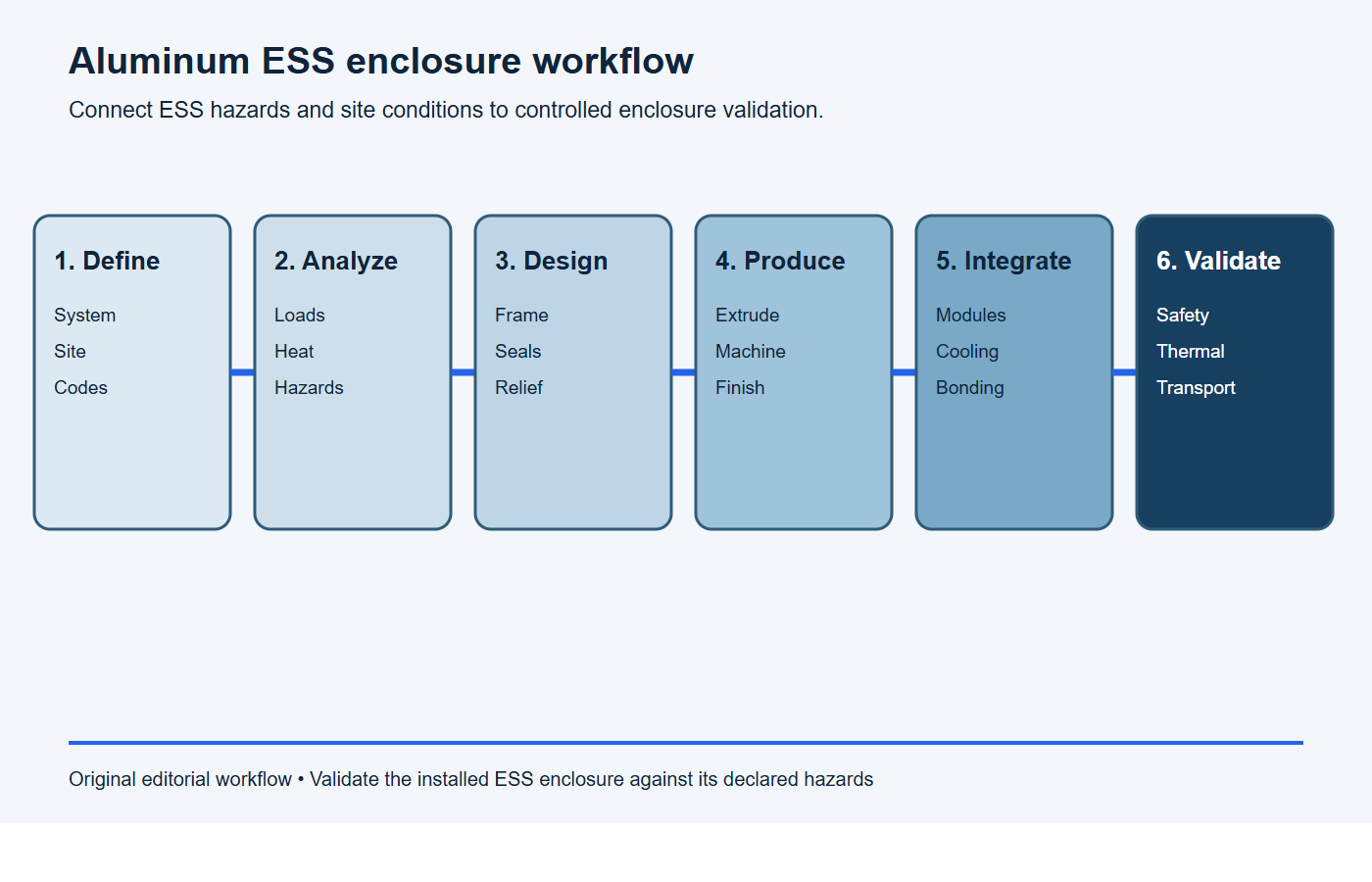
Use this sequence before selecting panels, rails or coatings:
- Define the ESS boundary. Record battery chemistry, modules, energy, power electronics, thermal system, installation and responsible parties.
- Build the hazard and code matrix. Identify normal, degraded and abnormal thermal, electrical, fire, gas, pressure and environmental conditions.
- Map structural and service loads. Include installed mass, lifting, transport, anchorage, seismic inputs, door use and maintenance access.
- Design the enclosure interfaces. Coordinate frame, panels, seals, vents, cooling, cables, bonding, corrosion protection and inspection datums.
- Validate the installed configuration. Use representative modules, thermal systems, doors, vents and protective equipment at the required system test level.
“Battery enclosure” can mean a module case, rack cabinet, walk-in container or outdoor housing that also contains power conversion, controls and cooling equipment. Define the boundary of supply. State which components are inside, which safety functions depend on the enclosure and which belong to the building or site.
UL Solutions’ ESS certification overview explains that UL 9540 covers energy storage systems as an integrated whole, including charging, discharging, protection, controls, communication and fluid movement. The same resource distinguishes system evaluation from the standards applied to batteries and power-conversion equipment. A fabricated aluminum housing should therefore be specified against its role in the evaluated system rather than described as independently “UL 9540 compliant.”
Map every authority and customer requirement to an owner and verification method. Local building, fire and electrical rules can change by jurisdiction. The authority having jurisdiction, certification body, system integrator and enclosure supplier may need different evidence, so resolve this framework before releasing tooling.
Build the hazard and interface matrix first
| Area | Inputs to define | Enclosure implication |
|---|---|---|
| Battery | Chemistry, module format, energy, mass, vent locations and fault behavior | Rack spacing, restraints, gas paths and service zoning |
| Thermal | Loss map, ambient range, airflow or coolant, degraded mode | Ducts, cold plates, heat exchangers and condensation control |
| Fire and gas | Propagation data, gas quantity, ignition risk, detection and suppression concept | Separation, relief path, penetrations and sensor locations |
| Electrical | Voltage, fault current, creepage, clearance, grounding and disconnects | Bonding, barriers, busbar covers and cable-entry design |
| Environment | Indoor or outdoor site, water, dust, salt, UV, altitude and temperature | Seals, drainage, corrosion system and cooling derating |
| Mechanical | Static mass, lifting, transport, anchorage, seismic and service loads | Frame sections, joints, base rails and door structure |
IEC 62933-5-1:2024 addresses hazard identification, risk assessment and risk mitigation for grid-integrated electrical energy storage systems. Use the applicable system and technology standards, contract edition and local rules to develop the matrix; this article is an engineering framework rather than a substitute for those documents.
Design the load path for installation and service
Stationary does not mean load-free. The enclosure experiences module weight, door loads, coolant and cable reactions, lifting, forklift handling, transport shock, anchorage forces and possibly seismic demand. Establish the installed mass and center of gravity for every permitted configuration, including partial population and service states.
Carry module loads into rails or shelves, then into vertical members and the base. Avoid asking broad skins to act as primary structure unless their connections and buckling behavior are designed for that role. Check door openings and removable panels because they interrupt shear paths. Model bolted, riveted and welded joints with realistic stiffness instead of assuming perfect continuity.
Extrusions can create stiff posts, rails, gasket lands and mounting channels in one section. Review BAOSONG’s custom aluminum extrusion design guide and extrusion tolerance guide before freezing long profiles. Use CNC machining for selected datum faces, locating holes and high-load interfaces rather than applying tight tolerances to the entire enclosure.
Thermal management must cover normal and degraded operation
Define cell and module temperature limits, allowable gradients, heat generation across charge and discharge, ambient extremes and expected fouling. Air cooling requires a known pressure-flow operating point and controlled distribution to every module. Liquid cooling requires cold-plate contact, coolant specification, pressure, flow, manifold balance, leak detection and a safe service procedure.
Aluminum spreads heat effectively, but the wall or frame alone does not create a controlled thermal path. Use dedicated fins, cold plates or heat exchangers where analysis requires them. BAOSONG’s aluminum alloy guide for heat sinks and enclosures supports initial material screening, while channel, joining, cooling and validation boundaries must come from the ESS design.
Test fan or pump failure, blocked filters, high ambient, low coolant flow and sensor faults as declared by the system safety plan. Prevent condensation on cells, busbars and electronics when cooling surfaces fall below local dew point. Drainage should discharge safely without creating an uncontrolled water or gas path.
Thermal runaway changes the enclosure design problem
During an abnormal battery event, cells may release hot gases and combustible products. The enclosure response depends on chemistry, state of charge, module arrangement, ventilation, ignition, barriers and surrounding equipment. A generic pressure rating or thicker door does not establish safe behavior.
UL 9540A is a test method for evaluating thermal-runaway fire propagation in battery energy storage systems. Its results inform system and installation decisions; they are not a simple material certificate. NFPA 855 addresses installation of stationary energy storage systems and includes commissioning, operation, maintenance and decommissioning as well as electrochemical ESS provisions.
Define detection ports, pressure-relief or explosion-control features, exhaust direction, door retention and separation from occupied or service areas with qualified fire-protection professionals. UL’s discussion of large-scale deflagration testing of BESS enclosures illustrates why vent opening, internal obstructions and measurement method affect conclusions. Do not extrapolate a test result beyond its tested configuration without technical justification.
Sealing, ventilation and pressure relief require one strategy
An outdoor enclosure may need to resist rain and dust during normal operation while also providing controlled airflow, drainage or emergency pressure relief. These functions can conflict. Establish the environmental protection target and exactly which doors, vents, glands, heat exchangers and drains are part of the boundary.
Design continuous gasket lands with controlled compression. Avoid sharp corners, joint steps and fastener spacing that allow local lift. Hinges and latches must hold the door uniformly over its life, including seal compression set and frame movement. Cable glands, pressure equalization devices and coolant fittings need their own interfaces and installation torque.
The IEC 60529 IP Code classifies protection provided by enclosures against access, solid foreign objects and water. Select the required rating from the product and installation specification and test the final configured enclosure. An IP designation does not describe fire, gas containment, corrosion life or condensation performance.
Plan electrical bonding and isolation
Aluminum panels and frames can provide a protective bonding network only when joints remain electrically reliable. Anodizing is insulating, and corrosion, paint, sealant or loose fasteners can increase resistance. Define bonding studs, bare contact lands, washers, jumpers and inspection points on the drawing.
Separate high-voltage areas from controls and communication. Protect busbars from dropped tools and service access, and control creepage and clearance according to the applicable electrical architecture and pollution conditions. Route fault current through intended conductors rather than hinges or structural fasteners unless those components are expressly qualified for the role.
Where geometry is controlled with GD&T, cite the governing drawing standard. ASME Y14.5-2018 (R2024) provides a dimensioning and tolerancing framework; electrical safety requirements still come from the applicable product standards.
Select material and finish for the actual environment
Material selection should consider extrusion, sheet or plate form, strength, joining, corrosion, thermal behavior and finish. Avoid specifying “aluminum” without alloy, temper and product standard. Use galvanic isolation where aluminum contacts more noble metals in a wet or salty environment, and design drainage so electrolyte or condensation cannot remain in crevices.
Anodizing, conversion coating or powder coating may be appropriate for different surfaces. Mask bonding locations, threads, gasket lands or thermal interfaces as required. BAOSONG’s surface-finishing overview and anodizing page support process selection, but corrosion durability must be qualified against the specified exposure and completed assembly.
Design manufacture around stable datums and controlled joints
| Feature | Process control | Verification |
|---|---|---|
| Base and rack | Weld or bolt sequence, fixture, stress control and machining allowance | Flatness, level, anchor pattern and loaded alignment |
| Door aperture | Frame squareness, hinge datum and latch sequence | Gap map, gasket compression and operating force |
| Cooling interface | Machined pads, port location, cleanliness and joint process | Dimensional, pressure, flow and leak tests |
| Bonding points | Masking, surface preparation and hardware control | Visual inspection and resistance test |
| Panels and vents | Forming, perforation, edge protection and coating | Fit, open area, finish and environmental test |
Define a datum strategy that follows the installed assembly: base interface, rack planes, module supports, busbar or connector planes and doors. Avoid using flexible cover edges as inspection datums. State whether dimensions apply before or after welding and finishing, and provide a measurement setup for large frames.
Validate the configuration that will be installed
Verification should combine dimensional inspection, loaded structural testing, lifting and transport qualification, seal or water testing, thermal performance, coolant leak tests, bonding, electrical safety and the fire or explosion evidence required by the system plan. Record the exact module arrangement, state of charge, ventilation state, software revision and protective functions for representative safety tests.
Inspect after environmental and mechanical tests. A cabinet can pass an initial water test but lose gasket compression after door racking, transport or thermal cycling. Likewise, verify that vents, drains and relief features remain unobstructed after cable installation and field service.
Retain measurement uncertainty, calibration and sensor placement with the results. NIST’s discussion of dimensional calibration uncertainty is a useful foundation for defensible inspection decisions.
RFQ checklist for an aluminum ESS enclosure
Paste this scope into the RFQ and attach the controlled system architecture, enclosure drawings, hazard matrix and validation plan.
RFQ scope: Please quote [ESS enclosure part number and revision] for [prototype quantity] and [annual volume]. The system contains [battery chemistry, energy and module arrangement], is installed [indoor/outdoor and site condition], and uses [thermal-management, ventilation and safety architecture]. Required load, environmental, ingress and finish targets are [requirements]. Quote the proposed aluminum alloys, structural split, joining, sealing, finishing, tooling, unit price, lead time and capacity. List every assumption and deviation.
Required evidence: Provide material traceability, structural and dimensional inspection, joining and finish records, seal/ingress evidence, bonding verification, first-article documentation, packaging and change-control triggers. Identify system certification, fire, deflagration, thermal-runaway and site-acceptance tests outside the enclosure supplier’s scope.
- System boundary, battery chemistry, module arrangement, energy and maximum installed mass.
- Applicable codes, standards, editions, certification plan and authority requirements.
- Controlled 3D model and 2D drawings with functional datums.
- Normal, degraded and abnormal thermal-management conditions.
- Fire-propagation, gas and explosion-control assumptions plus test evidence.
- Indoor or outdoor environment, corrosion exposure, IP target and condensation strategy.
- Lifting, transport, anchorage, seismic and service load cases.
- Electrical clearances, bonding points, cable entries and isolation barriers.
- Alloy, temper, joining, finish, masking and inspection requirements.
- Prototype and production quantity, traceability, packaging and validation plan.
Stop conditions: the ESS enclosure is not ready for release
Pause tooling or production release if any condition below remains unresolved.
- battery chemistry, module arrangement, maximum energy or installed mass is unknown;
- applicable code editions, certification path or authority requirements are unsettled;
- normal, degraded and abnormal thermal conditions have not been defined;
- gas generation, venting, pressure relief and ignition assumptions lack system-level evidence;
- lifting, anchorage, transport or seismic load paths are incomplete;
- sealing, drainage, condensation and ventilation requirements conflict;
- bonding, electrical isolation, cable entries or dissimilar-metal corrosion controls are undefined;
- a component or material report is being treated as proof of complete ESS fire or safety performance.
Frequently asked questions
Is aluminum suitable for an outdoor battery energy storage enclosure?
Yes, when the alloy, joints, coating, drainage, dissimilar-metal isolation and seal system match the exposure. Outdoor suitability must be demonstrated on the completed configuration under its specified environmental tests.
Does a metal enclosure stop thermal runaway propagation?
Not by itself. Propagation and pressure behavior depend on the cells, modules, spacing, barriers, ventilation, ignition and protective systems. Use hazard analysis and representative testing such as the applicable UL 9540A level to support decisions.
Should an ESS enclosure be sealed or ventilated?
The choice depends on normal cooling, water and dust protection, gas management, pressure relief and the tested safety architecture. Define all modes together; adding a vent after environmental qualification can invalidate the enclosure boundary.
Can an EV battery enclosure design be reused for stationary storage?
Some manufacturing knowledge transfers, but the load cases, module arrangement, site exposure, service access, installation rules and fire-safety strategy differ. Revalidate the stationary system against its own requirements.
Request an ESS enclosure manufacturing review
BAOSONG supports projects combining aluminum extrusion, machining and finishing. Send the controlled drawings, system boundary, site conditions, loads, cooling interfaces, sealing and bonding requirements, test plan and quantities through the contact page for manufacturability and quotation review.
Recommended Downloads for Aluminum Alloy Selection
Use these BAOSONG references to compare alloy families, temper conditions, machinability, strength, corrosion resistance and design implications before quotation.
- Aluminum Alloy Comparison Chart (editable Excel)
- Tolerance Reference Guide (PDF)
- Aluminum CNC Machining Design Guide (PDF)
- Aluminum Part Design Checklist (editable Excel)
Need help choosing an alloy or temper for your application? Contact BAOSONG Precision.